




The Great Panic of 1893
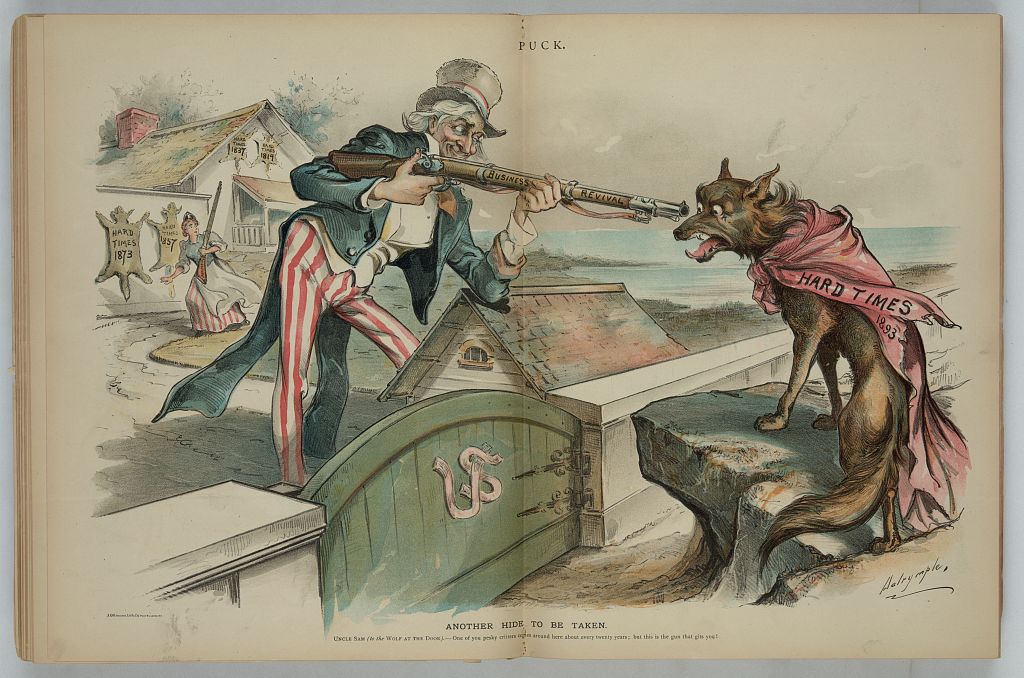
Uncle Sam (to the Wolf at the Door) One of you pesky critters comes around here about every twenty years; but this is the gun that gits you! (Illus. from Puck, April 11, 1894.
As I’ve mentioned before, occasionally an event, or person, or book, or idea begins tracking me down.[1] It shows up in footnotes or casual asides in books I’m reading. Eventually, I give in and go down the rabbit hole. Then, if it’s interesting or important enough, I share it with you. That is, after all, the social contract on which History in the Margins is based.
Lately, the Great Panic of 1893 has become insistent.
Here is what I knew pre-rabbit hole: The Great Panic of 1893 plunged the United States into a four-year depression. It was the worst economic panic in United States history prior to the Great Depression.[2]
Quite frankly, until recently, that was all I needed to know. But for the last year or so I’ve been spending a lot of time in the United States in the late nineteenth and early twentieth centuries. The Great Panic of 1893 keeps coming up in terms of how it affected individual families. (For instance, the panic was the proximate cause of Sigrid Schultz’s father moving the family back to Europe for what he thought would be a short time.) Finally I decided the time had come for me to get a firmer grasp on the panic’s causes, scope, and legacy.
Turns out there is a lot more to the story than I realized. Buckle up!
First we need to consider the term: a panic is not just a jazzier name for a recession or a depression, though they can, and often do, occur together.[3] A panic is a crisis in which people lose confidence in banks and large numbers of people withdraw their money in a short period of time[4], making banks unstable. A recession is a period of reduced economic activity: businesses can’t sell goods or services, so they lay people off, which means people can’t buy goods and services. A depression is a recession on a larger scale.
To my surprise, bank panics were pretty common in the last half of the nineteenth century: eighteen panics rocked the United States’ economy between 1863 and 1913. Most of them were centered in New York City, which was the heart of the nation’s financial system. In addition, regional panics hit the midwestern states of Illinois, Minnesota and Wisconsin in 1896, the mid-Atlantic states of Pennsylvania and Maryland in 1903, and Chicago in 1905.[5] I am neither an economist nor an economic historian, but it seems to me that the country was in a financial panic almost as often as it was in a state of non-panic between the end of the American Civil War and the beginning of the Great War.
Unlike most earlier nationwide financial panics, the Great Panic of 1893 began with banks in the Midwest and West instead of in New York. There were two causes of bank instability leading up to the panic. The U. S. Treasury’s gold reserves fell from roughly $190 million in 1890 to about $100 million in early 1893. The country was on the gold standard, which meant that Treasury notes could be redeemed for a fixed amount of gold.[6]Falling gold reserves led to fears, at home and abroad, that the government would be forced to suspend convertibility of notes. Some depositors began to convert their bank notes to gold while the converting was good. At the same time, roughly six months prior to the panic, the country entered an economic recession[7]. As the economy contracted, defaults on loans began to rise, which weakened banks’ balance sheets. Fearing for the security of their deposits, people began to withdraw their funds, creating a spiral of fear and further withdrawals.
In June, bank runs began in midwestern and western cities; more than one hundred banks failed. Between mid-July and mid-August, as the panic grew worse, another 340 banks failed. Banks in the Midwest and West began to withdraw funds they had on deposit with New York banks, creating strain on those banks in turn. In order to meet withdrawal requests, banks in New York began to sell assets. Asset prices fell. The downward spiral continued. More banks failed. Farm prices dropped. New construction largely stopped . Business and industry slowed down; more than 15,000 businesses had failed by the end of the year. People lost their jobs. Things were so bad that firms issued scrip and financial institutions used quasi-currencies like clearing house certificates[8] to make payments because the standard banking system was not functioning.
The banking panic ended in the fall of 1893. The economic depression it triggered lasted until mid-1897. The period was marked by violent strikes, the apogee and effective end of the Populist and free silver political movements, levels of unemployment that were only matched by those in the Great Depression[9], and a shift in public opinion in favor of currency and bank reform, regulation of business in the public interest, and labor relations. Even the wealthy were affected to some extent.
Not the Gilded Age portrayed in popular culture.
[1] You’re all familiar with this general phenomenon I’m sure. You become aware of something and then start seeing references to it everywhere. This is variously known as the Baader-Menhoff Phenomenon, frequency illusion, or, my favorite, the Blue Ford Syndrome.
[2] Looking back, I am surprised I knew that much. American history is not my academic field.
[3] The United States has not suffered a large scale bank panic since the establishment of the Federal Deposit Insurance Corporation in 1933, proving that bank panics aren’t the only cause of recessions.
[4] The phrase “bank run” is much older than I expected. According to the Oxford English Dictionary, it appears in its modern meaning as early as the end of the seventeenth century. I suspect I am not the only one who assumed it was a literal description of events like this:
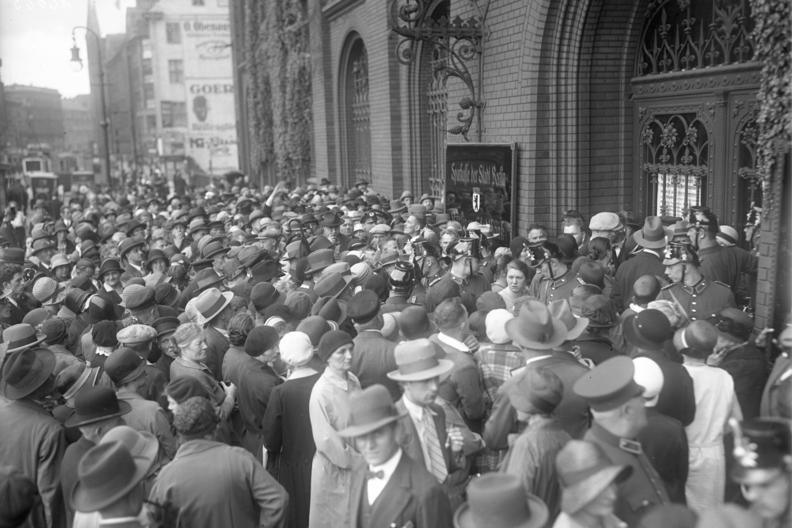
Depositors clamor to withdraw their savings from a bank in Berlin, 13 July 1931 . (Photographer Georg Pahl. Bundesarchive. Bild 102-12023)
[5] I must admit, I wonder how Chicago could have an economic panic all by itself. However, I refuse to go down that rabbit hole until I’ve dealt with the Panic of 1893 to my satisfaction. Any one else interested?
[6] Several years ago I tried to write a “word with a past” post about the term “gold standard.” I just went back to look at it again. The draft is a mess, but there are still some interesting bits there. Anyone interested in my giving it another try?
[7] In this case, the recession seems to have caused the panic rather than the other way around. Without going into details, factors leading the recession included a panic and depression in Europe that affected American markets, several years of agricultural problems as a result of storms, drought, and overproduction, and slowing investment in railroads, which had been an economic driver for two decades.
[8] I understood scrip, but I had to look up clearing house certificates. Turns out, the New York Clearing House was founded in 1853 to bring order to the complicated web of currency exchanges that had developed over the prior decade as a result of westward expansion. A Clearing House loan certificate, with the words, “payable through the Clearing House,” was the joint liability for all member banks. As such, they were a remarkably secure form of payment and were used as a substitute currency during financial panics between 1853 and 1913. It was probably illegal, but it was so successful that no one wanted to raise a fuss.
[9] More than ten percent for between five and six consecutive years.
[5] — _Natures Metropolis_, pretty sure.
1893! Who knew!
https://wwnorton.com/books/Natures-Metropolis/