




Talking About Women’s History: Three Questions and an Answer with the Hosts of Women Who Went Before
Rebekah Haigh and Emily Chesley host and produce Women Who Went Before, a gynocentric podcast on the ancient world. Both are PhD candidates at Princeton University. Rebekah specializes in Religions of Mediterranean Antiquity and is writing a dissertation that explores gendered piety and violence in the Dead Sea Scrolls and ancient Judaism. Emily researches late antique history, and her dissertation examines women in the eastern Roman Empire amidst the military and religious upheavals of the 5th–8th centuries CE.
Take it away, ladies!
-
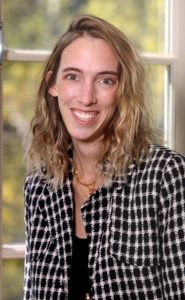
- Rebekah Haigh
-
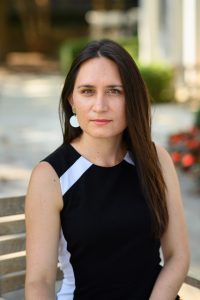
- Emily Chesley
Photocredit: Sameer Khan/Fotobuddy, LLC.
What inspired you to start the podcast?
Rebekah: We certainly didn’t set out to start a podcast! It all began as a Covid project. In spring 2020 Emily and I had a conversation about why neither of us had spent much time thinking about women and gender in the ancient world. We realized it was a huge gap in our preparedness to be scholars, but there was a pandemic happening and there were no classes or library access. Then we thought “since, we’re stuck at home … let’s try starting a reading group.”
We weren’t reading around specific historical women or texts about them. We were doing a lot of theory work work: looking at different waves of feminism and how they intersected with scholarship. It wet our appetite because when you do that kind of theory work, you’re always trying to find connections like, “Okay, could I apply it to women that I’m familiar with? The historical texts I’m familiar with? I kind of want to try it.”
Emily: As it happened, it ended up being pretty popular. People joined from beyond Princeton, from different universities and even multiple countries. We realized that we weren’t the only ones who felt there was a gap in our education! And that shared enthusiasm fanned the flame.
Even people who weren’t enrolled in graduate programs heard about our group through social media and their friends, and they reached out. Ultimately their interest made us realize that this topic wasn’t just of interest to people in the Academy; there is a hunger across society from people eager to learn about women in the ancient world. And then a conversation Rebekah had got us thinking towards a bigger picture.
Rebekah: At the end of that year, an administrator and mentor suggested turning our reading group into something more substantial, something that would reach that wider audience. As we brainstormed public scholarship formats, we assumed there were already a bunch of historical podcasts about ancient women. But while there were loads of podcasts on history, even ancient history, we couldn’t find anything on ancient women. Medieval women, women in 19th century America, but nothing about women in the ancient world. So we decided to make a podcast.
Emily: It’s been a really rewarding journey so far! Our first season just finished, and we’re in preproduction for season two which will release in the fall.
Rebekah: And one of the first interviews we recorded for the podcast, with Solange Ashby on the warrior queens of Meroe, was someone who had participated in the original reading group!
What work of women’s history have you read lately that you loved? (Or for that matter, what work of women’s history have you loved in any format? )
Rebekah: Well, the answer that jumps to mind is going to reveal a lot about me and how I first came to love history – and also a lot about Emily. Both Emily and I have this shared experience of being home schooled with the same curriculum, one of the things we initially bonded over. We even read the same cluster of historical novels about women. One of which was Mara, Daughter of the Nile, a book that I’ve always credited for my early interest in ancient history. The novel was about this young girl who lived in Egypt. She’s not a real person. But the book gave me a taste of what it might be like to live in the ancient world and I wanted to know more.
Emily: Historical fiction can powerfully engage you, whetting your appetite for “thicker” history books. Rebekah and I definitely shared a love rooted in a childhood of reading about women in history, whether real or fictional.
As far as books today, I have to caveat that as a grad student, I don’t read as much pure history outside of work. I find I have to take a mental break and separate out the other kinds of reading from the work-reading (which yes, I also enjoy; and if you check the source lists for our episodes you’ll find many of my go-to academic texts on women’s history). I love to read for pleasure, but it’s usually fiction of some kind, whether YA or Dorothy Sayers or something in between.
Rebekah: Yes, exactly. I don’t read much nonfiction beyond my own research. In my spare time, I want a break from heavier stuff, so I will usually read fictional stuff or sci-fi but not a lot of biographies of women.
Emily: One book both Rebekah and I read, which isn’t a history of the past so much but in a way is a history of our present, is Living A Feminist Life by Sara Ahmed. She does a wonderful job of linking academic work on feminist theory with lived women’s experiences in a practical way. She applies insights from feminist scholars to help women, especially women of color and queer women, understand their own day-to-day lives and the resistance they receive from the world. One of Ahmed’s famous ideas that recurs throughout her corpus is that when you point out a problem you become the problem, and it’s helped encourage me in moments advocating for gender equality in the workplace.
In terms of more traditional histories about women and still grippingly written, I loved Code Girls by Liza Mundy, and The Radium Girls and The Woman They Could Not Silence by Kate Moore. The latter is particularly moving; it’s about Elizabeth Packard, a 19th-century woman from Illinois whose husband institutionalized her, and it looks at the laws in that century that basically gave husbands complete control over their wives. Julia Cooke’s Come Fly the World is a history of the first jet-set stewardesses for Pan Am. I admit I was first intrigued by the topic (speaking of women’s history in other formats) because in college my roommates and I watched the short-lived TV series Pan Am, crowding onto our old couch every week and obsessed with the glamor of it all. Then reading this archival history, you can’t help but be struck by the indignities and sexism these women endured while breaking the glass ceiling and their fortitude in the first decades of commercial air flight.
This is in some ways an atypical women’s history book because she is still alive today, but Nell Painter’s memoir Old In Art School also stands out. She’s an award-winning historian of African American history and race, and one of her most famous books was The History of White People. Then after she retired, she went to art school and started working as an artist. Her memoir describes that journey, exploring the links and tensions between her academic work and her art practice, and mulling on her experiences as an older black woman in the predominantly white and younger art world.
Rebekah: I can add a nonfiction book which I have managed to get halfway through, The Way of Perfection by Teresa of Ávila. The book is not a biography or a historical piece but rather personal reflections by a Spanish nun and mystic who lived in the 16th century. She was pretty radical for her time. Teresa led a monastic reform that made many people unhappy with her, but her writings have endured the test of time. The Way of Perfection is a book about prayer and meditation, how to be intentional about your spiritual life. Though written hundreds of years ago, it remains an insightful piece on practices of meditation, a topic that I’ve been interested in for a long time.
I think one of the reasons that her personal reflections, and works like it, still speak to everyday people is because in them we have access to women’s inner thoughts and feelings, something we don’t usually have with the ancient world. There is a degree to which when we have access to what women are writing and what they’re thinking, it’s easier for contemporary history aficionados to identify with those figures and to find space for themselves and their stories.
What was the most surprising thing you’ve found doing historical research for your work?
Emily: Honestly, I think for me the most surprising thing was realizing just how much we actually know about ancient women, just how much research there actually is. Embarrassingly, I hadn’t read extensive scholarship on women’s history during college and graduate school because it wasn’t part of the core curriculum. I didn’t know all that was there until I began looking intentionally.
My introduction must have been in my final semester of seminary, when I took an elective on women in contemporary African Christianity and audited another class on medieval women, and those started to crack open the doors. Then, once your foot is in and you find, say, one article with robust footnotes, you can start following the trails. There are so many dedicated scholars unearthing stories and clues about pre-modern women through innovative detective work. The trails are rich and never-ending, and we’ve gotten to explore some for our podcast. I suppose that becomes the lesson –which, come to think of it, also applies to other areas of life– you have to choose to look.
Rebekah: Piggybacking on that, as an academic I find myself reading for things that I’m interested in, that intersect with my research on violence and ritual. If you’re not looking for women, it’s easy to overlook them. But, once I started thinking about questions of gender, especially once Emily and I had started the podcast, I started looking. Now as I’m doing my research, if I see a reference about a woman performing a ritual, I’m going to jot that down and go read about it. Because now that I am paying attention to women, I’m seeing texts and scholarship all over the place, usually in the footnotes. The surprising thing is that there are a lot more women than I thought there were.
It’s my sense, both from my students and also my own college experience, that learning about women in history is often regulated to a gender studies or topical class on women. You might get a course about women and magic, or women and sexuality. Or, perhaps women will appear as a topic for one week on a syllabus, or there might be a reading or two dedicated to them in a course otherwise dominated by historical men. I think we need to move beyond this tendency in academia to check boxes when it comes to teaching about ancient women or to limit student interest in women to certificate programs. Stop putting women in the footnotes.
Something one of our earliest podcast guests said has stuck with me, which is this concept of above and below the line in academic writing. Above the line is what’s written in the body of your paper, article, or book. This tends to be your thoughts and the thoughts of those you perceive to be the big name scholars – the people whose work you know really well. Everybody else goes below the line, in the footnotes. These conventions about which scholars “really matter” create a self-perpetuating cycle, so that other scholars (often women) keep getting relegated to the footnotes. This concept of above and below the line is really helpful for thinking about where we need to go with women’s history and research about women. There’s so much great work being done about women in the ancient world, but it often goes overlooked. It’s still “under the line” in some sense. So it is not enough to start paying attention to women, we need to actively put them above the line. Which is what Emily and I try to do in our podcast, Women Who Went Before. We’re taking all this amazing research and making it more accessible to people who might not be hanging out in academic libraries trying to write a dissertation.
Emily: Or who lack a subscription to JSTOR! Many people might not have access to academic journals or research libraries, but they definitely are interested in learning about history and its women. That’s where podcasts, blogs like yours, radio programs, TV series, historical fiction, video games, and more creative public scholarship come into play. And I’ll add lastly, it’s not just what scholars say and where, but also how we say it. To truly be accessible we need to communicate academic research and writing in emotive and engaging ways.
A question from Rebekah and Emily: What historical woman would you want to go back in time and meet, and how would you spend the day with her?
My first thought on reading this question was: So many women! How can I possibly choose?
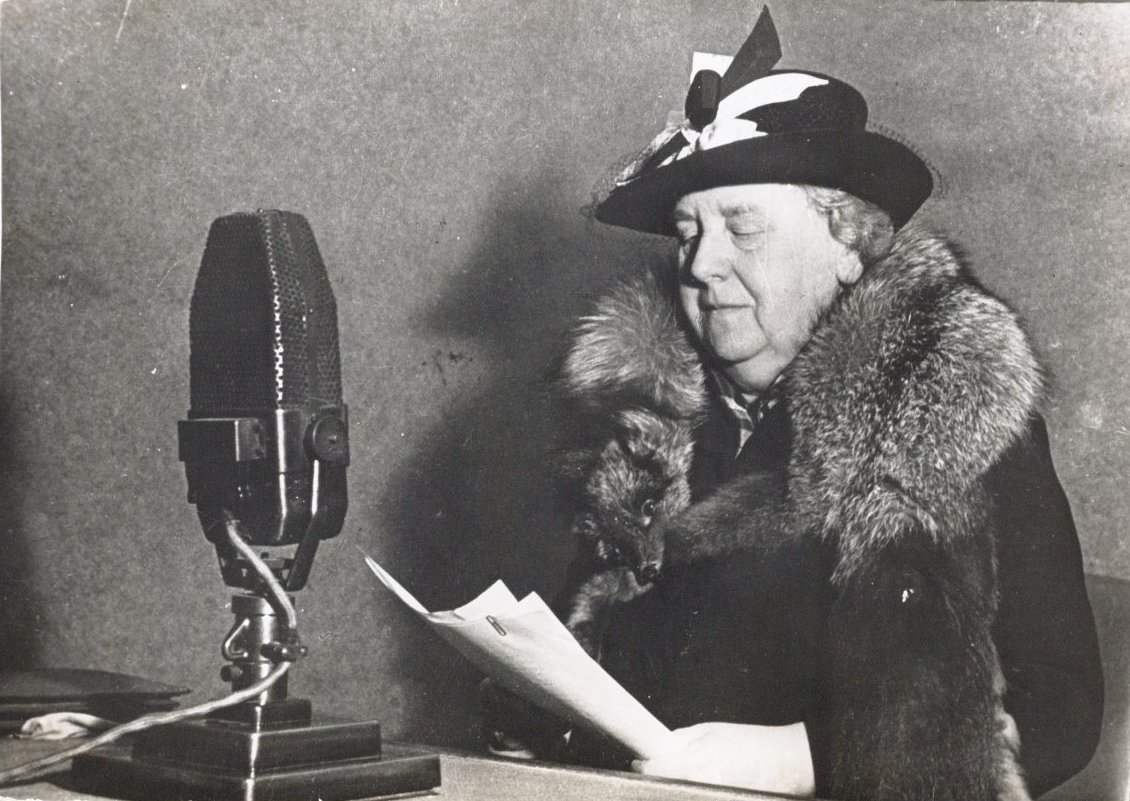
My second thought was: Queen Wilhelmina of the Netherlands. Wilhelmina ascended the Dutch throne in 1898 at the age of 18. She was sixty when Nazi Germany attacked the Netherlands. She transformed herself from a stiff, shy, distant ruler to the heart of her country’s resistance. Hours after the German attack began, she made her first broadcast against the Nazis on Dutch radio. She made her next broadcast the day after she arrived in Britain. Every day thereafter, the the queen spoke to her people at the start of the Radio orange program broadcast to the Netherlands by the BBC. Her radio speeches were passionate and personal; with one exception, she wrote them herself. The Dutch joked that the queen’s grandchildren weren’t allowed to listen to her broadcasts from their refuge in Canada because she used such foul language when she talked about the Nazis.
As far as what we’d do: given my current project I’m in the mood to kick back and trash talk the Nazis over a dark beer.
Want to know more about Women Who Went Before?
Listen to the podcast: https://womenwhowentbefore.com/
Follow them on Twitter: https://twitter.com/womenbefore
Check out the podcast Facebook page: https://www.facebook.com/womenbefore
***
Come back tomorrow for two questions and an answer with biographer Eleanor Fitzsimons
Talking About Women’s History: Three Questions and an Answer with Leah Redmond Chang
Leah Redmond Chang is a former Associate Professor of French literature and culture at The George Washington University. Her writing draws on her extensive experience as a researcher in the archives and in rare book libraries. Previous books include Into Print: The Invention of Female Authorship in Early Modern France, which focused on women and book culture in the sixteenth century, and (with Katherine Kong) Portraits of the Queen Mother, about the many public faces of Catherine de’ Medici. Her next book, Young Queens: Three Renaissance Women and the Price of Power, will be published by Bloomsbury in the UK (May 2023) and Farrar, Straus and Giroux in the US (August 2023). She lives with her husband and three children, and divides her time between Washington DC and London.
Take it away, Leah!
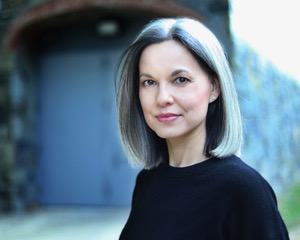
In your coming book, Young Queens, you write about three fascinating women. Do you have a favorite among them?
Not an easy question! Young Queens follows the intertwined lives of three sixteenth-century women: Catherine de’ Medici, her daughter Elisabeth de Valois, and her daughter-in-law, Mary Stuart, also known as Mary, Queen of Scots. I like them all for different reasons, but if pressed, I would have to say that Catherine de’ Medici is my favorite. She has an unfair advantage in some ways: Catherine was the power behind the French throne until her death in 1588 at age sixty-nine, whereas her daughter Elisabeth died young at twenty-two years old. Mary, Queen of Scots, as many people know well, fled Scotland at twenty-five only to become the prisoner of Elizabeth I of England. Her imprisonment lasted until her death, at forty-four, in 1587. Perhaps it’s easier for me to like Catherine because she lived the longest and moved around the most, filling many different roles during her lifetime. She also wrote thousands of letters, so we have an incredibly rich record of her life and policies. And yet, she remains less known than a woman like Mary, Queen of Scots. That intrigues me.
Catherine was always a little bit of an underdog – and I love an underdog. An orphan practically from birth, a ‘commoner’ in the eyes of the French nobility, the unloved bride of a second son – certainly as a young woman, she seemed unlikely to become so powerful. Yet it’s the adversity Catherine faced in her youth that made her strong. Catherine was a survivor, unlike Mary, Queen of Scots who, although the ‘it’ girl at the French court during her adolescence, didn’t possess Catherine’s grit. To be fair to Mary, though, in some ways she was set up to fail, and had little reliable support once she returned to Scotland at the age of eighteen. And she made such bad choices. Could she have avoided them? Every time I retrace her story, I kind of wish she could have.
I’ve often wondered what Elisabeth de Valois would have become had she lived beyond the age of twenty-two. She was very close to her mother, and Catherine had trained Elisabeth well. It was clear by Elisabeth’s teen years that she had the talent to develop into a canny political player. The tragedy, from a historian’s perspective, is that she didn’t live long enough to see it through. That she died trying to fulfill a queen’s first duty: to provide an heir for the kingdom. And that she suffered so much trying to be both a good wife and good daughter, queen of one kingdom and royal princess of another.
You can probably sense me weighing my answer here – even as I type this, I’m running through the lives of these women, assessing what appeals to me about them. In the end, though, I still return to Catherine. She was such a complex woman, and her legacy is equally complex. She’s always had a notorious reputation despite the many efforts by scholars to recuperate her image and reveal her astute political mind. From my first encounters with Catherine, I was a bit suspicious of that ‘bad girl’ image. But Catherine wasn’t exactly an innocent victim of baseless calumny, either. She had strengths and she had weaknesses; she did both good and bad things. In short, she was a real human being, with all the baggage that comes from being human. I think that’s what I love about her: in her complexity, Catherine allows us to see the real woman behind the crowned queen.
You are writing about women who were powerful and well-known in their own time. Are there special challenges in researching such women?
There are several challenges, but I’ll focus one here. I consistently run into the problem of reliable evidence. Sixteenth-century Europe was awash in propaganda. A lot of social dynamics and tensions in the sixteenth century will seem familiar to those of us living in the twenty-first: countries torn apart by civil strife, a hardening ‘right’ and ‘left’ with diminishing hopes of breaching the divide, the rapid growth of new technology and media that enabled voices to proliferate in the public sphere, something akin to religious ‘wokeness,’ and many misogynist voices raised against women in power. These are exactly the conditions that encourage the amplification of fake news, especially about a woman who wields any kind of authority. So how do you get to the ‘truth’?
Catherine de’ Medici and Mary Stuart were both fervently adored and deeply despised during their lifetimes. Years ago, when I first started working on Catherine de’ Medici, a scholar warned me that there is no objective account of her. I found this largely to be true: it is very hard to parse fact from fiction both in sixteenth-century sources and in those produced during the centuries that have followed. To a certain extent, the same can be said of Mary. I think any book on either of these queens has to take a historiographical stance: how are you going to tell this story? How does one do justice to these women who have so many ‘lives’ in the sources? Who have taken on such mythical proportions in the cultural imagination that it’s easy to lose sight of them as living, breathing human beings?
Elisabeth de Valois is a slightly different story. She was beloved by her kingdom. No one had anything bad to say about her. But this too can become a problem. Everyone loved her a bit too much – the praise can become a little inflated. Luckily, we have sources that do give us a more rounded, intimate portrait of her – my favorites are letters and accounts by her ladies-in-waiting. And from those letters we also catch a glimpse of Elisabeth’s inner life.
That said, the letters by the ladies-in-waiting were difficult to wade through. Elisabeth was well-educated for a noblewoman in her day; her ladies weren’t always. The spelling! Oh, the spelling! As it was, sixteenth-century French spelling wasn’t codified. But these ladies often spelled phonetically. Sometimes it took me several passes through the letters to figure out what they were saying at all, let alone analyze the nuances of it.
How would you describe what you write?
I write narrative history, with an emphasis on ‘narrative.’ The two books I wrote before Young Queens were quite scholarly, and I really enjoyed researching and writing them. But I’ve always been interested in writing narrative history and exploring how scholarship could be brought to readers through story.
Growing up, I loved history, and I loved fiction. I especially loved books that blurred the line between ‘history’ and ‘fiction’ (as a child, I was obsessed with the ‘Little House’ series for that reason). I still remember my history teacher in 9th grade: at the start of every class, Ms. Smith would come out from behind her desk, perch herself on the edge, and tell us a story. That was her entry into the material, and I would always bring those stories home to the dinner table. In college, I majored in an interdisciplinary program that focused on history, literature, and philosophy, and when it came time to apply to graduate school, I ended up applying to PhD programs in both history and comparative literature. Eventually, I decided to go with comparative literature with the rather naïve idea that I could work in both disciplines under that umbrella. Although that wasn’t entirely the case, comp lit did allow me to think outside of traditional disciplinary boundaries.
As a literature scholar, I have always been very archival in my research. I’ve always wanted to handle the objects of the sixteenth century and to use them to understand the culture and the people. Though I’ve left the university in an official capacity, I’m still archival, but now I’m more focused on trying to capture the inner lives of the people I study and translate those lives to the page. I try to think about story arc and about historical actors as characters. I also like the challenge of working with and around historiographical limitations: how do you create scene and story when you must respect what the archive gives you? To me, that question makes the whole endeavor exciting. I guess you can say that I love the craft.
-
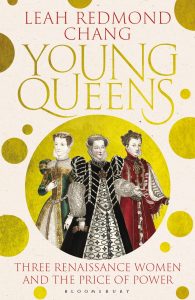
- The British version
-
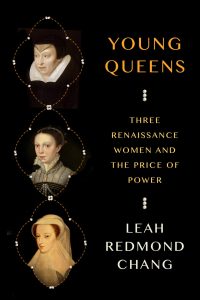
- The U.S. version
(They’re both so pretty! )
A question from Leah: Across your books, you cover a lot of ground both geographic and temporal. How do you land on your subjects? What makes you say ‘Yes! This is the woman / women I’m going to write about’?
There is no simple answer to that.
In the case of Women Warriors, the general topic caught my imagination at an early age but I didn’t start thinking about it in an orderly way until years later, when Antonia Fraser’s Warrior Queens came out. After that, it seemed like I ran across examples of historical women who fought everywhere and I started to collect their stories in a casual way. When it was time to write the book, I had hundreds of examples, and I continued to find more as I worked on the book. At that point, it was a matter of making hard choices because I wanted women from different times and different places and who fought for different reasons.
For my current book, the subject literally turned up in my news feed and wouldn’t let go of my imagination.
Ultimately, I think subjects find me.
***
Want to know about Leah Redmond Chang and her work?
Check out her website: leahredmondchang.com
Subscribe to her newsletter: leahredmondchang.substack.com (Consistently interesting <<Pamela sharing an opinion.)
***
Come back tomorrow for three questions and lots of answers with the women who host the Women Who Went Before podcast.
In which I finally read “A Woman of No Importance”
Earlier this month, I was called to jury duty. I must admit, I thought about trying to get out of it on the grounds that I am under deadline on this book.* But I just couldn’t do it. I believe in the importance of the jury system. And I have spent the last few years thinking about the destruction of of the rule of law in Nazi Germany. So, I grumbled about the loss of a day. I prayed that I wouldn’t end up on a jury and lose more than a day. And I thanked the powers that regulate civic duty that I was assigned to a downtown court instead of one in the distant suburbs.
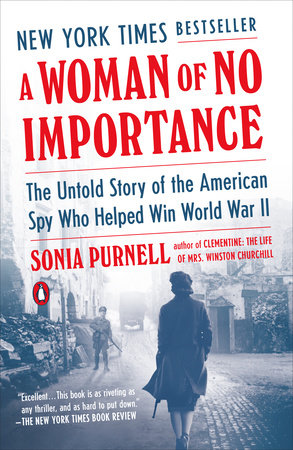
All of which is a long lead-in to the fact that I decided Sonia Purnell’s A Woman of No Importance: The Untold Story of the American Spy Who Helped Win World War II was the perfect thing to read in the jurors’ waiting room. The subject was adjacent to what I’m working on, but not so close that I needed to take notes. And by all accounts, it was a gripping read.
I am, as is so often the case, late to the game. Many of you may have already read Purnell’s bestselling account of Virgina Hall,** the American woman who talked her way into Britain’s Special Operations Executive (SOE) and was the first Allied woman deployed behind enemy lines—prosthetic leg and all.
A Woman of No Importance is a fascinating biography, with the tone of a thriller. Purnell starts with Hall as, in fact, a woman of no importance who had opted out of the life of a Baltimore socialite and been repeatedly frustrated in her attempts to join the diplomatic corps as more than a secretary. She traces Hall’s unlikely acceptance by SOE—in large part because the newly formed agency was desperate—and her invisible rise as a covert operator working with the French resistance in spite of repeated bumbling and failures on the part of SOE.
Because these days I read narrative non-fiction from a writer’s viewpoint,*** I was struck by the skill with which she weaves the larger story of World War II into Hall’s story. She consistently gives the reader the information they**** need, without dumping a chunk of information that disrupts the story line. It is harder to do than you might think.
If you’re interested in World War II, spies, spies in World War II, or forgotten women who did amazing things, this one’s for you.
*Probably not a valid excuse, now that I think about it.
**After all, lots of people reading (or at least buying) a book is what makes a book a best-seller.
***A habit I hope to ditch after I recover from writing the current book. It may require serious rehab involving sitting on the rear deck with a pitcher of ice tea, a stack of really well-written books, and no way to make notes in the margins.
****I hear some of you screaming and getting ready to send me emails about this usage. The big style manuals all gave their blessing to the use of they as an indefinite singular pronoun several years ago. If it’s good enough for the Chicago Manual of Style, it’s good enough for me.
* * *
Come back on Monday for three questions and an answer with historian Leah Chang.