




On War, Part Three: Lest We Forget
For those of you who missed the last blog post:
A couple of weeks ago I spent the day attending the fifth annual “On War” military history symposium at the Pritzker Military Library. This was the third time I’ve attended and the third time I’ve come away with a notebook full of ideas, factoids, and hot leads that I want to track down—complete with stars, arrows tying ideas together, and an occasional streak of highlighter. It was the first time I came away feeling like I was there as part of the community rather than an interested outsider. By day’s end I was both exhausted and energized. Most importantly, I was ready to write.
In previous years I’ve written reports on the conference as a whole. This year I’m exploring a couple of the ideas that caught my attention over the next few blogposts. You can see the previous posts here and here.
There were three more panels to the symposium. Here are the highlights:
Tim O’Brien, author of The Things They Carried, on the difference between writing fiction and non-fiction: Nonfiction aims for the reader’s brain. Fiction aims for the reader’s stomach, the back of the throat, the nape of the neck. (Personally, I don’t think it’s that cut and dried. I’ve read fiction that is an intellectual puzzle and non-fiction that has made me rage and cry.)
Michael Robbins, author of the Pritzker Library’s beautiful new coffee table book commemorating WWI, on the causes of that war: It was triggered in part by the size of the standing armies and the speed with which they could be mobilized.
Peter Paret, winner of this year’s Pritzker Literature Award, on what’s sometimes described as the “new military history”: It isn’t new. Historians were writing the history of wars together with the history of society, culture ,and ideas in the nineteenth century. You can’t get answers to the big questions about war by staying at the level of tactics and operations. (Can we get an “amen”?)
———–
As often happens at events of this time, a recurring, and presumably unplanned, theme emerged across the panels. This year it was the idea that war doesn’t end just because the opposing powers sign a treaty. * Here’s the form that idea took in three different panels:
Allan Millett, discussing the transition from Japanese control to nationalist resistance, made the point: “In a lot of these places, the war didn’t really end; it changed.”
Michael Robbins took Millet’s point a step further, and said that wars never stop when the treaty is signed: “It’s not just that people down at the end of the line didn’t get the news. Chaos has been unleashed.”
Tim O’Brien: “There’s an illusion that wars end when the the peace treaty is signed.” He then argued that wars live on in the lives of the veterans, what he described as “the things I carry with me.”
Moral of the day? Wars end not with a bang, but a whimper.
*Sometimes a treaty doesn’t ever get signed. I was stunned to learn that Russia and Japan never signed a peace treaty at the end of World War II—the ownership of a string of desolate volcanic islands off the coast of Hokkaido, known as the Northern Territories in Japan and the Kuril Islands in Russia, is still an unresolved issue. It’s not a meaningless pissing match: the islands are rich in minerals, control prime fishing grounds and have the potential to be strategically important. In other words, you don’t sign the peace treaty because you’re crossing your fingers behind your back and anticipating the needs of the next war.
Giving Thanks
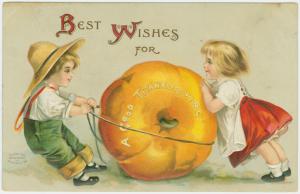
It’s almost Thanksgiving and things are hopping here at the Margins. My lists are made, checked and double-checked. The Wednesday and Thursday cooking schedules are set. The ham and the turkey are jostling for space in the basement refrigerator. The rental company should deliver the extra tables and chairs any minute.
It’s going to be a busy few days, so I’m taking this week off from blogging. But I wanted to take a moment to thank all of you who read History in the Margins: pointing out the typos (you know who you are), commenting, sending emails, asking the hard questions and cheering me on. Without you, I’d just be talking to myself.
On War, Part II: Occupied Japan and the End of Empire
For those of you who missed the last blog post:
A couple of weeks ago I spent the day attending the fifth annual “On War” military history symposium at the Pritzker Military Library. This was the third time I’ve attended and the third time I’ve come away with a notebook full of ideas, factoids, and hot leads that I want to track down—complete with stars, arrows tying ideas together, and an occasional streak of highlighter. It was the first time I came away feeling like I was there as part of the community rather than an interested outsider. By day’s end I was both exhausted and energized. Most importantly, I was ready to write.
In previous years I’ve written reports on the conference as a whole. This year I’m exploring a couple of the ideas that caught my attention over the next few blog posts.
For those of you who read the last blog post:
Muzzle-loading cannon barrels were swabbed out between each round to eliminate the possibility of sparks/hot embers remaining in the breech before the powder charge was loaded for the next round, causing the cannon to go boom prematurely. Swabbed, not swapped. Funniest/most embarrassing typo I’ve committed in a while.
Moving forward:
The second panel at this year’s On War symposium was a freewheeling conversation between Allan Millett, who specializes in the Korean War, and Gerhard Weinberg, who is one of the Big Names in World War II history, about the Allied occupation of Japan after WWII .
The big point of the panel was the differences between the occupations of Japan and Germany after the war, which was all news to me. Unlike Germany, Japan was never divided into zones of occupation and the Japanese administration was left in place. Also unlike Germany, the occupation was largely peaceful. I must admit, the part of this discussion that I enjoyed the most, and that gave me the clearest understanding of the occupation, was Gerhard Weinberg reminiscing about his experiences as a young soldier in the occupying army. (I won’t try to reproduce this here—if you’re interested this will probably show up on Pritzker Military Presents at some point in the future.* ) My two favorite lines:
- “If three two-star generals don’t see someone, he isn’t there.”
- “Latrine-o-grams tend to be accurate”
The part of the discussion that had me sitting up and madly taking notes was almost a sidebar to the main discussion: how the liberation of areas occupied by the Japanese affected anti-colonial movements after the war. At war’s end, Commonwealth forces rushed in to release POWs from Japanese camps (a good thing by any standard) and then held the metaphorical doors open for the return of British and French colonial armies to return (not a good thing from the perspective of the occupied). In many cases they were met by heavily armed resistance movements, courtesy of the Japanese. In what Millett referred to as a “regional transfer of weapons,” surrendering Japanese troops, fearing retaliation from the occupied “bought their way out” by turning over weapons to local resistance movements. In many of the areas the Japanese had held, World War II was over, but it was not replaced by peace.**
*Blatant Self Promotion Alert: You can also watch my program on Civil War nurses on Pritzker Military Presents.
**We’re going to come back to this idea in a future post. Don’t touch that dial!