




The Incident of the Flyswatter
Yesterday I received an e-mail from a friend and regular reader of History in the Margins suggesting I write a post about the long, complex, and often difficult relationship between France and its Muslim citizens, hoping it would give her/you a context for the Charlie Hebdo killings and their aftermath. I will admit that I hesitated. I’m a historian, not a political commentator.
But in fact, I feel strongly that the West in general and Americans in particular need to know more about this history of other parts of the world in order to understand how we got to where we are today, and more importantly to understand that no single perspective of the past is universally shared. I say so right on my website.
This is exactly the type of moment where some historical context might be useful. That said, I’m not going to give you a pundit-style analysis of current events. Instead, over the next several blog posts I’m going to tell you some stories about the French in North Africa and Muslim resistance to their presence, with perhaps a few detours that catch my attention. These are not intended as explanation for the recent events in France. They are simply pieces of the past that are part of the shared French and North African experience.
Let’s start at the beginning:
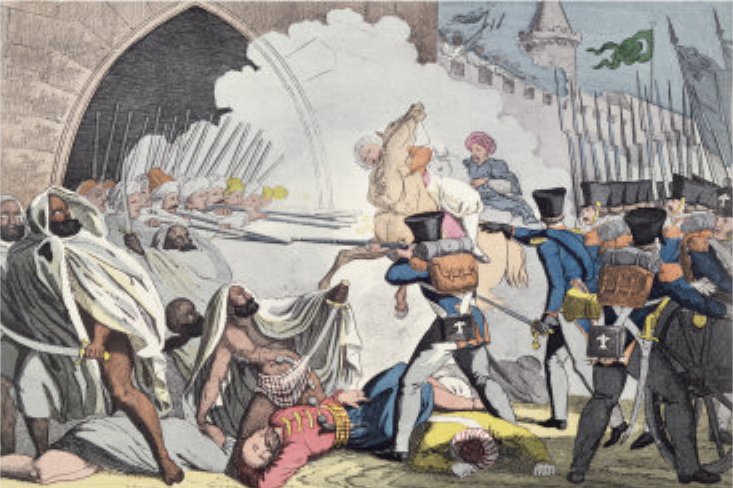
Anon. French illustration. I’d love to see its Algerian counterpart. Anyone?
In 1795, revolutionary France bought 8 million francs* of Algerian grain to feed its army. The French Republic failed to pay its debt, as did the French empire which succeeded it. When Napoleon was overthrown in 1815, the newly restored Bourbon monarchy disavowed the debt. From the French perspective, the matter was done but the Algerians weren’t willing to let it go. Not surprisingly, given the amount of money involved.
Despite ongoing negotiations, the matter was still unresolved by April, 1827 when a meeting between the Ottoman regent of Algiers, Hussein Dey, and the French consul, Pierre Duval, turned ugly Reportedly, when Hussein Dey pressed for an answer, Duval told him that France didn’t discuss money with Arabs. (!!!) The governor hit Duval in the face with the fly whisk that formed part of his royal regalia.** The French press dubbed the incident “the affair of the fly-swatter”–a term that magnified the insult.
Charles X demanded an apology for the insult to his representative. When no apology was forthcoming, he sent French ships to blockade the harbor of Algiers–a”cut off your nose to spite your face” technique that limited French access to much needed Algerian grain for almost three years.
In June, 1830, tensions between Charles X and French republicans were coming to a head. The French king attempted to distract his detractors by accelerating tensions in Algeria. On June 12, 1830, using a plan originally developed by Napoleon, 34,000 French troops landed in Algeria. Three weeks later, Dey had fled into exile and the French military found itself the occupying power in coastal Algeria. France’s decades- long struggle to conquer North Africa had begun.
The invasion did nothing to help Charles X, who was forced to abdicate on July 30.
*How much is that in today’s money? Good question, and not easily answered. The short answer is billions, if not gazillions.
If anyone knows of a good resource for translating 18th century francs to 21st century dollars, let me know. I spent way too much time chasing this down the rabbit hole. Eventually I found a site that gave me a conversion rate between francs and pounds sterling in the 1780s (1 pound =23 livres and a bit), then a site that gave me a rate for converting pounds to dollars in 1795 (1 pound=$4.53), and finally a site that gave me the relative worth of American dollars from 1795 and 2013. The answer ranged from $28,200,000 to $68,900,000,000–depending on the measures you use. (If you’re interested in the possibilities, I refer you to MeasuringWorth.com . And that’s not even taking into account my own questionable methodology in sliding from 1780s values to 1795.
**Is “royal regalia” redundant?
Cities of Empire
In Cities of Empire: The British Colonies and the Creation of the Urban World, historian Tristram Hunt (author of Marx’s General) explores Britain’s imperial history through the lens of the formerly colonial cities that he argues are her greatest legacy to the modern world.
Hunt organizes his work around ten cities and their role in the development of the British empire. Most, such as Boston and New Delhi, were founded as part of the empire. Others, such as Dublin and Liverpool, were transformed by the empire’s expansion. Hunt considers the history of each city’s creation or annexation not simply as an imperial act but as a series of negotiations and exchanges between two cultures, though admittedly often on unequal terms. He looks at their architecture, civic institutions and street names as imperial artifacts. He discusses the role of each city as both an entrepôt within the imperial network and a hub of the economy that developed around it. Working more or less chronologically, he traces the history of the empire from Boston’s transformation of itself from a colonial to a revolutionary city through Liverpool’s post-imperial decline. The book ends with Hunt’s assertion that Britain is now on the receiving end of the empire it created, shaped by exchanges and negotiations with its former colonies.
Cities of Empire is informed by post-colonial theory, urban history, and Hunt’s own Labour Party politics, but Hunt uses them with a light hand, creating a work of colonial history that is both lively and authoritative. If you’re fascinated by the British empire, this one’s for you.
This review previously appeared in Shelf Awareness for Readers.
In which I recommend some of my favorite history blogs

Image courtesy of the Library of Congress
Working on the assumption that if you enjoy History in the Margins you might enjoy other history blogs, I thought I’d share a few of my favorites for your reading pleasure. Some appear every day. Some appear on a schedule known only to their creators. All of them are blogs that I greet with glee when they appear in my inbox.* Here they are:
- Alison Taylor Brown’s wonderful blog about the sixteenth century, Wolfgang Capito’s View, has been on hiatus for a while now. I missed it, so I was glad to learn she’s returned to the past with 30-Second Renaissance. Quick bites of history that include a picture, an insight and a flash of wit.
- Historical novelist Sandra Galland blogs about her research into 17th and 18th century life at Baroque Explorations. Sumptuous stuff. (I also enjoy her blog on surviving the writing life, but I promised myself I wouldn’t talk about writing blogs, book blogs, cooking blogs, needlework blogs or any of my other bloggish passions here. This is, after all, a place for history buffs to hang out.)
- Nancy Marie Brown’s God of Wednesday is a fascinating mix of Viking history, Norse mythology, Icelandic horses, miscellaneous things medieval and her personal relationship with all of the above. (If these topics are among your passions, I also recommend the Icelandic Language Blog –which is far more interesting than its title would suggest.)
- I return regularly to the late M.M. Bennett‘s blog on life in the eighteenth century. She knew her stuff.
- Military History Now looks at “the strange, off-beat and lesser-known aspects of military history”–just the kind of military history I like. Unlike many of the military history places I hang out, it considers social and cultural history as well as what I think of as “technical military history”. One of my favorite recent posts: The Secret Life of Napoleon Bonaparte. This is not your weird uncle Albert’s military history.
- Bart Ingraldi, regular commenter here at the Margins, explores historical ephemera at Paper Sleuth, where he uses literal scraps to illuminate bigger issues .
- Donna Seger’s Streets of Salem is local history at its best. She uses the history of Salem, Massachusetts, as a jumping off point for topics large and small, from historical ephemera** to world-shaking events.
- Two Nerdy History Girls is the on-line home of novelists Loretta Chase and Susan Holloway Scott. What female history nerd can resist eighteenth century fashion and mores, historical hotties, and tough broads from the past? Not me.
- Alphabetically last, but definitely not least, the award-winning group blog Wonders and Marvels.*** The tag line says it all: A community for curious minds who love history, its odd stories, and good reads. That’s you, right?
Those are my recommendations: a wide range of styles, periods and general approaches because that’s the way I read. I hope you enjoy them: just don’t forget to find your way back here when you’re done.
What history blogs would you suggest I check out?
*I don’t know about you, but I find it hard to keep up with blogs that don’t let me subscribe by e-mail. I have a Feedly account, but find I go there rarely. Which means I miss some great stuff. (Now that I think about it, this is closely related to my relationship with my filing cabinet.)
**Hmmm, I’m seeing a pattern here.
***Just so we’re clear: I loved Wonders and Marvels long before I became a regular contributor. In fact, writing for Wonders & Marvels was one of my goals when I started writing.