




Talking About Women’s History: Three Questions and an Answer with Kathryn Gehred
Kathryn Gehred has a master’s degree in Women’s History from Sarah Lawrence College and was part of a team of editors who completed The Papers of Martha Washington, a transcribed collection of all of Martha Washington’s known correspondence published by UVA Press in 2022. She began releasing Your Most Obedient & Humble Servant in 2020 as a personal side project because she thought a podcast would be a great way to share some of her favorite 18th-century women’s letters with the world.
Take it away, Kathryn!

What inspired you to start Your Most Obedient & Humble Servant?
I used to be a tour guide at Thomas Jefferson’s Monticello, and while working there I came across dozens of letters from Thomas Jefferson’s daughters and granddaughters that I thought were hysterical. Letters where sisters talk about getting ready for dances and their dresses falling apart, really mean gossip, family news, that kind of thing. However, when I tried to quote from the letters on tour they almost never landed, because there wasn’t enough time to introduce all the people involved and set the scene. Later, when I began to work as a documentary editor at the Martha Washington Papers project, I discovered even more fascinating letters, and I acquired the research skills to really dig into the context. I thought that a podcast would give me a way to share my joy and interest in these letters with other people who would think they are as interesting as I do. So that was how I came up with the format of the podcast. I decided to focus on one letter, set up the context, read it from beginning to end, and then dig into what makes it interesting.
How would you describe the purpose of the podcast?
I think of the podcast as a different approach to doing public history. I’m not trying to teach my listeners about a specific event or make a vast historical argument, I am sharing the way that one individual person experienced one specific moment. And since we are all one individual person experiencing the current historical moment together I’ve found that it really brings the past to life. My favorite letters are the ones where you feel like you get to know the writer a little bit by the end of it, even if the letter doesn’t reference any major political moment.
What do you find most challenging or most exciting about researching historical women?
I think one of the most challenging things about researching historical women is how, to a certain group of people who consider themselves “history buffs,” because my work focuses on women it doesn’t count as “real history.” Women’s history has made great progress, but there are still a lot of folks out there who think history=dead white guys, and anything outside of that is irrelevant. I know that you should ignore everything that you see on Twitter (I’ll never call it X), but I saw a guy complain that he didn’t see enough women history podcasters out there. I was like… what universe are you living in? I only listen to women’s history podcasts and there are too many for me to keep up with! But because this guy only listened to a certain type of history podcast he just assumed that there weren’t any women interested in history. But GOOD historians are including women and women’s perspectives more and more, and that makes me optimistic for the future.

A question from Kathryn: Do you have any favorite women’s history podcasts that you enjoy, and what about them do you like?
It’s hard to choose. Like Kathryn, I listen to many women’s history podcasts, as well as history podcasts in general. That said, the two I come back to most often are the What’s Her Name podcast and The Exploress. In both cases, I am drawn by the diversity of topics, the humor, and the distinctive voices (in the literary rather than the physical sense) of the hosts.
I also strongly recommend Unsung History, which is not explicitly a woman’s history podcast but often includes episodes on forgotten and under-reported women, as well as many other stories about marginalized populations in American history.
***
Interested in learning more about Kathryn and her work?
Listen to the podcast: https://www.r2studios.org/show/your-most-obedient-humble-servant/
Follow her on Bluesky
***
Come back tomorrow for three questions and an answer with Elaine Weiss, author of Spell Freedom.
Talking About Women’s History: Three Questions and an Answer with Olivia Campbell
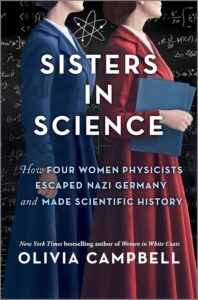
Olivia Campbell is the New York Times bestselling author of Women in White Coats: How the First Women Doctors Changed the World of Medicine and Sisters in Science: How Four Women Physicists Escaped Nazi Germany and Made Scientific History. She is also a thesis advisor at Johns Hopkins University’s science writing master’s program and a regular contributor to National Geographic. Her work has appeared in The Atlantic, History.com, Scientific American, The Guardian, and New York Magazine, among others. Her newsletter, Beyond Curie, brings the stories of women in science history to life.
Take it away, Olivia!

In Women in White Coats and, more recently, Sisters in Science, you write about historical women of STEM whose stories have been left out or, with the possible exception of Elizabeth Blackwell, underreported. When did you first become interested in historical women in STEM? What sparked that interest?
My interest—my entry point in any topic—has always been women. Where are the women? The more science texts I read, the more I wondered: who were the women who made these findings possible and why aren’t they present in the narrative? I’m pretty sure I could write a story a day about women scientists whose male colleagues/supervisors took credit for their work or whose discoveries went unnoticed until a man made the same finding. I feel like it’s my calling to bring women’s overlooked and stolen contributions to science.
How does your work as a science writer inform your work in women’s history?
I consider myself a journalist first and foremost; I have degrees in journalism and science writing. Of course, my science writing helps me interpret the work of historical women scientists for a wider audience. But I think the biggest transferable skill has been my ear for quotes. I pride myself on being able to pick out the best quotes from my interviews with experts in my science journalism. In history writing, I don’t get many opportunities to interview living subjects, but I am quite good at reading through stacks of letters, diaries, notes, books, essays, and other texts and finding the quotes and anecdotes that not only best serve the narrative, but also represent who these women were as people, their character and motives.
Why do you think it’s important to tell these stories today?
As our current government leaders work to downplay, diminish, and erase women’s scientific contributions—and even fire many women scientists and defund scientific research into women’s issues—these stories are more important than ever. Chronicling these tales for a modern audience in accessible ways. Women have always been brilliant scientists, genius inventors, and extraordinary thinkers; it’s my job to ensure everyone remembers that.

My question for you is: How do you work to make history relevant to modern readers?
First, I don’t think relevant is the right word. I want to make the reader care.
At some level, that means choosing the right story. The fact that I find a story fascinating is not enough. As anyone who reads this blog regularly knows, I am interested in lots of things. But keeping a reader’s attention over the course of a blog post or a magazine article is different than making them care over the course of a book. Deciding whether I think I can do that is built right into the complicated process of choosing a topic for a book.
First, I need to find a story or idea that not only has enough heft to carry a book but that I can picture living with over the course of several years. (Not only the time it takes to write the book, but beyond. I still have people asking me to talk about Heroines of Mercy Street, which came out in 2016.*) A few months ago, I sent a highly relevant and potentially successful book idea back into the universe because it wasn’t for me.** The topic needs to have the capacity to excite me, enrage me, surprise me. If I am bored writing the book, you will be bored reading it. Trust me on this.
Next, I need to determine whether there are enough sources available to make it possible to write the story. (What that means varies from book to book.)
Finally, at some point in the search process I have to ask myself “Why this story? Why now?” If I can’t answer that question*** to my own satisfaction, not to mention that of my agent and then my editor, that book isn’t going to going to get written.****
Ultimately, though, making a reader care depends on my skill as a story teller. Giving readers just enough historical background so they understand the why and what without weighing them down. Finding the detail that brings a moment or a character alive. Using quotations with a light hand.
We’ve all read books on subjects that we weren’t deeply interested in because the author has made us care as much as they do. That’s the goal.
*At the moment, the ebook is on sale on Amazon for $2.99. Whether that will still be true when you read this, who knows.
**I hope it finds a home. It’s an important story.
***I know, it looks like two questions. It really isn’t. There is an implication “and” between them.
****As written, this looks like a linear process. In fact all of those questions are going on simultaneously in a tangled mess of exploration. It is more like chopping my way through a jungle than traveling down a highway.
***
Want to know more about Olivia Campbell and her work?
Check out her website.
Subscribe to her newsletter: Beyond Curie.
Follow her on Bluesky and Instagram
***
Come back tomorrow for three questions and an answer with Kathryn Gehred, host of the podcast Your Most Obedient and Humble Servant.
Talking About Women’s History: Four Questions and an Answer with Stacy Cordery
I am delighted to have Stacy Cordery back for another round of three, or in this case four, questions and an answer.
At Iowa State University, Stacy A. Cordery is a professor of History and the department’s Director of Undergraduate Studies. In addition to the modern U.S. survey, she teaches the Gilded Age, the History of First Ladies, and the Historical Methods course. Cordery is the president of the Society for Historians of the Gilded Age & Progressive Era (SHGAPE), a board member for the First Ladies Association for Research and Education (FLARE ), and an advisor to the Theodore Roosevelt Center in Dickinson, North Dakota. She has addressed groups of all sorts and sizes, on-line and off, from platforms which included NPR, the History Channel, Smithsonian TV, Anderson Cooper 360°, CNN, and C-SPAN, and at venues ranging from the Wilson Center and the National Constitution Center to her local library. Her five books include biographies of Alice Roosevelt Longworth and Juliette Gordon Low, as well as her newest biography, Becoming Elizabeth Arden: The Woman Behind the Global Beauty Empire.
Take it away, Stacy!

What path led you to Elizabeth Arden? And why do you think it is important to tell her story today?
As with so many authors, the path to this topic was a combination of personal and professional. As a young teen, my mom and I spent a marvelous mother-daughter day at an Elizabeth Arden salon where we learned all about skin care and makeup from gorgeous Arden experts. It was all very hands on and totally fun. I still have the jar of Eight Hour Cream from that day, and it still has its utterly unique color and–for me—Proustian scent. As a classroom professor and a woman’s biographer, it had been clear to me for years that female entrepreneurs are largely missing from history. Most of us can name at least a handful of Gilded Age or Progressive Era captains of industry (or robber barons; take your pick). But few of us teach our students about women of vision and grit who overcame the odds in the overwhelmingly masculine world of business. In seeking a topic acceptable to my agent and to my editor at Viking/Penguin, it dawned on me how very little I knew about the woman whose ideas and guidance had given my mother and me such a memorable day.
I learned that Elizabeth Arden’s is a rags-to-riches immigrant success story—not unlike John Jacob Astor’s or Andrew Carnegie’s. Because she was a woman, however, she lacked a network, access to bank loans, a mentor, or even a wife to aid in the varied and critical ways wives have always helped their businessmen husbands. Arden began with little beyond fierce determination. She wanted to help women to a greater inner and outer beauty so that they could feel good about themselves, project internal strength, and attain their goals. In the process, she brought about a cultural sea change when she overrode the deep social taboo against cosmetics. She successfully introduced makeup to America with her minimalist and sophisticated “Arden Look.” She originated the first holistic beauty system, which included healthy skin, physical fitness, mental well-being, a nutritious diet, and flattering clothes for all occasions. Arden wasn’t just ahead of the curve, she had a genius for creating it. For nearly six decades she was the premier innovator in the prestige fashion and beauty industries. She built—from scratch and in an extraordinarily short time—a global beauty empire. She ran it as owner and CEO, redefining customer loyalty as her loyalty to her clients. She built the first luxury beauty spa, Maine Chance, which became the destination for celebrities, royalty, and the wealthy from all walks of life. In the process, she hired and promoted countless women, discovered and launched influential couturiers such as Charles James and Oscar de la Renta, and began innovative newspaper, magazine, radio, and television advertising campaigns to reach ever broader swaths of consumers. Elizabeth Arden was also a patriotic contributor to the Allied effort in World War II, an inventor, and a philanthropist, who built a winning thoroughbred racing stable on the side! Her life was fascinating and instructive, and including this successful female entrepreneur enriches the historical record in critically important ways.
What was the most surprising thing you learned about Arden doing historical research for your work?
The most surprising thing may have been how truly self-taught and self-driven she was, and yet how successful. Elizabeth Arden was born in poverty in rural Canada. She never graduated high school, let alone business school. She had an unshakeable faith that she understood women’s desires. She knew that she knew more about her clientele, her products, her industry, and how to run her company than anyone else. She made so much money and methodically rose up the social ranks that her name became a synonym for luxury. How? Where did that conviction originate? She was occasionally wrong, but not often! Elizabeth Arden was by far the most self-certain individual I have ever studied.
If I can add the most admirable thing I learned about Arden, it would be all of her amazing accomplishments during World War II. Her efforts were generous, sincere, and motivated by a deep patriotism. She loved working with the women’s auxiliaries in the U.S. military, particularly the Women Marines. She aided recruitment, designed the color Montezuma Red for products such as lipstick and nail polish to match their uniforms, and loved every visit to a base where she could mingle with the WRs. Elizabeth Arden teamed up with Kappa Kappa Gamma to create, stock, and pay for makeup bars at Women’s Service Centers—what an incredible story!
Elizabeth Arden lived a very different life than the subjects of your earlier biographies of influential women, Juliette Gordon Low and Alice Roosevelt Longworth. Were there similarities that surprised you?
It is true that on the face of it, those are three very different women! But all of them devoted their lives to their own “passion projects,” and while they were certainly unalike, all three operated on behalf of a larger population: women (Arden), girls and women (Low), the U.S. democracy (Longworth). Plus, all three were single-minded in their commitment and utterly convinced of the rightness of their cause. Arden, who at the time had one salon and was doing it all—from staffing the front desk to providing treatments to sweeping up—nevertheless started by advertising in Vogue, which was even then was national and aimed at elites! Juliette Gordon Low famously began, when there were exactly zero Girl Scouts, by stating that she had “something for the girls of Savannah, and all of America, and all the world, and we’re going to start it tonight!” Longworth worked mostly behind the scenes, but for sixty years the nation’s most powerful leaders sought her opinion. And of course, the similarity that mattered to me as their biographer is that all three intriguing women deserve to be better known.
Do you think Women’s History Month is important and why?
I’m at the end of my career, and I will speak frankly. Misogyny exists. It is (often but not always) subterranean, persistent, harmful, and costly. It is debilitating to everyone, including misogynists. Women’s History Month at the very least gives us a rationale to shine the spotlight for one short period on women, without too much blowback. Women’s History Month has been going on in some fashion since the 1980s. It has generally been an uncontroversial thing on the calendar—that is, until very recently I have not been aware of protests against the idea. I do think Women’s History Month is important. These 31 dedicated days mean that we can educate ourselves and deepen our corporate understanding of women’s nuanced and complicated histories. While perhaps a small thing in the ancient and often overwhelming presence of misogyny, I believe it is worthwhile to continue to set aside March to focus, to learn, to remember, to caution, to inspire. As Hillary Clinton wrote in Something Lost, Something Gained, “We need to understand women’s history (and all our history) to better secure our rights and fight for the ones we’ve lost or have yet to gain.” (p. 293)

A question from Stacy: I love libraries and librarians, archives and archivists. Tell us about a time when an archivist made all the difference!
One subject I wrote about in Women Warriors, was the role supportive fathers played in the creation of women who fought. I wanted to move the story beyond the past to the modern world. I had plenty of anecdotal evidence about women following their fathers into the military, but I really wanted some hard data.
I was spending a lot of time at the Pritzer Military Library, which was then located in downtown Chicago. When I asked the chief librarian, Teri Embry, if she had any ideas about where I could find the information, she grinned, held up a finger and walked away. She came back with a large book, West Point’s Annual Register of Graduates for 2010, and flipped to the genealogical succession table, which listed every West Point graduate from 1802 to 2010 who was a descendant (or ancestor) of another West Point graduate. Beginning with the class of 1980, every graduating class has included women who are the daughters, granddaughters, nieces, sisters and in one case great-great granddaughter of former cadets. I would never have found that source without Teri’s help.
After that I regularly turned to Teri and her reference staff when I ran into questions for both Women Warriors and The Dragon From Chicago, or when I found it difficult to get my hands on a source. During Covid, they were a lifesaver.
It broke my heart when the library moved to Wisconsin.
***
Interested in learning more about Stacy and her work?
Check out her website: https://www.stacycordery.com/
***
Come back tomorrow for three questions and an answer with Olivia Campbell, author of Sisters in Science.