




Whiskey Women

Fred Minnick is an award-winning, ascot-wearing, journalist and photographer. His newest book, Whiskey Women, combines two of my favorite things–history and whiskey.* I’m thrilled that he’s agreed to answer a few questions about the book, and whiskey, here on History in the Margins.
Pour yourself a dram, pull up a seat, and enjoy!
You came to Whiskey Women as a journalist, not a historian. How did you make the leap to writing about the past?
I’m fascinated with history, and whiskey essentially equals history. Early Americans used it for medicinal purposes and currency. You can’t professionally write about whiskey without covering history at some point. Whiskey helped found this country. George Washington was a distiller; and the Whiskey Rebellion was the first time the federal army took arms against citizens.
You cover a lot of historical ground in Whiskey Women, from Mesopotamian beer brewers to Prohibition bootleggers to women distillery owners. Was there one story that initially caught your imagination?
There were so many. But I found six so-called Queen of the Bootleggers. Every time a woman was apprehended for bootlegging during Prohibition, the press gave her a moniker. If she had a large amount of booze, they seem to always call her Queen of the Bootleggers. But there was really only one—Gertrude Cleo Lythgoe. She ran a multimillion-dollar bootlegging operation and supplied the United States with premium Scotch and rye whiskey. She was so famous that men wrote to newspapers asking Cleo to marry them.
The phrase “whiskey women” calls to mind tough broads. Did you find that the stereotype held true?
I certainly discovered quite a few pistol-packing women, but most women making legitimate or illicit whiskey were just trying to provide for their families after a husband died.
The importance of women in the whiskey business seems to hold true across time and geographical boundaries. Are there traditional social factors that link women to whiskey?
Yes. Poor women were often forced into distilling. During the Irish famine, when arrested, one woman said illegal whiskey was the only way she could provide for her family. The same story was told to judges during America’s Prohibition. It was such an issue that President William McKinley and governors frequently pardoned single mothers from moonshining and bootlegging sentences. Judges were also more lenient to single mothers.
How will whiskey brands react to your book?
I’ve had several people tell me it will change the industry or at least how they market to women. After Prohibition, distillers made a pact not to market to women. They lifted this nearly 30 years ago, but are only now marketing to women and are doing so by creating lighter whiskies or flavoring them. In my book, I dispel the myth that women don’t like whiskey. In fact, they’ve been drinking and making whiskey since the beginning.
Finally, for those of us who like whiskey as well as history, is there a particular tipple you’d recommend that we sip while we read Whiskey Women?
I hope more people ask me this question, because I’m extremely excited about my findings in researching Bushmills, Laphroaig and Maker’s Mark. Women shaped these three brands and really changed their respective categories.
For more information on Fred and Whiskey Women,visit his website: www.fredminnick.com
* Or whisky, depending on where your bottle hails from. Personally, I’m picky but not parochial.
History on Display: The Gettysburg Cyclorama
Cycloramas were the I-Max of the nineteenth century. Viewers stood in the center of a specially constructed auditorium, surrounded by a huge cylindrical oil painting of an exciting historic event or dramatic scene. Sometimes the exhibit included music or a narration of the events. With or without a soundtrack, when you went to see a cyclorama, you were right in the center of the action.
Hundreds of cycloramas were painted and exhibited in the 1800s. Almost every major city in the United States had a circular or hexagonal building specially designed to house the exhibits. The most popular traveled from town to town: not the ideal way to keep an enormous painting in good repair. Over time, most were lost or destroyed. The art form only lost its popularity with the arrival of motion pictures in the 1890s.
One cyclorama that survived is The Battle of Gettysburg, painted by Paul Philippoteaux, a professional cyclorama artist, in 1883. A group of business men hired the French artist to create a cyclorama depicting Pickett’s Charge, the final Confederate attack at the battle of Gettysburg, for a special display in Chicago.
Philippoteaux arrived in Gettysburg in 1882 with a sketchpad, a guidebook and a team of assistants. He spent several weeks on the battlefield, studying the terrain. He made hundreds of sketches and hired a local photographer to take panoramic photographs of the landscape. He also interviewed veterans of the battle to be sure his painting was as accurate as possible.
The Battle of Gettysburg opened in Chicago in 1883. The painting was 359 feet long and 27 feet high. The impact of the painting was increased by a landscaped foreground that included battle debris, stone walls, shattered trees and broken wooden fences. The effect was so realistic that Major General John Gibbon, who commanded the unit that drove back Pickett’s division in the battle, wrote “…I say nothing more than the truth when I tell you it was difficult to abuse my mind of the impression that I was actually on the [battle]ground.” High praise indeed for three tons of canvas and paint.
The cyclorama was so popular that Philippoteaux was commissioned to make three more copies. One was exhibited in Boston for almost twenty years. When the theater finally closed its doors, a Gettysburg businessman bought it and brought the battle home.
The cyclorama was a popular tourist attraction in Gettysburg from 1913 to 2005, first as a private concern and later as the star turn at the Gettysburg National Military Park. After more than a hundred years of active use, the painting had begun to show its age. In 2005, conservation specialists went to work on the painting, repairing unstable portions of the canvas and restoring sections that were badly faded by sunlight. Three years and $13 million later, the cyclorama’s facelift was complete. Installed in a specially designed visitor center and museum, the cyclorama is ready to make visitors feel like “they were there” for another 120 years.

This little bitty pictures doesn’t capture the impact of the original. I guess you’ll just have to go see for yourself.
Protection Against More than Just the Cold
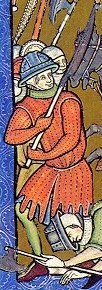 When we think about quilting, we tend to think about hand-crafted patchwork coverlets and puffy down coats. We don’t think about armor. But in fact, quilted armor played an important role in European warfare from the time of the Crusades through the sixteenth century.
The most simple form of quilted armor, the jack, was simple enough for a soldier or his wife to make at home: a sleeved coat made of two outer layers of linen, canvas , or fustion that enclosed a layer of padding, with small pieces of metal stuffed in the padding for extra protection.* The jack’s up-market relative, the brigandine, was made by a professional armorer and combined the flexibility of the jack with the protection of plate. Small metal plates were riveted to a canvas foundation, overlapped like scales for ease of movement. The scaled canvas was then covered with a rich material and a lining.
Whether made by a pro or run up by loving hands at home, so-called “soft armor” was surprisingly effective against sword cuts and arrows, though it provided no protection against a thrown lance or a mace. Even with the advent of metal armor, foot soldiers continued to wear fabric armor as their primary defense and knights wore padded garments in conjunction with chain or plate as an additional defense.
The use of quilted armor finally declined with the rise of firearms and heavy artillery at the beginning of the seventeenth century, only to reappear in the twentieth century in the form of the bulletproof vest.
* Sir Thomas Wyatt, who led a Protestant rebellion in England in 1554, had gold pieces sewn into his jack instead of the usual metal or horn scales so that he would have the dual protection of armor and ready money if he had to flee the country.