




In which I sink into Queen of the West: The Life and Times of Dale Evans
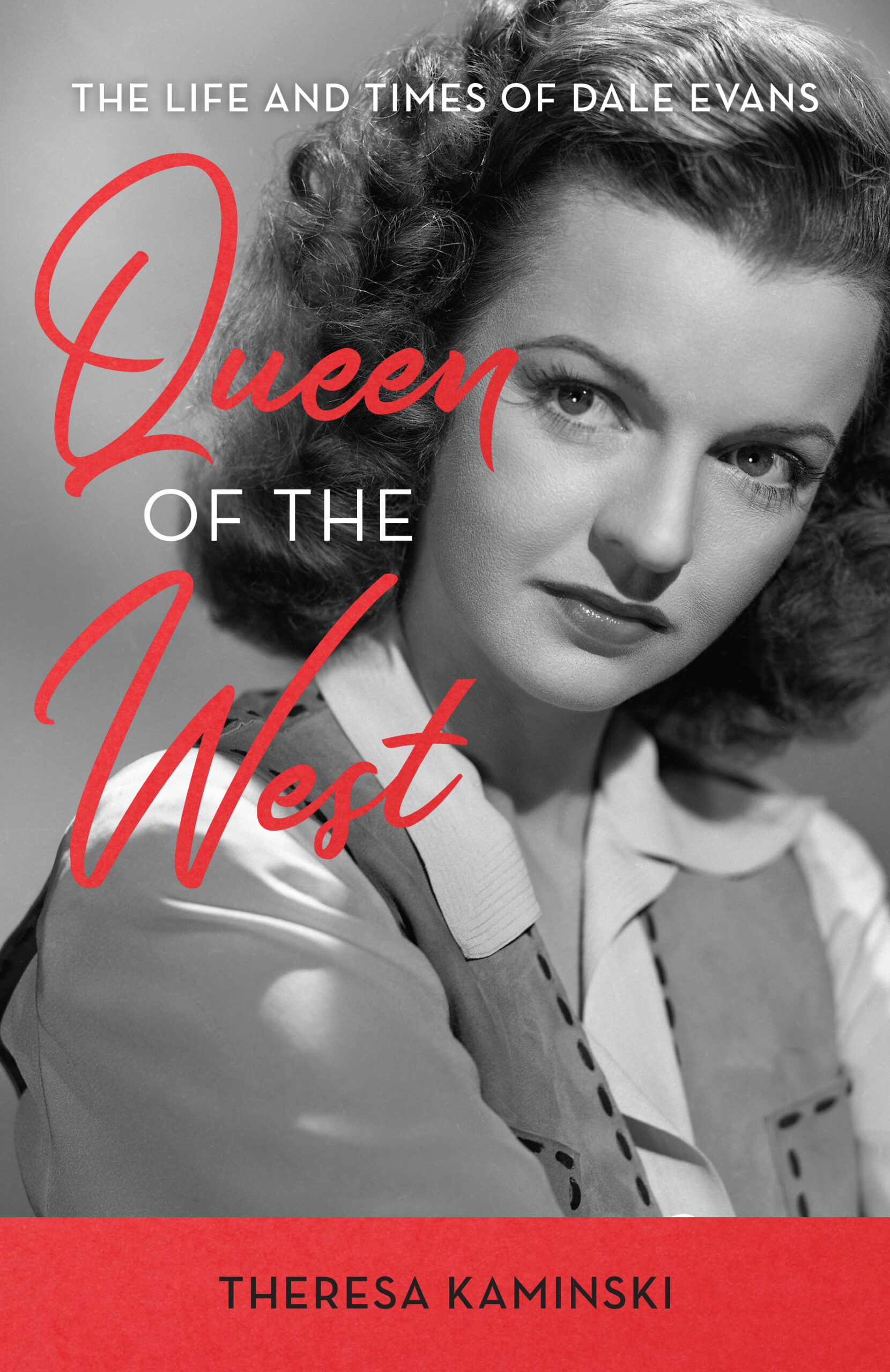
I will admit, I picked up Queen of the West: The Life and Times of Dale Evans by Theresa Kaminski with a sense of relief. Even though I knew Evans suffered personal tragedy in her life, I was looking forward to a mental palate cleanser after a month of reading books that took on tough topics from Black history. A biography of a Hollywood icon seemed like just the thing. Kaminski did not disappoint.
I went into the biography knowing very little about Evans: she was an image and a name but not much else.*
Kaminski creates a vivid picture of a complicated life. She introduces the reader to the often harsh realities of the music world, following Evans from local radio, to Chicago lounges, to Hollywood. She creates the picture of a career woman, who hid the fact that she had a child by her first marriage and yet championed traditional roles for women later in her life. She follows Evans through four marriages, ending with her decades-long marriage to Roy Rogers. She traces Evans’ attempts to create a career as a glamour girl, her success as a songwriter,** her initial reluctance to be cast in Westerns because female characters were typically overshadowed by their male co-stars, and her re-invention later in her life as a stalwart of the inspirational/Christian country music world. And she makes it clear that Evans was actively involved in shaping her career and her image every step of the way.
Much more than a singing cowgirl.
*I’m not sure I ever saw an episode of the Roy Rogers Show as a child. My local television station offered reruns of Sky King instead.
**Who knew? Not me!
Interested in learning more about how Kaminski researched and wrote Queen of the West? Check out this Q & A from March 2022: Three Questions and an Answer with Theresa Kaminski
* * *
Come back on Monday for six questions and two answers with K.S. Barton and Johanna Wittenberg, hosts of the podcast Shieldmaidens: Women of the Norse World
Talking About Women’s History: Three Questions and an Answer with Shannon Frystak
Shannon Frystak, Ph.D. is a first-generation college student who went on to pursue a Masters and Ph.D. focusing predominantly on Women’s History. An award-winning writer and historian, she is Professor and Graduate Coordinator of the Department of History and Geography at East Stroudsburg University of Pennsylvania where she has taught since 2007. Her first book, Our Minds on Freedom: Women and the Struggle for Black Equality in Louisiana, 1924-1967 looked at the important and, often, overlooked work of female civil rights activists in a Deep South state. Her second book, Louisiana Women: Their Lives and Times, part of the Southern Women Series at the University of Georgia Press, is a collection of essays co-edited with her friend, Mary Farmer-Kaiser. She is widely published in a number of collections and journals and is currently working on a book about Lucille Watson, a plantation owner in Tensas Parish, Louisiana.
Take it away, Shannon

When did you first become interested in women’s history? What sparked that interest?
I always knew that I wanted to be an academic, in some capacity, but as I had worked full-time to put myself through undergraduate school at Bowling Green State University, my grades were less than stellar and I decided to take some time off before deciding on a career long-term. After traveling across country, living in Washington, D.C. and working as a waitress while I volunteered at the Community for Creative Non-Violence, a homeless shelter/advocacy program, I moved to New Orleans and it was here that I began researching programs that might interest me; it felt like there were so many possibilities. One day I was perusing the Peterson’s Guide to Graduate Programs and happened to notice that Sarah Lawrence had a Master’s program in Women’s History. One of my favorite classes as an undergraduate student was my Women’s Studies course and I had long been an activist, attending many a women’s march in our nation’s capitol. So, I gave it a shot and I applied. And I got in! However, being that my undergraduate GPA wasn’t up to par, mainly because I worked full-time as a bartender to finish school, they asked me to take a few classes at a local university to prove that I was up for the challenge of a rigorous graduate program. The class I chose was called “Black Movements and Messiahs,” and it was taught by professor and civil rights activist, Raphael Cassimere. That class everything changed – I began to do research into black women’s history, reading Nikki Giovanni and Paula Giddings, and this course led me to pursue a Master’s in what was essentially African-American Women’s History. My thesis looked at the integration of the New Orleans chapter of the League of Women Voters, a story I happened upon when researching the white activist, Rosa Freeman Keller. The local chapter of the League of Women Voters allowed me access to their records where I came across a thin folder titled “Integration.” That serendipitous find led me to expand my research and to what ultimately became my larger work on women in New Orleans and across the state who were an integral, yet overlooked, part of the Louisiana civil rights movement.
What unsung woman activist from the past would you most like to read a biography of and why?
I’m currently looking at the life of Lucille Watson, a white female plantation owner, who successfully oversaw the daily operations of her family’s cotton (and later cattle) farm in Tensas Parish, Louisiana, just over the Mississippi River from Natchez. Her life should be made into a movie – she was a young debutante who married her uncle when her aunt died, a tennis pro, an avid hunter and fisherwoman, an amazing host who loved to entertain and who’s Christmas Eve parties were notorious, and the chatelaine of Cross Keys plantation, until her death in 1985.
What work of women’s history have you read lately that you loved? (Or for that matter, what work of women’s history have you loved in any format?)
When I first began research in women’s history there was so little about women in Louisiana and writ large. Today there are so many wonderful histories and books dedicated to uncovering stories about women and their contributions to American history. Some of the best recently published include my good friend Virginia Summey’s work on Elreta Melton Alexander Ralston, the groundbreaking attorney and first black female graduate of Columbia Law School, who in 1947 became the first black woman to practice law in North Carolina. My friend Jess Armstrong, who has a Master’s Degree in History, has recently published some really fun and engrossing historical fiction – The Curse of Penryth Hall and The Secret of the Three Fates – set in early 20th century gothic Great Britain where the protagonist, Ruby Vaughn, solves mysteries in London, Scotland, and, next up, Oxford. The field of women’s history has expanded greatly since the 1970s and the studies of women in this country and abroad are numerous, illustrating how significant women are to the history of world.


A question from Shannon: What is something that you learned in your research/studies of women in history that was striking, something we wouldn’t otherwise know, that surprised you or delighted you? Something that was completely unexpected.
I will never forget learning that Alexander the Great had an older half-sister, Cynane, who was also a successful general—a story that scholars of the period are familiar with, but not one that makes it into mainstream world history classes. When I first stumbled across her story I literally ran down the stairs, shouting to my husband “You’ll never guess what I found!”
***
Want to known more about Shannon and her work? Check out her faculty page.
***
Tomorrow will be business as usual here on the Margins with a blog post from me. Then we’ll be back on Monday with six questions and two answers from Kim Barton and Johanna Wittenberg, novelists and hosts of the podcast “Shieldmaidens: Women of the Norse World.”
Talking About Women’s History: Three Questions and an Answer with Joan Fernandez
Former senior marketing executive, speaker, blogger and book reviewer, Joan Fernandez brings to light brilliant women’s courageous deeds in history. Her short story, “A Parisian Daughter,” is published in the award-winning anthology, Feisty Deeds: Historical Fictions of Daring Women. Her debut novel, Saving Vincent, A Novel of Jo van Gogh, will be published in April 2025 by She Writes Press.
Take it away, Joan!

What path led you to Jo van Gogh? And why do you think it is important to tell her story today?
I found out about Jo on a long weekend in Amsterdam. I was with three girlfriends, and we’d carved out a getaway between crammed schedules of kids’ sports and dual parental juggling and hectic work demands. It felt giddy, like we were getting away with some crazy caper, and gloriously indulgent since traveling with friends feels different than traveling with a spouse, when a big chunk of attention includes the other person’s welfare.
So, one of our stops is the Van Gogh Museum. I purchase the audio tour and immerse myself in Vincent van Gogh’s artistic tragic life as I follow the recording from painting to painting. In fact, it’s so engrossing that at the end of the tour there are tears in my eyes. At this moment I’m in front of the final exhibition boards. I notice a small notation about Jo—Vincent’s sister-in-law—and how she was the one who worked for over a decade to promote him. I remember staring at her photo and thinking, “If not for you, none of this would be here.” Like a fishhook, Jo caught my thought. A few years later I retired from my corporate career and decided to write her story.
Even though this year, 2025, will be the hundredth-year anniversary of Jo’s death in 1925, I believe her story is coming out at a crucially relevant time. There’s been a gathering storm of societal pressure against women’s rights and agency, Recent attacks on DEI initiatives is just one example. The fact that Jo prevailed despite her experiences of patriarchal prejudice can give comfort and inspiration to readers today. I think there’s a special impact from reading real women’s stories from the past that can give hope today.
How did you walk the line between historical fact and fiction in Saving Vincent?
I started with research from official biographies and letters, including reading the 101-letter exchange between Jo and Theo and all 902 letters of Vincent van Gogh’s correspondence. The first letter exchange gave me a sense of their relationship and what Jo valued and was curious about. I read Vincent’s correspondence because Jo read and organized Vincent’s letters after his death, getting to know him through his writing since she only met him three times in person.
At this juncture, I applied a storytelling framework: choosing an inciting incident, finding a point of no return, identifying a climactic moment, etc. Then I scoured my factual research to give intentional meaning to Jo’s moments within events, a timeline, art exhibitions and relationships. Overlaying all of it, I wanted to show her personal growth from a timid widow to the strong advocate she became. Finally, I also wanted to include societal pressures of her time, so I personified this headwind by creating a fictional antagonist, who represented pushback against her efforts from the art establishment.
How did your previous career as a marketing executive inform your response to Jo van Gogh, whom you’ve described as the “greatest marketer of the century?”
When reading Jo’s biography, my background in marketing caused Jo’s marketing strategies to leap off the page. I’ve gone back to identify eight specific strategies, many ahead of her time. For example, she was vigilant about protecting Vincent’s “brand”—responding to criticism even though it caused others to scold her publicly. Another tactic: she educated the public about Vincent by publishing excerpts from his letters and drawings in six editions of a prominent Parisian newspaper. These letters created curiosity around Vincent, which in marketing is creating awareness. She reminded me of a genius whose talent is so instinctive that what’s elusive to others feels perfectly natural. This genius transformed a product worth nothing (Vincent’s works) into one worth millions upon millions today. It’s by this measure that I’ve enjoyed calling Jo, the greatest marketer of the century.

A question from Joan: Over the long arc of humankind, you’ve studied and written about there have been shifting worldviews on women—what’s your perspective on the current rhetoric and backlash against women’s rights and agency?
First: I want to know if you people got together this year and said “Let’s ask Pamela hard questions.”
Okay, now that I’ve gotten that off of my chest, let me take a stab at this.
Speaking as a historian: progress is not a continuous upward curve. (The most dramatic version of this in American history is the backlash against the Reconstruction following the Civil War.) Instead, progress comes in fits and starts, whether we are talking civil rights, labor safety or clean air. Certainly in the case of women’s rights and agency, every step forward we have made has been followed by an attempt to push us back that was successful in the short run. (As I have said in previous posts I’m talking about the history of women’s rights because that is what I know best, but it is true of every marginalized group who has fought for equal rights.)
Moreover, progress does not occur evenly across a population. The 19th Amendment gave American women the right to vote, but did not address the rules that were already in place to disenfranchise Black men, and consequently Black women.* There is a reason that intersectionality—the way different forms of inequality overlap and exacerbate each other— is an important part of the discussion.
Just because this isn’t the first backlash we’ve seen against civil rights of the marginalized, doesn’t mean we can just wait for the pendulum to swing again. Advances are made because people fight for equality.
On a personal level, I am really angry and my stomach hurts all the time.
*The role of Black women in the suffrage movement and the racism of many of the leading White suffragists is too big a topic for me to handle here, and painful. I was shocked when I first learned some of the stories. I’ve said it before, and I suspect I will say it many times this year: history is hard, and perhaps it should be.
***
Want to know more about Joan and her work?
Check out her website at https://www.joanfernandezauthor.com
Read her provocative weekly essays as https://joanfernandez.substack.com
***
Come back tomorrow for three questions and an answer with Dr. Shannon Frystak, who studies the lives of historical women in the Deep sosuth.