




Isidore, Patron Saint of the Internet

From left to right, Bishops Braulio and Isidore
In a recent discussion on Facebook, a friend of a friend mentioned that St. Isidore of Seville is the patron saint of the Internet. Luckily I had already swallowed or there would have been iced tea all over the computer and the cat. Isidore the encyclopediast looking over computers and the Internet? Who knew the Vatican had a sense of humor?
I first encountered Isidore of Seville when I began to read about the impact of Muslim science on Western civilization. His contemporaries accurately described Isidore as saeculorum doctissimus (the most learned man of the ages). Nineteenth century historian Charles de Montalembert called him “the last scholar of the ancient world”–an assessment that stuck.
Isidore was the archbishop of Seville from 594 to 636. Spain was under the rule of the Visigoths, who were not significantly less barbaric than they had been when they sacked Rome two hundred years before. The little classical learning that remained in the west seemed to be disintegrating.
Isidore, the most learned man of his time, set out to preserve every piece of knowledge that he could put his ink-stained hands on. * The result was Etymologies a twenty-volume encyclopedia of knowledge, including volumes on grammar, rhetoric, mathematics, medicine and law. According to his friend Bishop Braulio of Saragossa, it contained “well-nigh everything that ought to be known,” but much of that knowledge was half-digested and/or badly translated.** (Isidore’s mangling of a classical text was the primary source for the popular “flat earth” fallacy, even though most educated people of the time knew better.)
Etymologies was a medieval best seller and a standard book in what passed for libraries in Europe at the time. It remained popular well into the Renaissance. Despite his errors, Isidore succeeded in his goal of preserving knowledge for the future. We know many of the classical works he discussed or quoted only through his work.
In short, Isidore, Bishop of Seville, gave people access to a sprawling compendium of knowledge, some of it inaccurate and much of it incomplete. Sounds like the perfect patron saint for the Internet to me. Now if you’ll excuse me, I think I’ll light a candle and ask for a little help to stop Firefox crashing.
* Isidore wasn’t the first man to make a heroic effort to save classical knowledge for future generations. A hundred years earlier, a Roman patrician named Boethius, serving in the court of the Gothic king Theodoric, created a similar encyclopedia for similar reasons.
**It’s easy to poke fun. But who among us could do better? As someone who is currently reviewing galley proofs for what is essentially a history of the world, *** I feel a new sympathy for Isidore.
***BLATANT PROMOTION WARNING: Mankind: The Story of All of Us is coming to a bookstore near you sometime in October (I hope).
The Whiskey Rebellion
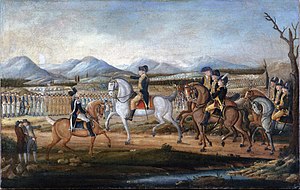
“No taxation without representation” was a rallying cry in the American Revolution*, but taxation controversies didn’t go away after the United States was formed. The new government needed regular revenue. The average man on the street (or dirt road through the wilderness) was opposed to taxation and had his doubts about government in general. Some questioned the value of a revolution if all it did was replace British aristocrats with local elites.
In 1791, at the urging of Secretary of State Alexander Hamilton, Congress levied the new government’s first nationwide tax: an excise tax ** on distilled spirits produced in the United States. Large commercial distillers in the east grumbled, then raised their prices to pass on the cost of the “whiskey tax” to their customers. Small farmers in the west, many of whom distilled and sold whiskey because it was difficult to transport their grain over the mountains, did more than grumble.
The government had trouble collecting the tax almost immediately. Many western distillers simply didn’t pay. Others met the brand new “revenooers” with violence–not only beating tax officials but anyone who rented them housing or an office. In July, 1794, five years after the former colonies had adopted a new constition, opposition flamed into open rebellion when US Marshall David Lenox arrived in western Pennsylvania to serve writs against distillers who had failed to pay the tax. The so-called Whiskey Rebellion spread rapidly. By the end of the month, several thousand armed rebels had gathered in Braddock’s Field near Pittsburgh. The same leaders who cheered on the Boston Tea Party less than years before now had to contend with a tax protest of their own.
On August 7, President Washington alerted the state militias to stand by and sent in negotiators, but the whiskey rebels had no interest in negotiated. In September, Washington himself led 13,000 militiamen from Carlisle, Pennsylvania over the Alleghenies to the town of Bedford.*** In Bedford, Washington turned the command over to General Henry “Lighthorse” Lee, then governor of Virginia. By the time the federal forces arrived at Braddock’s Field, the rebellion had collapsed and most of the rebels had retreated to their farms.
The federal government had proven it could maintain order, but opposition to taxes and federal authority wasn’t at an end. Farmers in Pennsylvania rose in protest again in Fries’s Rebellion in 1799. A few veterans of the Whiskey Rebellion decided that it was more effective to fight from the inside and went into politics. Thanks to their efforts, the hated whiskey tax was repealed and replaced with duties on imported goods, something that would become an issue in the lead up to the War of 1812.
* I didn’t really need to tell you that, right?
** I realized I didn’t really know what an excise tax was. I looked it up, so you don’t have to. It’s a tax on a good produced inside the country.
***The only US president to personally lead armed forces while in office.
History on Display: 1001 Inventions
Last year, a couple of months before I launched History in the Margins, My Own True Love and I met up with one of my best history buddies to visit an exhibit at the New York Hall of Science: 1001 Inventions: The Enduring Legacy of Muslim Civilization.
Although the exhibit was obviously designed with children in mind, we found it utterly engaging, from the introductory film starring Ben Kingsley as 12th century engineering genius, al-Jazari, to the working scale models of medieval Islamic technology. The exhibit’s creators did an excellent job of bringing the medieval Islamic world, in all its diversity, to life for a western audience. This is a topic I’ve spent a lot of time on, and I still learned plenty of new things.
I hear some of you grumbling, “That was more than a year ago, why is she telling us about this now?”
Because, dear readers, 1001 Inventions is due to open for a six month run in Washington DC on August 12 at the National Geographic Museum. If you live anywhere nearby, or have a DC trip on the schedule, it’s well worth the visit.