




Word with a Past: Maverick
The word “maverick” has always had overtones of the American West in my head—or at least the American West of a childhood spent watching shows like Gun Smoke, Bonanza, and, of course, Maverick.[1] Imagine my surprise when I recently learned that the word in fact has its roots in nineteenth century Texas.
-

- Bret and Bart Maverick
-
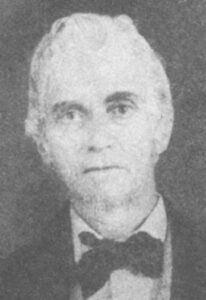
- Samuel Maverick
Samuel A Maverick (1803-70) was born to a wealthy family in South Carolina and earned a law degree from Yale. Instead of taking over one of his father’s businesses, he headed to the Texas region of Mexico in 1835, shortly before the Texas War of Independence began. He joined the Alamo militia—though he did not fight at the Alamo. He signed the Texas Declaration of Independence. He served as the major of San Antonio when the war was over.
Six years after independence, Maverick was captured and imprisoned when Santa Anna sent troops back into Texas, with the intention of re-taking the territory. The Mexicans offered Maverick his freedom if he signed a document saying Texas had been illegally seized and should be returned to Mexico. Maverick refused. When a family friend negotiated his freedom, he again refused to leave until the other prisoners from San Antonio were also released. They all returned home a few days later.
None of which explains how Maverick’s name became a noun, a metaphor, and a cultural construct.
When Maverick arrived in Texas, he bought up huge tracts of land around San Antonio and further east along the Brazos. In 1847, he bought a farm that included some 400 head of longhorn cattle. Maverick was interested in land, not ranching, and he was busy as a member of the new Texas legislature. He left the cattle in charge of a nineteen-year-old enslaved man named Jack, who was quickly overwhelmed by the task. The cattle began roaming unsupervised. Although the original herd carried the brand of the man who had owned them previously, few of the subsequent calves were branded. Neighboring cattlemen knew an opportunity when they saw one. After all, you couldn’t call it rustling if an unbranded steer or two found its way into your herd. Once you branded it, the cattle were yours, right?
In 1856, Maverick sold what remained of his herd to neighboring rancher Augustine Toutant-Beauregard. The terms of the sale specified on-range delivery, which meant the purchaser had to round up the cattle himself. Toutant-Beauregard took advantage of the fact that Maverick (and Jack ) had lost control of the herd. He sent his men into neighboring counties with instructions to round up any unbranded cattle they found, declaring them to be Maverick’s. The term rapidly entered the language to describe unbranded range animals.
By the end of the nineteenth century, the term maverick had come to refer to an individual who goes their own way without reference to the custom, but it didn’t really take off outside Texas until the late 1930s, when Samuel Maverick’s grandson, Maury Maverick, became the Democratic congressman from Texas. He was famously and stubbornly independent in his political positions.—a maverick as well as a Maverick.[2]
Maverick: An unorthodox or independent-minded person.
[1] In fact, I never actually saw Maverick, which went off the air when I was four.
[2] He also coined the term “gobbledygook” to describe “the overinvolved, pompous talk of officialdom.” He said he chose the sounds in the word to imitate the noises made by a turkey.