




From the Archives: Independence Lost
I will admit it: it didn’t even occur to me until last week that the 250th anniversary of the United States was the perfect opportunity for a series of blog posts related to the American Revolution, the creation of the constitution, and like that. Or that I could have spent the last six months reading some of the new books that have tied themselves to the anniversary.[1] If I had the bandwidth. Which I didn’t. What can I say? Sometimes I’m a little slow.
But I’m on it now. Over the next few weeks, I’m going to circle the idea of America 250.[2] A couple of posts from the archives. A couple of reports on some interesting new projects that have crossed my path.. A story or two. I’ll maybe even read one of the books from the To-Be-Read Shelves. [3]
Starting off, a post that first ran in 2015
Those of you who’ve been hanging out in the Margins for a while now know there are some types of history books that can be counted on to make me say “I want to read this”:
- Books that tell a story we think we know from a radically different perspective
- Books that deal with people outside the mainstream of history
- Books that tell a story I didn’t even know existed
- Books–oh, well, you get the idea.
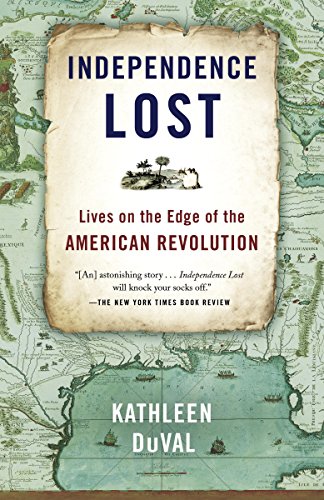
In Independence Lost: Lives on the Edge of the American Revolution, historian Kathleen DuVal, author of The Native Ground, reminds us that the American Revolution was part of a larger global conflict involving France and Spain, and that Britain had 13 other colonies in North America and the Caribbean that were also affected by the war.
West Florida, which included much of what is now Florida, Mississippi, Alabama and Louisiana, had only recently become a British colony–part of the redistribution of imperial territories at the end of the Seven Years War– when the Continental Congress declared war on Britain. Located on the border between the British and Spanish empires, and a distant frontier for both, it was home to former French and Spanish citizens, British loyalists fleeing the disruptions of the revolution and well-organized Indian nations with their own agendas. The possibility of a Spanish invasion was real, and at least some of the colonists thought Spain was a better choice than Britain or France if push came to colonial shove.
DuVal considers how eight very different colonists–a second-generation African slave, a young Cajun with a deep-seated hatred of the British, leaders of the Creek and Chickasaw tribes and two British couples who chose different sides in the conflict–responded to the dangers and opportunities that the revolution brought to their doorsteps and the impact of those choices. While each of these characters stands in for a larger population, the complicated calculus of self-identity, self-interest and personal history that they use to make decisions about the world around them makes it clear that revolution and politics were always personal.
[1] A few new books on related subjects that are on my radar for your consideration:
Obstinate Daughters: The Rebels, Writers and Renegade Women Who Ignited the American Revolution by Denise Kiernan (Due out 6/23)
The Capitol: The Surprising Biography of an American Building by Brian Jay Jones
This Land is Your Land: A Road Trip Through American History by Beverly Gage
[2] It’s a slightly silly title, in my opinion. But Semiquincentennial does not roll off the tongue as easily as Bicentennial did.
[3] No promises