




David Roberts, Egypt, and Me
Almost a year ago, I promised readers of my newsletter, that I would write a blog post about Scottish-born artist David Roberts (1796-1864), whose work played a small role in my doctoral dissertation and provided many of the images of ancient Egypt in my head. I had forgotten all about that promise until I recently had reason to read back through earlier newsletters. (What can I say? it’s been a busy and difficult twelve months.)
Here we go:
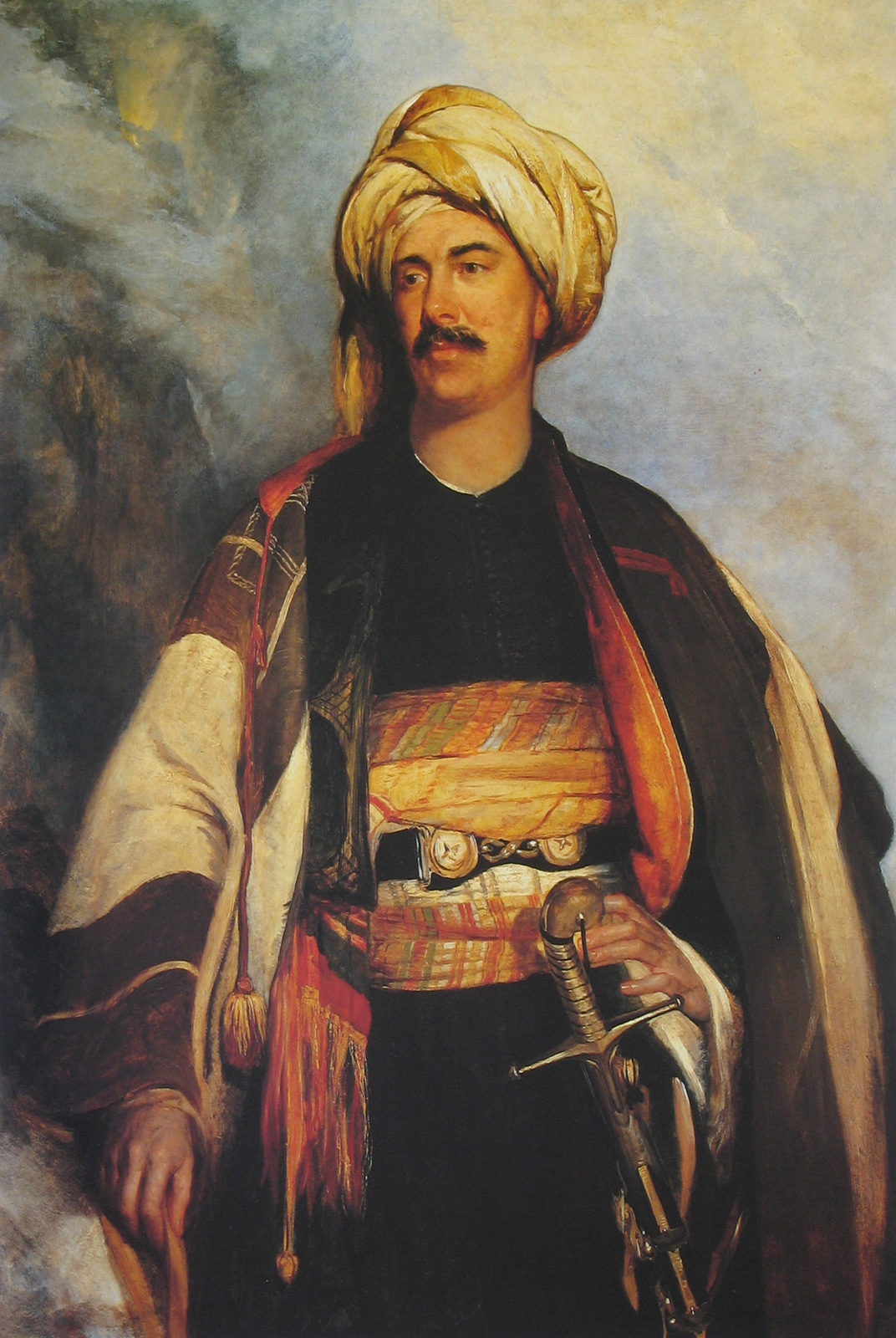
David Robert, painted by Robert Scott Lauder. 1840
David Roberts was a prominent Orientalist painter during his lifetime: one of those artists who was well-known in his time, but is relatively unknown today. Even as a tourist in Egypt, you will see prints of his work everywhere but won’t necessarily learn anything about him.
Here’s the version I would give you if you asked me about Roberts in a public question-and-answer session, or at a dinner party:[1]
Roberts was one of the most celebrated painters and travelers of his generation and a member of the Royal Academy. He is best known for his illustrated travelogue The Holy Land, Syria, Idumea, Arabia, Egypt, and Nubia.
That’s all true, but it leaves out the unusual path that led him to the Middle East and fame. Here’s the longer version:
The son of a shoemaker, Roberts began his artistic career in his hometown of Edinburgh as an apprentice to a house painter and decorator—a trade that included creating elaborate stenciling, trompe l’oeil effects, and faux wood grain and marble. After a seven-year apprenticeship, he took a job as foreman for the redecoration of Scone Palace in Perth. It was a respectable living, but Roberts had artistic aspirations and began to study art in the evenings.[2]
In 1816, Roberts began working as a scene painter and set designer (and occasional straight man for the clown acts) for James Bannister’s traveling circus. His work for Bannister ultimately led to work in theaters in Edinburgh and then London, where he moved in the early 1820s.
In the 1820s, while he continued to make a successful living as a scene painter, Roberts began to devote himself to oil painting, with an emphasis on landscapes. (Personally, I think his time working as a scene painter influenced his later paintings and drawings.) He first exhibited his paintings at the Fine Arts Institute in Edinburgh in 1821. In 1826, he hit the big time with a painting in the annual Royal Academy exhibit. By 1829, he was a full time artist.
Roberts’ early works depicted picturesque scenes from the Scottish and British countryside, or images inspired by books of engravings. But like other painters of picturesque topography , Roberts soon traveled in search of topics for his work. Unlike other painters, he traveled independently, without the support of a wealthy patron or a commission from a publisher for one of the illustrated travel books that were gaining popularity at the time.[3]
In 1832, Roberts traveled to Spain and Morocco—his first trip outside Britain. He returned with a portfolio of sketches that he turned into paintings and illustrations, tapped into the growing European and American interest in travel, armchair and otherwise, to what they thought of as “exotic” places.[4] In 1837, he took his first step into the world of travel books with a popular selection of lithographs titled Picturesque Sketches in Spain.
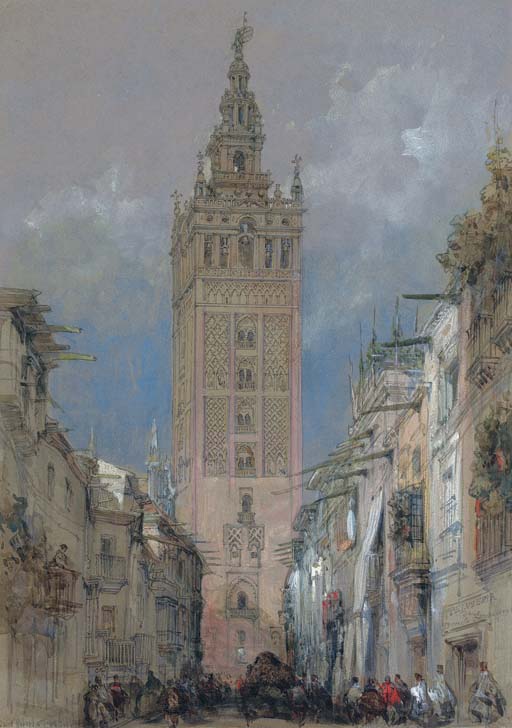
Moorish Tower at Seville.1833
In 1838, Roberts set off a nine-month-long trip through Egypt, Nubia, Sinai, Jordan, Lebanon, and the Holy Land. It was a defining moment in his career. He returned with what he described as “One of the richest folios that ever left the East.” Building on the style he had developed in his Spanish works, he created a distinctive style in which he set scenes of contemporary life in the Middle East against carefully delineated images of ancient monuments, Islamic mosques, and harsh landscapes.
The oil paintings based on sketches from his trip received critical acclaim, but his most influential work was the travel book he created, which was illustrated with 247 hand-colored and tinted large scale lithographs, produced in collaboration with Belgian-born lithographer Louis Haghe (1806-1885). The prints were published in a series of monthly parts between 1842 and 1849. As was generally the case with expensive and uncertain publishing ventures, the portfolios were sold by subscription. Queen Victoria was the first subscriber, a fact which undoubtedly helped the publisher’s marketing effort. (Her complete set is still in the Royal Collection.)
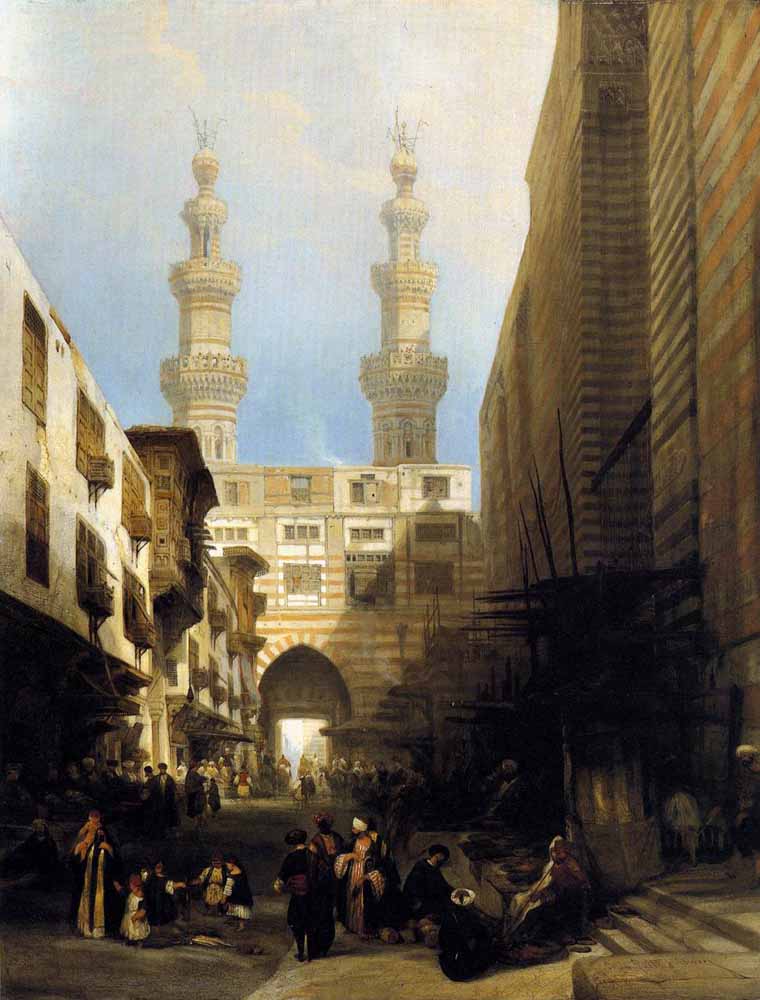
A View in Cairo. 1840
Roberts visited Italy in 1851 and 1853. His last volume of illustrations, Italy, Classical, Historical and Picturesque, was published in 1859.
He spent the last years of his life on a series of views of London from the Thames. He had completed six of the series at the time of his death in 1864.
[1] Or at least I like to think I would show this type of restraint. Actually, as any of you who know me in real life can attest, if someone gives me an opening in company I’m comfortable with I’m apt to lean forward let fly my history nerd flag Iuntil I notice what I’m doing. Then I will shut up and apologize.
[2] Self-improvement was an important part of working class culture in Britain, and especially in Scotland, at this period. A big topic for another time.
[3] Think coffee table books with lithographs instead of photographs.
[4] With full recognition that exotic is a problematic term, with racist and imperialist overtones. Too big a topic to grapple with in a footnote.