




Talking About Women’s History: Three Questions and an Answer with Olivia Campbell
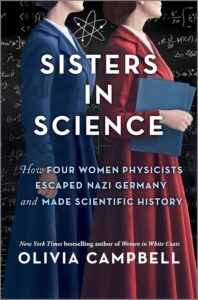
Olivia Campbell is the New York Times bestselling author of Women in White Coats: How the First Women Doctors Changed the World of Medicine and Sisters in Science: How Four Women Physicists Escaped Nazi Germany and Made Scientific History. She is also a thesis advisor at Johns Hopkins University’s science writing master’s program and a regular contributor to National Geographic. Her work has appeared in The Atlantic, History.com, Scientific American, The Guardian, and New York Magazine, among others. Her newsletter, Beyond Curie, brings the stories of women in science history to life.
Take it away, Olivia!

In Women in White Coats and, more recently, Sisters in Science, you write about historical women of STEM whose stories have been left out or, with the possible exception of Elizabeth Blackwell, underreported. When did you first become interested in historical women in STEM? What sparked that interest?
My interest—my entry point in any topic—has always been women. Where are the women? The more science texts I read, the more I wondered: who were the women who made these findings possible and why aren’t they present in the narrative? I’m pretty sure I could write a story a day about women scientists whose male colleagues/supervisors took credit for their work or whose discoveries went unnoticed until a man made the same finding. I feel like it’s my calling to bring women’s overlooked and stolen contributions to science.
How does your work as a science writer inform your work in women’s history?
I consider myself a journalist first and foremost; I have degrees in journalism and science writing. Of course, my science writing helps me interpret the work of historical women scientists for a wider audience. But I think the biggest transferable skill has been my ear for quotes. I pride myself on being able to pick out the best quotes from my interviews with experts in my science journalism. In history writing, I don’t get many opportunities to interview living subjects, but I am quite good at reading through stacks of letters, diaries, notes, books, essays, and other texts and finding the quotes and anecdotes that not only best serve the narrative, but also represent who these women were as people, their character and motives.
Why do you think it’s important to tell these stories today?
As our current government leaders work to downplay, diminish, and erase women’s scientific contributions—and even fire many women scientists and defund scientific research into women’s issues—these stories are more important than ever. Chronicling these tales for a modern audience in accessible ways. Women have always been brilliant scientists, genius inventors, and extraordinary thinkers; it’s my job to ensure everyone remembers that.

My question for you is: How do you work to make history relevant to modern readers?
First, I don’t think relevant is the right word. I want to make the reader care.
At some level, that means choosing the right story. The fact that I find a story fascinating is not enough. As anyone who reads this blog regularly knows, I am interested in lots of things. But keeping a reader’s attention over the course of a blog post or a magazine article is different than making them care over the course of a book. Deciding whether I think I can do that is built right into the complicated process of choosing a topic for a book.
First, I need to find a story or idea that not only has enough heft to carry a book but that I can picture living with over the course of several years. (Not only the time it takes to write the book, but beyond. I still have people asking me to talk about Heroines of Mercy Street, which came out in 2016.*) A few months ago, I sent a highly relevant and potentially successful book idea back into the universe because it wasn’t for me.** The topic needs to have the capacity to excite me, enrage me, surprise me. If I am bored writing the book, you will be bored reading it. Trust me on this.
Next, I need to determine whether there are enough sources available to make it possible to write the story. (What that means varies from book to book.)
Finally, at some point in the search process I have to ask myself “Why this story? Why now?” If I can’t answer that question*** to my own satisfaction, not to mention that of my agent and then my editor, that book isn’t going to going to get written.****
Ultimately, though, making a reader care depends on my skill as a story teller. Giving readers just enough historical background so they understand the why and what without weighing them down. Finding the detail that brings a moment or a character alive. Using quotations with a light hand.
We’ve all read books on subjects that we weren’t deeply interested in because the author has made us care as much as they do. That’s the goal.
*At the moment, the ebook is on sale on Amazon for $2.99. Whether that will still be true when you read this, who knows.
**I hope it finds a home. It’s an important story.
***I know, it looks like two questions. It really isn’t. There is an implication “and” between them.
****As written, this looks like a linear process. In fact all of those questions are going on simultaneously in a tangled mess of exploration. It is more like chopping my way through a jungle than traveling down a highway.
***
Want to know more about Olivia Campbell and her work?
Check out her website.
Subscribe to her newsletter: Beyond Curie.
Follow her on Bluesky and Instagram
***
Come back tomorrow for three questions and an answer with Kathryn Gehred, host of the podcast Your Most Obedient and Humble Servant.