




Air Minded: A Q & A with Kimberley Sheeter
Those of you who’ve hung out here on the Margins for a while know that aviation history is something that comes up often in our house. My Own True Love is interested in historical planes; both of us are interested in the people who flew them.
For some time now, I’ve enjoyed the aviation adjacent stories that Kimberly Sheeter shares on LinkedIn. When I realized she had written a novel rooted in aviation history, titled Air Minded, I asked her if she would answer a few questions for us.
Take it away, Kimberly!
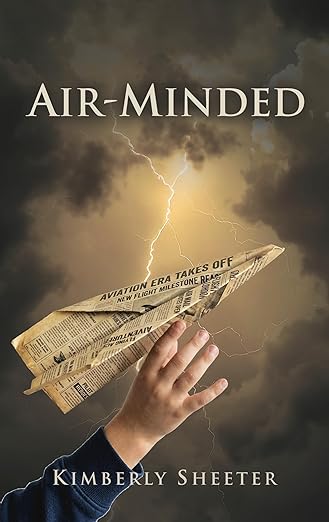
What inspired you to write Air-Minded?
Air-Minded started as a straightforward biography of the founder of the university where I work (and my master’s thesis in nonfiction writing). It morphed into narrative nonfiction and eventually into historical fiction because I was frustrated by my inability to explore the inner lives of the key figures.
It’s historical fiction with a bit of a fig leaf: Almost every character is a real person, in the right place at the right time. I had accumulated about 200 pages of footnotes before I finally called it quits on nonfiction. I tended to get rather chatty in those footnotes, somewhat like Bill Bryson. I love providing context. Possibly too much.
How did you walk the line between historical fact and fiction in Air-Minded?
I tried to stay close to the facts, largely because I discovered that facts regularly outperform my imagination.
The most George Saunders-like moment in the manuscript is a passage in which John Paul Riddle’s wife has a conversation with a UFO about her inability to connect with her husband. Granted, that sounds surreal. But consider the circumstances: Her marriage was disintegrating, she was receiving the wrong medication for early-onset multiple sclerosis and mixing prescription drugs with alcohol. She lived on the beach in Miami, and in 1947, reports of flying saucers were appearing up and down the Eastern Seaboard.
So it’s dramatic license, certainly, but with a foundation in historical plausibility.
What types of sources do you rely on to create rich fictional characters who are historically accurate?
I’m a Newspapers.com addict. I’ll happily spend hours reading grocery prices and society columns alongside the more obvious research material. I enjoy immersion. I also listen to music from whatever era I’m writing about.
Find a Grave can be a treasure trove, as can those Facebook pages called things like “You Might Just Be From [Insert Town].” I’ve also had wonderful luck with small-town librarians who still maintain files of old newspaper clippings. State and university archives are invaluable, although responses can sometimes be slow, probably because they’re understaffed.
There’s also a brilliant woman on YouTube who recreates fashions from different eras and demonstrates how all the pieces go on, including undergarments, accessories and the things a woman might carry. That was enormously helpful when I was writing Scandal Sisters, which spans from the Gilded Age through the 1930s.
I like knowing what things cost, what people wore, what they listened to and what they worried about. Those details make the past feel inhabited rather than researched.
Did you base your characters on real-life historical aviators?
My left brain definitely based John Paul Riddle on the early aviator of that name. I had access to university archival materials, including his correspondence. I also interviewed family members and invited them to weigh in on the draft.
My right brain may have snuck in a little of my own father, another farm kid who bought a biplane as soon as he could afford one and loved flying for the rest of his life.
What was the most surprising thing you’ve found doing historical research for your work?
My understanding of the events surrounding Earnest Pletch, the midair murderer featured in Air-Minded, was turned upside down when I discovered that his uncle had been institutionalized with a diagnosis of schizophrenia. An extended family member also told me about allegations of predatory sexual behavior involving Earnest.
Those discoveries forced me to reconsider my understanding of the family dynamics and how I portrayed them.
Sometimes research doesn’t simply fill in the blanks. It changes the picture altogether.
It’s obvious from your LinkedIn articles that you’re deeply interested in aviation history. When did you first get the aviation history bug?
I’ve worked for Embry-Riddle Aeronautical University for almost nine years. Deep, dark confession: I’m not inherently interested in aviation. I’m wildly curious about people, especially what obsesses them.
I see aviation as a particularly revealing lens through which to examine American culture. It was a technology that transformed what was possible, often faster than the law or society could adapt. I think we’re seeing a similar race today with artificial intelligence, between what we can do and what we should do.
Are you a pilot as well as a novelist and historian?
I’m considerably closer to being a novelist and historian, both of amateur standing, than I will ever be to becoming a pilot.
My earliest aviation memories involve throwing up in the back of my father’s biplane. Also, my eyesight, depth perception and spatial skills are abysmal. The world is a safer place with me in the passenger seat.
What are you working on now?
My next book, Black Hangar, is a history of aviation told through true crime. It’s nonfiction, so I’m back in my comfort zone for a while.
I’ve had enormous fun collecting killers, skyjackers, con men, impostors and people who were eccentric, to say the least. I’ve deliberately avoided cases everyone already knows and introduce readers to characters they’ve probably never encountered.
Take Mabel Boll, for example, who cursed Amelia Earhart as “the other woman” when the pilot she had hired opted to fly Earhart across the Atlantic first.
I do love oddballs and overlooked figures, as a writer and a reader.
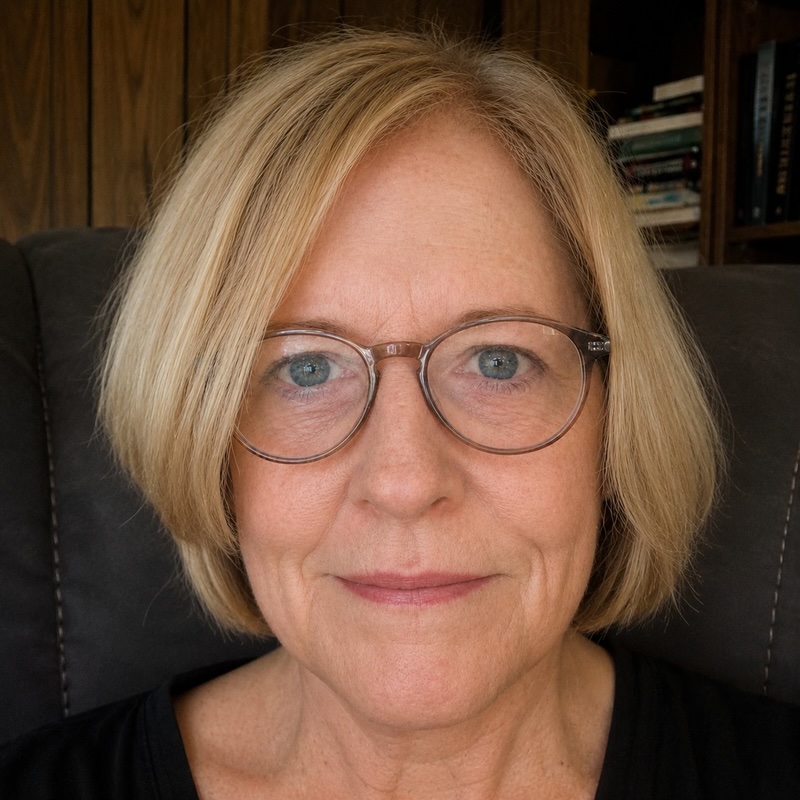
Kimberly Sheeter has been on organization charts with a variety of titles but has always been a writer. She holds a master’s degree in creative writing and has been a promotional or technical writer for Embry-Riddle Aeronautical University, Lockheed Martin, Disney, Scholastic Book Fairs, AAA, and almost every corporation that has ever held a conference in Orlando or Las Vegas. She has earned 13 American Business Awards (Stevies) and has served as a judge for the program. Her books include Walt’s Apprentice: Keeping the Disney Dream Alive (an as-told-to memoir) and the novels No Gifts, Please (as Bridget Shanahan), Scandal Sisters and Air-Minded. Her forthcoming Black Hangar explores aviation’s darker corners through true tales of crime, fraud and spectacularly bad judgment.