




World War II in Sicily
We spent one night in a renovated vineyard/ “farm stay” hotel that dated from the eighteenth century. The vineyard operated continuously through World War II, when it was abandoned. It was reopened in 2000. When I asked our Sicilian tour leader why it had been abandoned, he shrugged and said “So many possible reasons.” The war had been hard on Sicily.
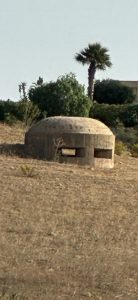
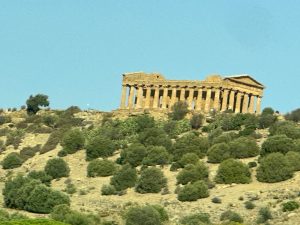
Not surprisingly, World War II was not a focus of our visit. (As I’ve mentioned, several times before, the tour focused on food.) And yet it was never far away. Our guide in Palermo pointed out concrete apartment buildings in the historic district of Palermo— built during a brief period in the 1950s as post-war replacements for the baroque-style villas that were destroyed in 1943 when both the Germans and the Allies bombed Sicily. In Siracusa, we learned that Mussolini razed medieval and baroque buildings to clear a path for his parade through the city. (I’ve not been able to verify this, but there is definitely a swath of ugly post-war concrete buildings through the historic district.*) And German pillboxes scatter the countryside near the coast, much like the Grecian ruins which we saw on many hilltops—a reminder of the past without a specific context.
Faced with constant physical reminders of the war, I began to realize that I didn’t know much about World War II in Sicily. Back home, I set out to learn more. (Does this surprise anyone?) I quickly realized that unless you look at something specifically focused on Sicily, its role in the war is often described as “the doorway to Italy.” In fact, one reference book on my shelf summed up 38 days of hard fighting for control of the island this way: “The Allied invasion of Sicily began on July 9, 1943, and the battle for Italy followed.”
In fact, the Allied invasion of Sicily, known as “Operation Husky,” was a major amphibious operation that gave the Allies a preview of many of the issues they would encounter a year later in the D-Day invasion. More than 3,000 ships landed 160,000 soldiers— the combined forces of British General Bernard Montgomery’s Eighth Army and the US Seventh Army under General George Patton. (Not a pair inclined to play well together.) They were covered by 4,000 aircraft from Malta. More would follow
The Nazis believed that the Allied attack would focus on Sardinia and Corsica, thanks to an elaborate misinformation campaign run by the British, known as “Mincemeat”.** As a result, only two German divisions were on the island to oppose the invasion. The German commander, and subsequent historians, dismissed the Italian forces as being of little help—an assessment that may well have been accurate due to Italy’s political instability.
On July 24, Benito Mussolini was deposed and arrested. The new Italian government immediately sued for peace with the Allies and withdrew their troops from Sicily the next day. Germany, too, began to withdraw troops across the Messina Straits in order to reinforce their forces in mainland Italy.
Over 38 brutal days, half a million Allied soldiers fought over rocky terrain through at least three defensive lines of the German retreat. The Allies reached the port city of Messina on August 17. They now controlled Sicily, the first section of the Axis homelands to fall to Allied forces in the war and a strategic key to the Mediterranean.
*It is only fair to note that not all post-war concrete buildings, in Sicily and elsewhere, are ugly. Siracusa, for instance, has several stunning examples of Brutalist architecture from the 1950s.
**Has anyone written about who named the various Allied campaigns and why they chose the names they did?
Go For Baroque?
On January 11, 1693, a major earthquake struck eastern Sicily,* Malta, and parts of southern Italy. It was followed by a tsunami that struck the coasts of the Ionian Sea and the Messina straits. More than 60,000 people died as a result of the earthquake; the tsunami killed thousands more. At least 70 town and cities, including Siracusa, were damaged and eight towns in the Val di Noto region were totally destroyed. It was possibly the most powerful earthquake in recorded Italian history.
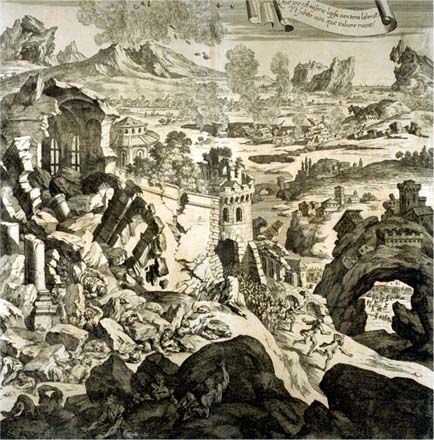
Depiction of the earthquake in an engraving from 1696
The earthquake changed the landscape of Italy in more ways than one. The reconstruction that followed was shaped by a generation of local architects commissioned to rebuilt palaces, villas, and churches throughout the region, many of whom had trained under the great Baroque architects in Rome. Baroque buildings added an new ingredient to what one of our guides described as the “lasagne” of Greek, Roman, Byzantine, Muslim and Norman styles typical throughout Sicily
The eight towns in the Val di Noto, in particular, were rebuilt in what became known as “Sicilian Baroque,” which added grinning masks, chubby putti, and decorated balconies to the flamboyant curves and flourishes of typical of Baroque architecture. The rebuilt towns are now a UNESCO world heritage site due to the time-capsule feel of towns built in a single style at a single time. The guides, the historical markers, and to a lesser degree the UNESCO website, focus on the towns’ homogeneity and the high architectural and artistic quality of the rebuilt towns.
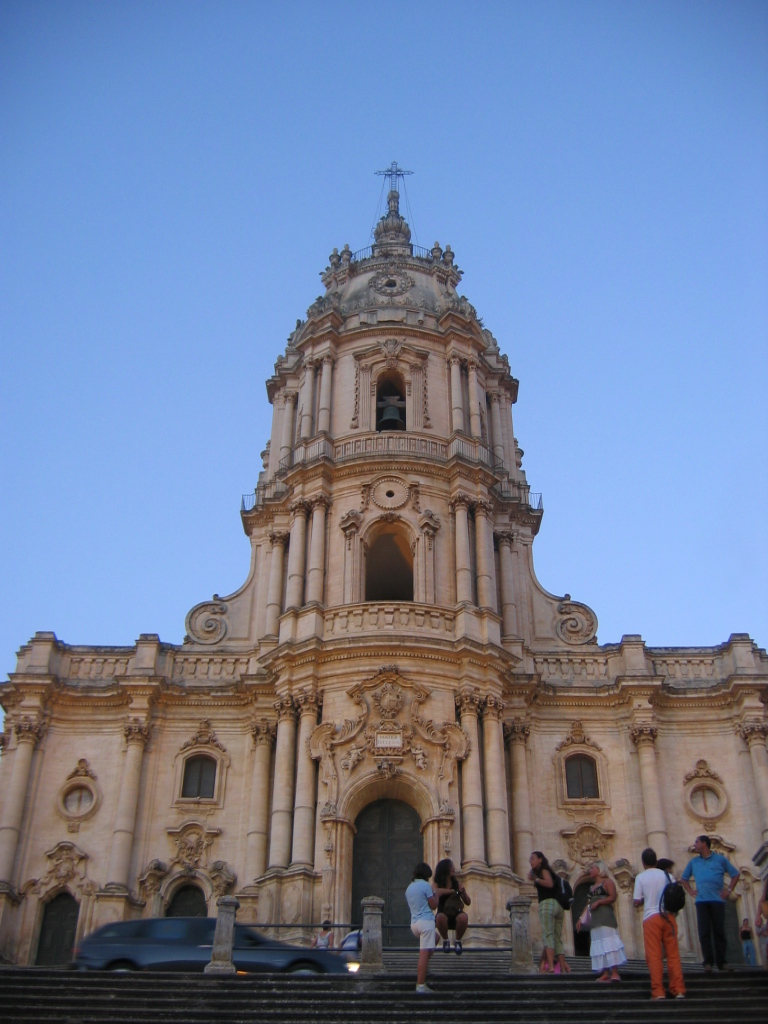
The cathedral of San Giorgio in Modica, built after the earthquake
*Then part of the Spanish Empire, for anyone trying to keep track of the timeline.
From the Archives: An Islamic Map for a Christian King
When we last left Sicily, the Roman Republic had taken Siracusa, which became the capital of Roman government in Sicily. The Romans held Sicily for 300 some years. The island was subsequently occupied by the Byzantine empire in 535 CE, Arabs from North Africa in 965 and the Normans in 1060. *
Under the Normans, Sicily enjoyed a brief period of Christian-Muslim synergy similar to that occurring in Spain at the same time. Here is one of my favorite stories from that period, which first ran in 2013.

Most maps made in twelfth century Europe were based on tradition and myth rather than scientific information. The only practical maps were mariners’ charts that showed coastlines, ports of call, shallows and places to take on provisions and water. Roger II, the Christian king of Sicily, wanted a map of the known world that was a factual as a mariner’s chart. In 1138, he hired well-known Muslim scholar al-Sharif al-Idrisi to collect and evaluate all available geographic knowledge and organize it into an accurate picture of the world.
For 15 years, al-Idrisi and a group of scholars studied and compared the work of previous geographers. They interviewed the crews of ships who docked at Sicily’s busy ports. They sent scientific expeditions, including draftsmen and cartographers, to collect information about relatively unknown places.
Finally, al-Idrisi was ready to make his map. He began by making a working copy on a drawing board, using compasses to accurately site individual places. The final copy was engraved on a great silver disk that was almost eighty inches in diameter and weighed over 300 pounds. Al-Idrisi explained that the disk was just a symbol for the shape of the world: “the earth is round like a sphere, and the waters adhere to it and are maintained on it through natural equilibrium which suffers no variation”
Al-Idrisi’s map was accompanied by a descriptive geography that contained all the information his college of geographers had collected. Its formal name was Nuzhat al-Mushtaq fi Ikhtiraq al-Afaq, or The Delight of One Who Wishes to Traverse the Regions of the World. It was more commonly known as Roger’s Book.
In 1160, the Sicilian barons revolted against Roger’s son, William. They looted the palace and burned the library, including Roger’s Book. Not surprisingly, the silver map disappeared. Al-Idrisi fled to North Africa with the Arabic text of Roger’s Book. His work survived in the Islamic world, but it was not available in Europe again until the Arabic text was printed in Rome in 1592.
* Six years before William the Conqueror, aka William the Bastard, invaded and conquered England.