




In which I take a side trip in time and space to consider the Mayans, the Aztecs and Chocolate
During our visit to Antica Dolceria Bonajuta, the artisanal chocolate producer in Modica, our guide emphasized the fact that most modern chocolatiers, who use heat based methods such as conching and tempering to create smooth chocolate with a shiny appearance. By contrast, the Bonajuta chocolate makers still used a traditional “cold-processing” method similar to that used in Mesoamerica. in which cacao beans were roasted on a metate ( a rock grinding stone) that was heated over charcoal and then pounded into a paste.
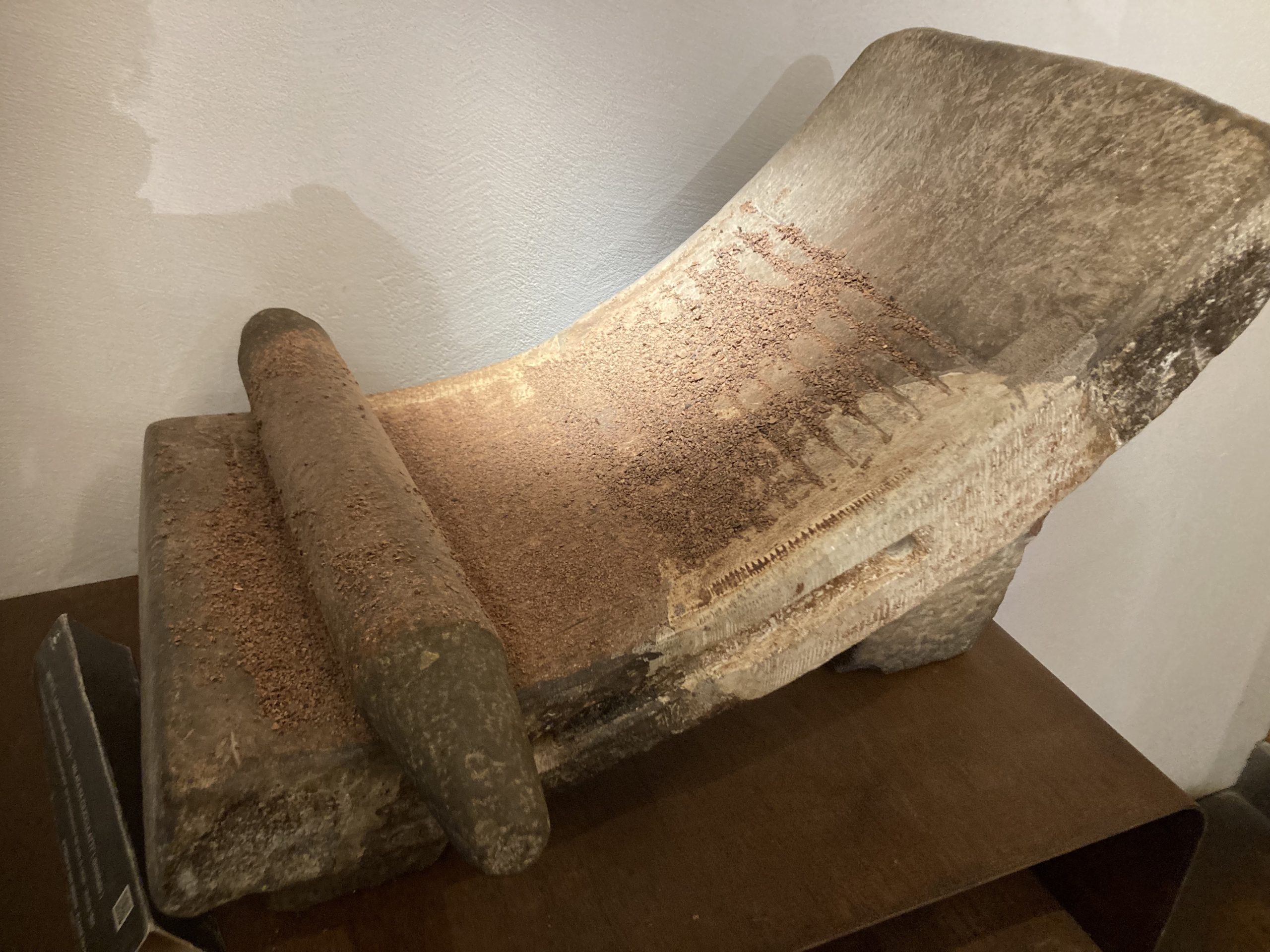
Cacao beans, and the cold-processing method arrived in Modica during the period of Spanish rule, which began soon after Spaniards invaded the Aztec empire and discovered chocolate, not only the cacao bean itself, but the highly flavored beverage served in the court of the Aztec emperors.
The cacao tree is native to Central America. It only grows in tropical areas with a temperature above 60 degrees Fahrenheit and year round moisture. In its raw state the cacao bean grows in pods on the trees known botanically as “theobroma cacao,”from the Greek word for “food of the gods” and the Mayan word for the bean itself.
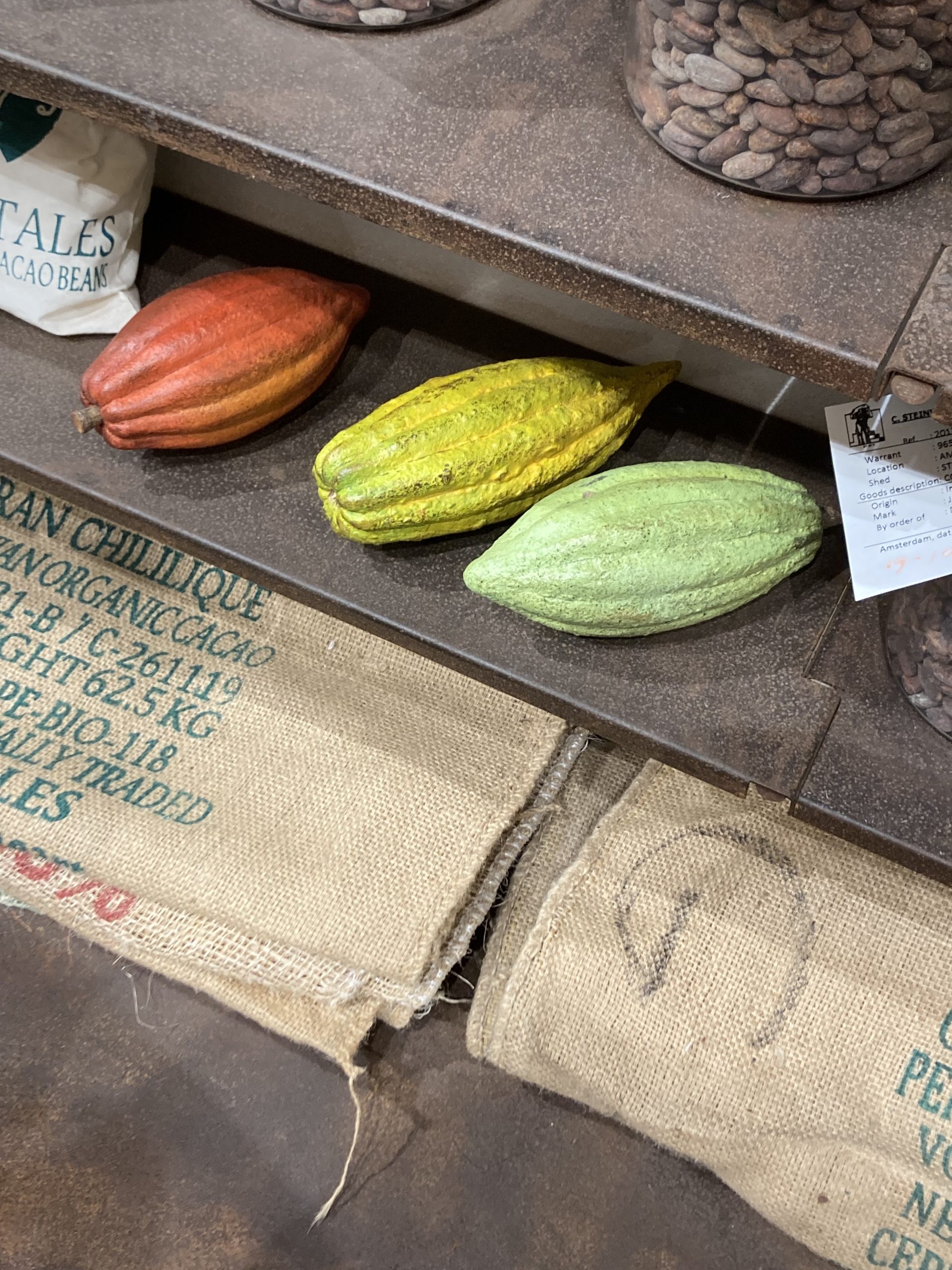
The Mayans* domesticated the cacao tree and grew it both in home gardens and in large commercial plantations. They venerated the beans as a gift of the gods, using them in religious ceremonies and for healing. Pots full of chocolate drink were included in the burial goods of important people. They also traded the beans throughout Central and South America as a valuable commodity. In fact, they had a god named Ykchaua who was the patron of cacao merchants. They roasted the beans and used them to make spicy, bittersweet drinks, gruels, and porridges that they flavored in a variety of ways.
By the time of the Aztec empire,** the cacao plant was so highly valued that the beans were used as currency. One hundred cacao beans was one day’s wages for a porter. The same amount could buy a slave or a hare. Three beans would buy an egg or an avocado. One bean would buy a tomato.. The beans were valuable enough that people would make counterfeit beans or mix them with less valuable material.
One reason the beans were so valuable is that the Aztecs could not grow the tropical cacao tree in the temperate highlands near their capital. Cacao beans became the object of both trade and war. When the Aztecs conquered tropical lowland areas of the Gulf Coast from Vera Cruz to the Yucatan, tribute was often paid in cacao beans. In the reign of Ahuitzotl (1486-1502), the Aztecs conquered the province of Xoconochco specifically because it was famous for the production of high quality cacao. One of the most important areas of cacao production, the Chontalpa of Tabasco, never became part of the Aztec empire. The only way the Aztecs could get cacao beans grown in the huge Chontalpan cacao plantations was by traveling to the Chontalpan trading city of Xicallanco, which drew long distance traders from all over Mesoamerica.
The importance of cacao and other luxury products in Aztec society can be measured by the status of the long distance traders, called pochtecas. Aztec society was very stratified and the pochtecas enjoyed a high rank. There were twelve pochteca guilds in the empire, each with its own headquarters and warehouses. Membership was hereditary. The pochtecas were described and treated as warriors because their work was so dangerous. They often traveled through hostile territory to reach the markets where they purchased luxury goods for the royal house and the nobility. In addition to cacao, they traded for beautiful feathers, jaguar skins and amber.
In addition to rules about who could be a long distance trader, Aztec society had heavy restrictions on who could use or consume the luxury products that the pochteca brought back. One of the luxury goods governed by these sumptuary laws was “xocolatl” (pronounced “shoco-latle”) or “bitter water”, a cold beverage made from cacao beans that had been ground into a paste and flavored with chilies, herbs, or honey. (The Mayans, by contrast, preferred their cacao hot.) Only the royal family, nobility, warriors and long distance traders were allowed to drink it. A Spanish chronicler named Bernal Diaz del Castillo recorded that more than 2000 containers of chocolate with foam were drunk every day by Montezuma’s guard alone. The other high ranking people in Aztec society, the priests, are not included in the lists of chocolate drinkers, possibly because the priesthood were expected to live in strict austerity.
The only commoners who ever had a chance to taste chocolate were soldiers on the march. Ground cacao made into wafers was issued to every soldier on campaign as part of the military rations, along with toasted maize, maize flour, toasted tortillas, ground beans and bunches of dried chilies.
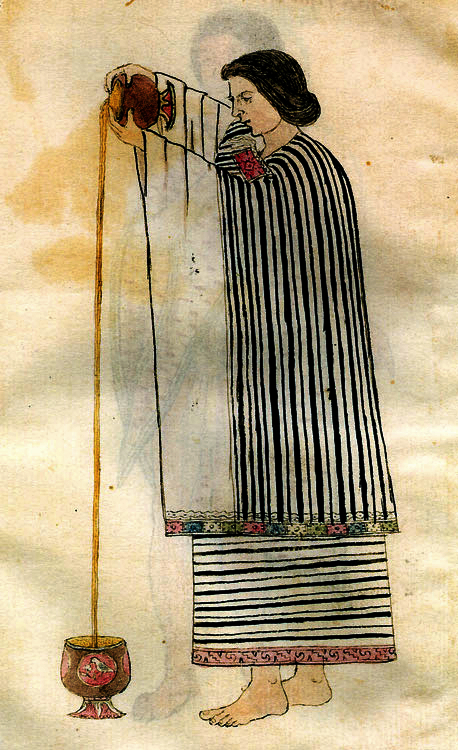
The sixteenth century Franciscan missionary, Fray Bernardino de Sahagún, listed nine different chocolate drinks served to the emperor in his twelve volume book on the Aztecs, A General History of New Spain. They included “green cacao-pods, honeyed chocolate, flowered chocolate, flavored with green vanilla, bright red chocolate, huitztecolli-flower chocolate, flower-colored chocolate, black chocolate, white chocolate”. In addition to vanilla, honey and cinnamon, the drinks were flavored with spices such as hot chilies, anise, achiote, and allspice. It was poured from container to container to produce stiff foam that was an important element of the drink. It was served at the end of a meal, like a dessert.
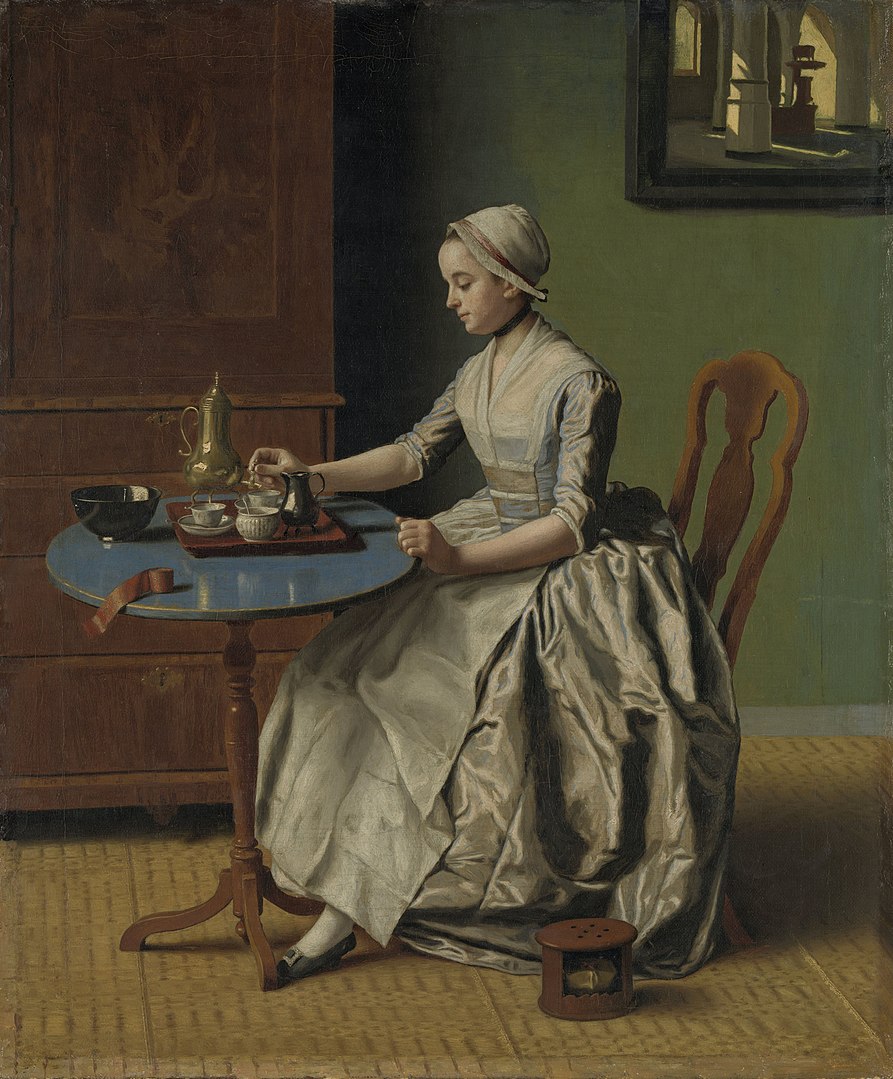
The Spaniards brought back cacao beans alongside other treasures, but the bitter beverage was slow to catch on in Europe until the Spanish added sugar—which arrived in Europe from Southeast Asia at much the same time.*** Once it was sweet, chocolate became a popular luxury item in Europe.
*Just to give you a sense of the timeline, because even chocolate needs context: The classic Mayan civilization flourished from around 250 to 900 CE. In the ninth century, the Mayan culture suffered from a major political collapse, in which cities were abandoned. A reduced version of the culture, marked by independent provinces that shared a common culture, survived to the eve of the Spanish conquest. The final independent Mayan city fell to the Spanish in 1697.
**The Mexica, as the Aztecs called themselves, are believed to have been a nomadic people who migrated into central Mexico in the thirteenth century and founded the city-state of Tenochtitlan in 1325 CE. In 1428, the Mexica allied with two other city-states, forming the Aztec Triple Alliance and the beginnings of what we know as the Aztec Empire. The Spanish, led by Hernando Cortez, arrived in 1519. Two years later, after a bitter siege, the Aztecs surrendered and Cortez began to build a new city on the ruins of Tenochtitlan.
***The relationship between imperialism and food is long and complicated.
Cheese, Chocolate, and Siracusa
Our second stop in Sicily was the city of Siracusa, which is a history nerd’s delight, or more accurately would have been a history nerd’s delight if we had been on a different kind of tour. (Two areas of the city are UNESCO World Heritage sites.) Instead of spending our time at the city’s archeological park and museum, we visited a small producer of farmstead cheeses near Calascibetta one day and an artisanal chocolate producer that has been in business in Modica since 1880 the following day.*
-
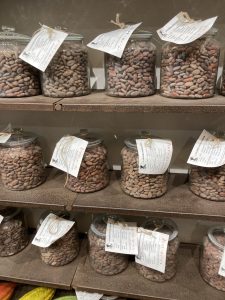
- Caco beans at Antica Dolceria Bonajuto
-
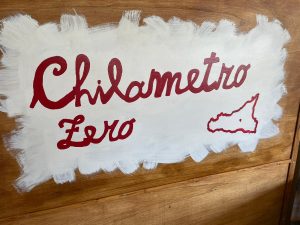
- The cheese producer we visited served lunch in a small restaurant devoted to “kilometer zero”–using products from within a one-kilometer radius.
Nonetheless we managed to get peek at the city’s rich history as we went past. As in Sicily as a whole, a series of foreign conquerors took the city over the centuries and left their mark without totally obliterating the cultures that came before. It is clear, even from the passing glance we managed, that Siracusa’s moment of historical glory was during the classical period, when it was one of the most important cities of the Hellenic world. Here are the bits that stuck with me:
- Siracusa was founded in the eighth century BCE by settlers from the Greek city-state of Corinth and became a city-state in its own right. By the fifth century BCE, it rivaled Athens in size.
- It was the birthplace of the mathematician and engineer Archimedes (c 287-212 BCE), who derived an approximation of pi, was one of the first to apply mathematics to physical phenomenon, articulated the law of buoyancy (known as Archimedes principle), and invented several machines, including an innovative screw pump.** He also designed a number of weapons that were used to defend the city when it was besieged by Romans. A Roman soldier killed Archimedes during the siege despite orders by the Roman proconsul Marcus Claudius Marcellus that he not be harmed, because obviously such an inventive scientist would be an asset to the Roman Republic.
- The Romans successfully took the city in 212 BCE. Siracusa became the capital of the Roman government in Sicily and remained the most important city in Sicily until Palermo became the capital of the Norman kingdom of Sicily in 1130.
- As was so often the case, conquerors used their predecessors monuments as quarries for building materials. The most notable example of this in Siracusa is the cathedral, which was built in the seventh century, when Siracusa was under Byzantine rule. Stone pillars from a fifth century BCE temple to Athena are integrated into the walls and shape the floor plan. Its facade was rebuilt in the baroque style after an earthquake in 1693 damaged the city.***
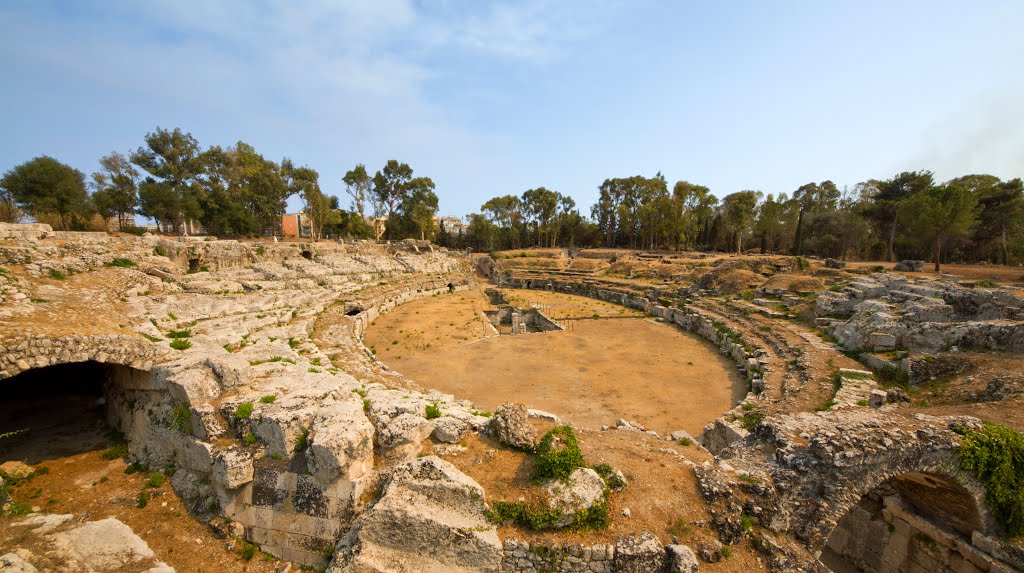
Roman amphitheater in Siracusa, part of the UNESCO World Heritage area
*No complaints here. We learned a lot about how both products were made and enjoyed meals centered onthem. Saffron cheese! Ricotta made that morning! An amazing cold chocolate drink! I must admit, after a four course lunch that included chocolate in every course I was not interested in eating chocolate again for several days.
**Spoiler alert, the Archimedean screw will appear in a blog post coming to this site.
***You’ll be hearing more about that earthquake as well.
The Unexpected Legacy of the Carob Seed
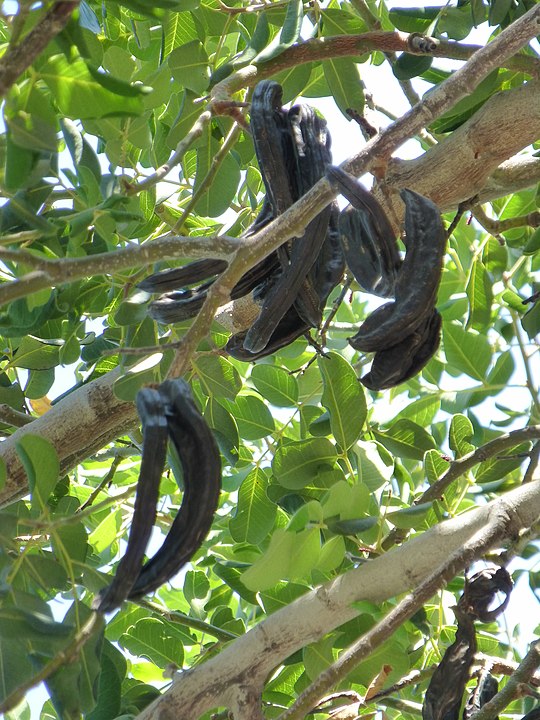
As those of you who also read my newsletter already know, My Own True Love and I recently got back from a ten-day tour in Sicily. The tour focused on food, not on history, but you can’t keep history nerds from noticing history, especially in a cultural melting pot like Sicily, which at various times was controlled by the Phoenicians, the Greeks, the Romans, Goths and Vandals, the Byzantines, Muslims from North Africa, Normans, and Spain.
Our first day in Sicily included a walking tour of Palermo, on which we were introduced to the carob tree, and more importantly from my perspective, the carob pod.
Most of us know carob as an unsatisfactory substitute for chocolate—made by drying, roasting and grinding the pulp found inside the pods— that was foisted on us in the name of health. In addition, the seeds are the source of a widely used thickening agent that is used in commercially prepared foods, including ice cream.
That is not what caught my attention, however. In the days before standardized weights and measures, carob seeds were used by traders around the Mediterranean as a standard for weighing small valuable items, particularly gemstones. The story is that the seeds are relatively consistent in size: 0.2 grams or 1/150th of an ounce.* Certainly they were readily available throughout the Mediterranean, where the tree is commonly found. The average weight of the carob seed, once known as carats, from the tree known as Ceratonia Selequia,** became the standard measure for gemstones: the carat.**
Who knew?
*Scientific studies demonstrate that this isn’t necessarily true. https://www.ncbi.nlm.nih.gov/pmc/articles/PMC1686184/
**Pronounce Ceratonia with a hard c, as is proper in Latin, and the relationship will be clear.