




Alice Barber Stephens, Illustrator (Yes, Another One)
You may have noticed that I’ve been sharing the stories of women artists and illustrators over the last few months. I didn’t set out to look for them, but one woman led to another. Like women warriors, women journalists and women inventors, even women artists who were well known and successful in their time are left out of the historical account.[1] Women illustrators have suffered the additional indignity of being left out of texts devoted to recovering forgotten women artists because of the perceived distinction between fine arts and illustration.
I almost didn’t write a post about Alice Barber Stephens (1858-1932) because in many ways her story is similar to that of other women artists working at the end of the nineteenth and beginning of the twentieth centuries.[2] Then a couple of details about her life and her work caught my imagination.
Here we go!
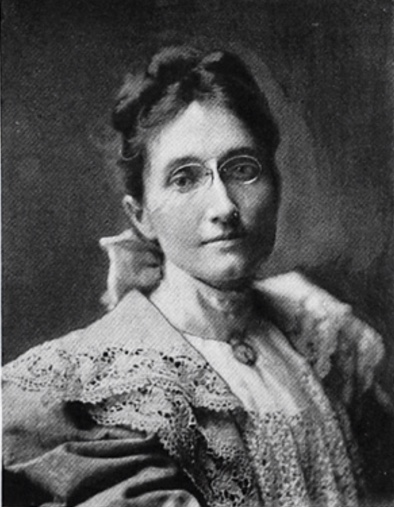
Stephens began attending the Philadelphia School of Design for Women[3] one day a week when she was seven (!) and became a full time student when she was fifteen, studying wood engraving as well as taking classes in painting and drawing. The school was the first of a number of women’s design schools that were established in industrial cities in the northeastern United States in the 1850s and the 1860s with the purpose of training women to support themselves.[4] The school succeeded in the case of Stephens. She began working as a professional engraver while still a student, which allowed her to help pay for her tuition.
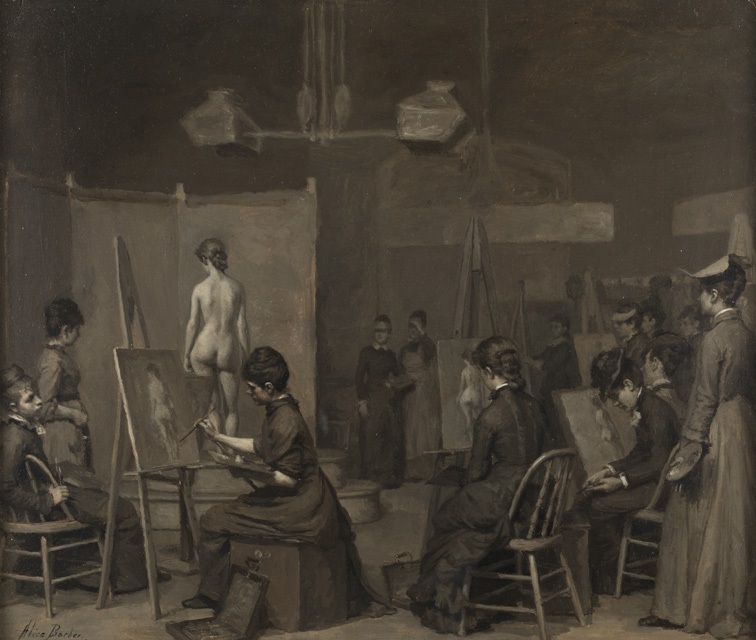
Eager to learn more, she enrolled in the Pennsylvania Academy of the Fine Arts (PAFA)[5] in 1876, the first year that the school admitted women. Opening the doors to women didn’t mean they got the same education as their male peers. Women were not allowed to take life-drawing classes using nude models, which was seen as the foundation of serious art education. Stephens and her fellow women students petitioned for the right to attend life-drawing classes and won, sort of. Instead of opening the men’s life classes to women, the academy offered separate women’s life-drawing classes. As is so often the case, separate was not equal. The women’s life classes offered female nudes and decorously draped male models. Life classes for male students used both male and female nudes. No drapes required.
Stephens’s first published illustration, Female Life Class (1879), appeared in a Scribner’s magazine article about their victory.
Like many other American artists of the time, Stephens spent some time in Paris studying at one of the academies, but she made her living as a commercial artist. She worked for several years as a full-time engraver for Scribners but by 1885 she had pivoted to supporting herself with illustrations, first pen and ink drawings and later paintings in watercolor and oils. Her work appeared in popular magazines such as Century, Harpers, Scribners, and The Ladies Home Journal, often illustrating the domestic genre stories that were typical in magazines in the period. She also illustrated books, many by well known authors such as Louisa May Alcott,[6] Sir Arthur Conan Doyle, Bret Harte, Nathaniel Hawthorne and Sarah Orne Jewett.[7] In 1895, The Philadelphia Inquirer claimed “there is scarcely any American illustrator better known today.”
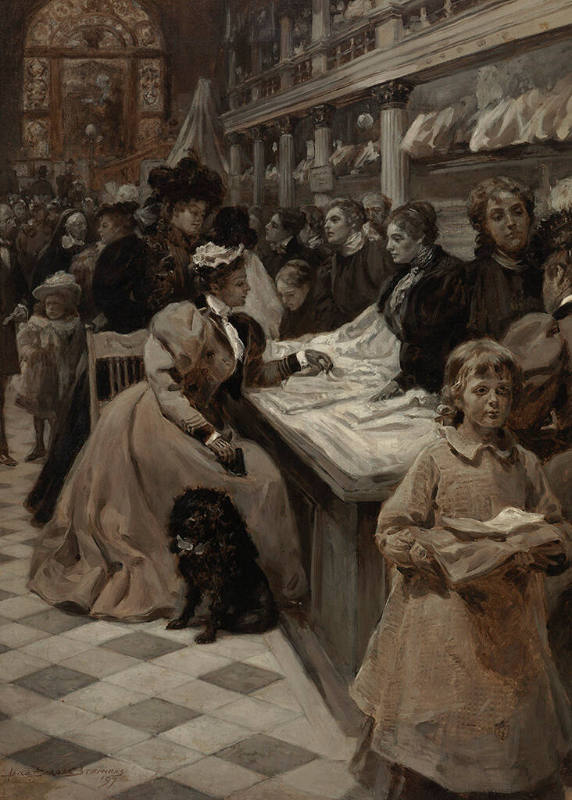
One illustration of hers particularly caught my attention. Titled “The Woman in Business,” it was one of six full-page illustrations by Stephens, collectively titled “The American Woman” that ran in The Ladies Home Journal throughout 1897. The paintings depicted (white, middle-class) women in a variety of settings. “The Woman in Business” was the fifth in the series. Set at a sales counter in Wannamaker’s department store, it is unusual in that it portrays a well-to-do woman of the leisure class in contrast to the working class women squeezed into a narrow space on the other side of the counter
Stephens also taught at the Philadelphia School of Design for Women at the invitation of the school’s principal, Emily Sartain. Together they expanded the curriculum to include more than the practical instruction on which the school was founded. Among other things, Stephens taught a popular life-drawing class—the first offered at the school of design. Along with Sartain and Cecilia Beaux, she founded the Plastic Club, a response to the exclusively male Philadelphia Sketch Club which, like other arts organizations of the time, did not allow women to join. The club provided women with a space to exhibit their work and a network of friends and allies. She organized and participated in all-women’s art exhibitions—important at a time when women were often left out of larger exhibitions.
In 1890, she married a classmate, Charles Hallowell Stephens. Unlike many middle class women of the period, she continued working not only after her marriage, but after the birth of their son, accepting commissions until she was no longer able to paint.
[1] My copy of H.W. Jansen’s History of Art, the Big Fat Art History Book that dominated introductory art history classes for the last fifty years, did not include a single woman artist. Not even Mary Cassatt or Georgia O’Keefe. According to Bridget Quinn, later editions include a whopping sixteen women.
[2] Though perhaps that similarity is part of the bigger story that these women aren’t individual exceptions but are part of a solid cohort of overlooked women in a specific field. According to art historian Kelsey Frady Malone, women made up at least one-third of the artists whose work was regularly published in the illustrated press during the golden age of illustration.
[3] An institution that we’ve seen before. Grace Drayton was a student there.
[4] It also had the related purpose of creating a cadre of home-grown designers for the American textile industry, which at this time depended heavily on imported French designs. As I have mentioned before, I am absolutely fascinated by these schools.
[5] Another school which has appeared in these posts before, and may well appear again. Cecelia Beaux and Louis Glackens also studied there.
[6] As soon as I read this, I hurried downstairs to see if Stephens had illustrated any of the editions of Alcott that I own. Nope.
[7] If you don’t travel in the world of forgotten/recovered women writers, you may not be familiar with Sarah Orne Jewett (1849-1909) She was a big deal in the nineteenth century. Today she is considered a foundational figure in American literary regionalism.
Lord Macartney’s Embassy to China
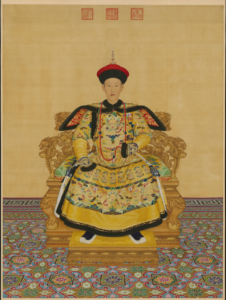
In my last blog post, I mentioned Lord Macartney’s embassy to China in 1793. It was an aside to a post that was itself not much more than an aside, but, as so often happens around here, one story led me to another.
A beautiful copy of the journal Macartney kept about his time in China has been sitting unread on my bookshelves for a long, long time. (Roughly twenty years. Yikes!) I pulled it off the shelf to see if I could find any details about John Crewe’s role in the expedition.[1] You will not be surprised to hear that I was immediately sucked in. The journal now has a place on the ever-growing stack of partially read books next to my reading chair.[2] It will take me a while to get through it. But that doesn’t mean that you should have to wait to hear the story of the embassy and its consequences.
In the eighteenth century, China was a hot market from the European perspective, the source of luxury items such as silk, tea, and porcelain.[3] The Chinese were not interested in European merchandise or European ideas. In 1760, the Chinese emperor declared that all foreign trade would be limited to the port of Canton (now Guangzhou). Even within Canton, European merchants were only allowed to trade in Canton for five months of the year, and were limited in where they could live, what they could trade and who they could trade with.
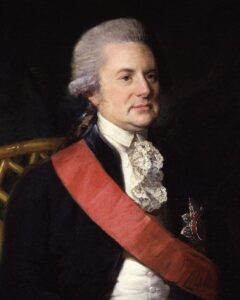
In 1793, the British government sent Lord George McCartney (1737-1820) on diplomatic mission to China with the goal of establishing a British ambassador at the Court of Beijing, improved trading conditions in Canton, and access to additional trading ports.. Macartney seemed like the perfect man for the job. He had previous diplomatic experience, having served as a special envoy to the Empress Catherine of Russia, and as the governor of British possessions first in Grenada and then in Madras. When he was home in England, he was an active member of The Club, the group of intellectual and scientific men who gathered around Samuel Johnson[4]—making him well suited to the intellectual complexities of the assignment. James Boswell summed up The Club’s opinion of Macartney’s assignment when he described it as a “magnificent, dangerous embassy.”
The embassy was doomed to failure. Britain and China came to the table with very different, and mutually exclusive, ideas about what the meeting entailed. Macartney believed he was there to negotiate with the emperor as the representative of an equal power. He carried British-made products intended to impress the Chinese: clocks, watches, carriages and pottery.[5] The Qianlong emperor (r. 1736-1796) and his court saw Macartney’s goods as tribute presents from a lesser power—and not very impressive ones at that. The difference in their viewpoints were summed up in the courtly ritual known as the kowtow, or prostration. Macartney was expected to prostrate himself before the emperor, and touch his head to the ground multiple times. Instead he went down on one knee and bowed his head, as he would bowed to the British king.
Not surprisingly, the Chinese refused all of Britain’s requests. The Chinese Emperor sent a condescending note to King George III explaining his refusal: “I set no value on objects strange or ingenious, and I have no use for your country’s manufacture.”
The Macartney embassy was the first of several diplomatic failures that led to the Opium Wars
[1] No luck, other than confirming that Lt. John Crewe was indeed a member of the small military escort that accompanied Macartney’s ambassadorial “suite”: a group that included a painter, a watchmaker, a gardener/botanist, a natural philosopher (scientist) a mechanic/mathematical instrument maker (also a scientist of sorts), and a draftsman, one William Alexander, who recorded their experiences in over 1000 watercolor sketches. These were published in two books in 1805 , The Costume of China and Dress and Manners of the Chinese. A number of his sketches illustrate my copy of the journal, and they are lovely indeed.
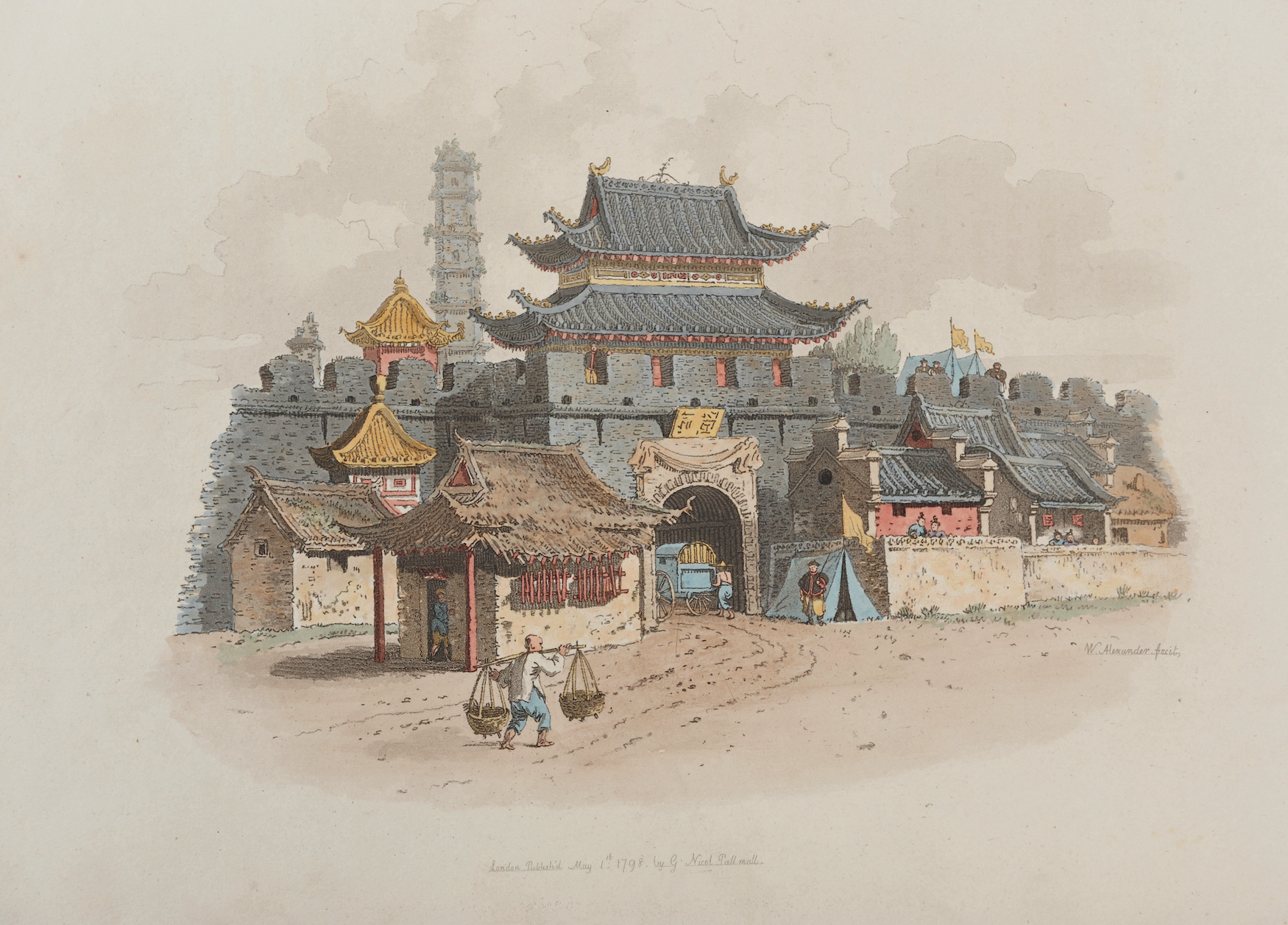
But I digress
[2] Some of which have been in that pile for a while now. I am easily distracted.
[3] They also imported zinc, which was not technically a luxury product. It was, however, a was a critical element in making brass, and hence necessary for a whole range of scientific instruments and consumer goods that were being developed in Europe. None of which interested the Chinese.
[4] A group I have long wanted to know more about. Also the Lunar Society of Birmingham, which was more heavily scientific and industry-oriented than The Club
[5] Bringing pottery, even Wedgwood’s finest, to the home of fine porcelain is an example of how little the British understood about the people they were negotiating with.
Master Crewe as Henry VIII
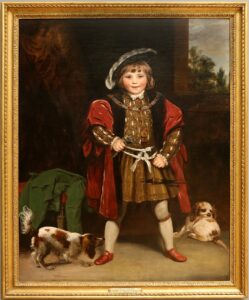
A recent rabbit hole in the peculiar world of “Cute Studies” led me to this unlikely and delightful eighteenth century painting by Joshua Reynolds (1723-1792),[1] which was inspired by Hans Holbein’s sixteenth century portrait of Henry VIII.
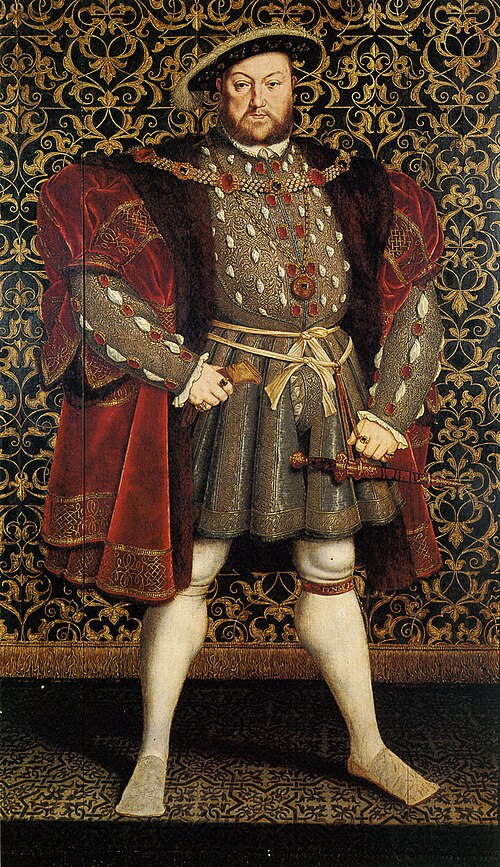
I was temped to share the two images with no commentary, but one rabbit hole led to another.
Reynolds painted Master John Crewe, three-year-old son of a British politician named John, 1st Baron Crewe , in the costume his parents had ordered made for him to wear to a children’s costume party.[2] Copies of Holbein’s portrait were widely available at the time. The tailor faithfully reproduced the details in Holbein’s painting, right down to the Order of the Garter on the king’s leg. Master Crewe faithfully reproduced the king’s stance.
The work was displayed in the Royal Academy’s annual exhibition of 1776[3], where it was an enormous success. Writer and connoisseur Horace Walpole, who was eighteenth century England’s equivalent of an influencer, praised the way Reynolds had taken “the swaggering and colossal haughtiness” of Holbein’s original and created the “boyish jollity of Master Crewe.”
Master Crewe grew up to become a soldier and took part in Lord Macartney’s embassy to China[4] in 1793. He succeeded his father as Baron Crew, though he was estranged from his family for reasons that my rabbit-holing did not reveal.
[1] For those of you who are unfamiliar with art history, Joshua Reynolds was one of the most important portrait painters of the eighteenth century.
[2] And I thought my neighbors created some elaborate Halloween costumes for their children!
[3] Not quite as big a deal as the annual Paris Salon, but still a big deal in the world of British art.
[4] A story for another time