




Talking About Women’s History Month: Three Questions and an Answer with Cathy Curtis
I’m pleased to start off this year’s Women’s History Month series with Three Questions and an Answer with biographer Cathy Curtis.
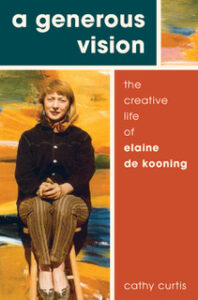
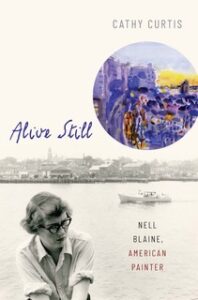
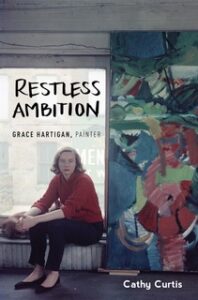
Cathy is a former Los Angeles Times staff writer with degrees from Smith College and the University of California, Berkeley. She is the author of three recent biographies of twentieth-century artists—Restless Ambition: Grace Hartigan, Painter; A Generous Vision: The Creative Life of Elaine de Kooning; and Alive Still: Nell Blaine, American Painter—all published by Oxford University Press. Curtis also has written A Splendid Intelligence: The Life of Elizabeth Hardwick (W. W. Norton), and Edna O’Brien: The Passionate Life of a Fearless Irish Writer (forthcoming).
Take it away Cathy!
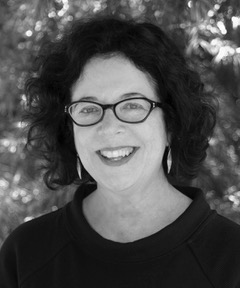
How do you choose subjects for your biographies?
I look for an artist or writer whose work I admire, who led an eventful life, and who has an archive that is open for researchers. By now, having written five biographies (the fifth is still in manuscript), I’ve learned that the most important components of an archive for my purposes are the subject’s journals and letters (written and received), followed by newspaper and magazine interviews. Of course, I also look for letters from my subject in the archives of the people to whom she wrote.
One of the questions I’m fascinated with right now is how biographers name their subjects, particularly when writing about a woman. Where do you stand on the first name/last name question in your books?
I am not an academic, which perhaps explains why I was surprised to discover the existence of the first name vs. last name issue. I use my subject’s first name freely because I have “lived” with her every day while researching and writing my books. Employing the last name strikes me as the sign of an impersonal, arm’s-length relationship with a subject, better suited to a book with a theoretical or critical approach than to an intimate biography. The notion that first-name references are somehow demeaning to a subject (whether male or female) strikes me as ridiculous. My respect for my subjects is clear from the context of the book.
You’ve written about a number of interesting women. Do you have a favorite?
My favorite subject tends to be the last one I’ve written about, in this case, the great Irish author Edna O’Brien. But each of my subjects have endeared themselves to me in a different way, often by means of overcoming a significant obstacle.
Grace Hartigan, who never attended art school, struggled to master the painting medium, ultimately developing a memorable abstract style. Elaine de Kooning found her niche in a painting genre (portraiture) that her famous husband, Willem de Kooning, had largely abandoned in favor of abstraction. The painter Nell Blaine prevailed against enormous odds after becoming a paraplegic in her late thirties, by simplifying her canvases and loosening her technique. The author Elizabeth Hardwick kept writing her deeply considered essays despite the ongoing stress of coping with the mental illness of her celebrated husband, the poet Robert Lowell.
By the way, I was intrigued to discover that none of these women were outspoken feminists: they all viewed themselves essentially as independent agents. Women artists who managed to carve out careers in the 1950s tended to believe that superior work would triumph, so there was no need to give women a special break. For Elizabeth Hardwick, great art always trumped ideology; she disparaged the novels of feminist writers that were poorly written. She also believed that women’s great strength is fortitude, a quality that allows them to carry on in the face of disappointment and hardship.

A question from Cathy: What overlooked woman from the past would YOU like to read about in a biography, and why?
A once famous and now largely forgotten artist/writer named Rose O’Neill (1874-1944). She was the creator of the Kewpie doll, based on her cartoons with the same character, and the first person to license characters of her own creation on an international scale. (Think of her as a predecessor to Walt Disney in some ways.) She was famous, productive, and connected to lots of famous artists. She was active in the suffrage movement–and made pro-suffrage Kewpie cartoons. She became rich thanks to her work, and died in poverty. I was exploring the possibility of a book when my current subject, Sigrid Schultz, grabbed me by the lapels and said “My turn!”
* * *
Want to know more about Cathy Curtis and her work? Check out her website: www.cathycurtis.net
***
Come back tomorrow for three questions and an answer with attorney and author Nancy Kopp, talking about her work on the first woman attorney in Wisconsin. Good stuff!
From the Archives: Book thieves
Every time I write a book I reach the point where I am so deep in the work that I have to stop writing blog posts and newsletters. I always hope to avoid it. That somehow I’ll be smarter, or faster, or more organized, or just more. This time I’ve managed to avoid hitting the wall for several months by cutting back to one post a month. But the time has come. For last two months, I’ve shared blog posts from the past.–including this one from 2017. I hope you re-discovered an old favorite, or read a post that you missed when it first came out.
Tomorrow is March 1st–time to celebrate Women’s History Month here on the Margins with our annual series of mini-interviews, and a few blog posts from me. I have some interesting people lined up to talk about their work in women’s history, starting with biographer Cathy Curtis. Good stuff, people.

Ceremonial book burnings and the theft of precious art works are well-known elements of Nazi Germany’s rampage through Europe. In The Book Thieves: The Nazi Looting of Europe’s Libraries and the Race to Return a Literary Inheritance, Swedish journalist Anders Rydell tells the less familiar story of how two Nazi agencies—the intelligence wing of the Schutzstaffel (SS) under Heinrich Himmler and the Reichsleiter Rosenberg Taskforce headed by Alfred Rosenberg –competed to plunder Europe’s libraries until the regime’s fall in 1945.
The Nazis’ motivation for the theft and dismemberment of libraries was different from that which inspired the looting of precious artworks from museums and private homes. The stolen books were intended to supply Nazi “research” libraries with the raw material for an intellectual war between Nazism and its enemies. Jewish libraries, public and private, were the primary targets, but the agencies also attacked libraries dedicated to Freemasonry, socialism and the occult. Plunder was followed by destruction. Collections were divided up between different research institutes and warehouses. Books that were not deemed valuable, whether for their rarity or for research, were often destroyed.
The Book Thieves is written in the form of a quest. Rydell travels across Europe, visiting the remains of plundered libraries and the institutions that still hold many of the stolen books. He talks to librarians who are engaged in the overwhelming task of identifying stolen books and their owners, those attempting to rebuild lost collections, and those who mourn the libraries that are lost without a trace. In the process, he tells the story of how the collections were built and the heroic attempts to protect them, creating a vivid and heartbreaking picture of lost communities and lost knowledge.
From the Archives: The Empress Maud (aka Matilda)
Every time I write a book I reach the point where I am so deep in the work that I have to stop writing blog posts and newsletters. I always hope to avoid it. That somehow I’ll be smarter, or faster, or more organized, or just more. This time I’ve managed to avoid hitting the wall for several months by cutting back to one post a month. But the time has come. For the next little while, I’m going to share blog posts from the past. (This one is from 2014.) I hope you re-discover an old favorite, or read a post that you missed when it first came out.
There will be new posts in March no matter what: we celebrate Women’s History Month hard here on the Margins. (I have some fascinating people lined up.)

I was first introduced to the Empress Maud and her battles to regain the throne of England by mystery writer Ellis Peters.(1) The war between Maud and her cousin Stephen is the immediate background against which her Brother Cadfael mysteries are set. (One step behind that stand the Crusades–a deft way to place her stories within their larger historical context and to give her main character a broader view of the world than many of the people around him.) Both Maud and Stephen are distant figures in the book and Peter’s main characters are Stephen supporters, so for years I never thought about why a medieval noblewoman would feel she had a right to the crown.
Since then I’ve spent a fair amount of time thinking about Maud within the context of women warriors.(2) It turns out she had a good reason to claim the crown. Here’s the short version.
Born in 1102 CE, Maud was the daughter of Henry I of England and Normandy.(3) When she was twelve, she was married to the Holy Roman Emperor, Henry V, who was almost twenty years her senior.(4) By all accounts, she was a hardworking empress and well-regarded by her people: her German subjects called her “the good Matilda”. She may have even been happy.
In 1125, the Emperor Henry died. If he had left an underaged son as heir to the throne, Maud would no doubt have served as the child’s regent.(5) Since they were childless, she was left as a dowager empress at the relatively young age of 23. The options for a surplus empress were limited, though Maud clung to the title, calling herself “Matilda the Empress, daughter of King Henry”.
In fact, the death of her brother some years previously meant that Maud was once again a factor in Henry I’s dynastic calculations. Henry could have named one of his twenty-some illegitimate sons as his successor or one of his numerous nephews, Instead he called his now-marriageable daughter home, named her as his successor, and forced his council of nobles and bishops to swear fealty to her as “lady of England and Normandy”. He then made the mistake of arranging another political marriage for her, this time to the teenaged son of the Count of Anjou, whose lands lay next to Normandy.
When Henry died in 1135, Maud was in Normandy. Her cousin Stephen of Blois had himself crowned in Westminster Abbey before a very pregnant Maud could hurry across the Channel and claim her throne, plunging England into nineteen years of civil war, known as the Anarchy. (6) The English nobility took sides, and sometimes changed sides depending on who seemed to be winning.
Finally the war ended with a compromise. Stephen kept the crown accepted Maud’s young son, the future Henry II, as his heir. (Which, if truth be told, was probably Henry’s intention in naming Maud his heir–women who inherited thrones or titles were often seen as the conduit between two generations of men.) The Empress Maud settled for the title Lady of the English.
As for me, I’m now squarely on team Maud.
(1) I realize not all hard-core history buffs agree, but I find that well done historical fiction is an excellent doorway to history itself.
(2) She was the first woman that I had to cut from the book because she didn’t fit even my broadest definition of woman warrior. Just about broke my heart.
(3) Just to help you keep track: He was the son of William the Conqueror. Hard to tell the players without a program.
(4) That sounds horrible enough to a modern reader. Consider this: she was betrothed to him at the age of eight and sent immediately to Germany. Once there, her future husband sent away her English attendants and did his best to turn her into a good German. Now picture yourself at eight.
(5) Mothers were often preferred over uncles or grandfathers as regents, under the (usually correct) assumption that they were less likely to get ambitious and/or greedy and seize the throne for themselves.
(6) He claimed that Henry had changed his mind and named Stephen his heir on his deathbed. It may even have been true–primogeniture was not yet a settled theory of inheritance and thrones tended to go to the man most able to seize them. (There are echoes here of the rival claims to the English throne that led to the Norman Conquest. Or is that just me?)