




Treasures in the Paper Pile,Pt 2:Joanna of Flanders, also known as Jeanne la Flamme
In recent weeks I’ve been working my way through some of the paper stashes that have accumulated in the corners of my office in anticipation of the arrival of a new desk which will give me room for two computer screens. In the course of sorting, I’ve run across a couple of women warriors I had forgotten about.
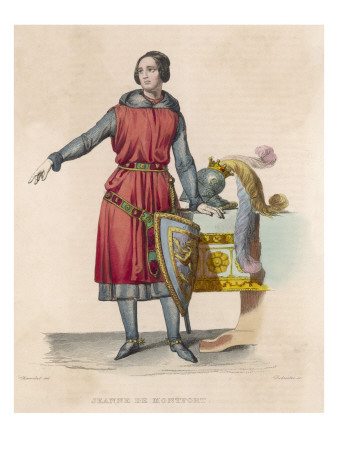
Previously I introduced you to Jeanne the Hatchet. Next up, Joanna of Flanders, who fought for first her husband’s and later her son’s claims in the War of the Breton Succession. The war was a sideshow in the Hundred Years War between the French Valois dynasty and the English Lancastrian dynasty over the control of France, which had begun in 1337.* In 1341, England and France were in a period of fragile truce, and the War of Breton Succession became a proxy for the larger conflict.
The conflict began in 1341, when the Duke of Brittany died without a direct heir. There were two rival claimants for the lands and title: his half-brother John of Monfort (aka the husband of Joanna of Flanders), whose claims were supported by the English, and Charles of Blois (aka the husband of Joan of Penthièvre, niece of the late duke), whose claims were supported by the French king, Philip VI (aka Charles of Blois’s nephew). **
After obtaining a safe conduct from Philip, John of Monfort traveled to Paris to make his case. (You can see that this won’t end well, right?) Philip, who was not an impartial observer, did not honor the safe conduct. He imprisoned John, and declared Charles of Blois the Duke of Brittany.
Joanna continued to battle in his absence. In the process, she earned the nickname Jeanne la Flamme, or fiery Joan. Some of my sources claim it was because of her determination. Others claim that she rode out of the besieged town of Hennebont with a troop of her men and set the enemy camp on fire. When it became clear that she was losing ground against de Blois’s troops, she sailed to England, where she succeeded in gaining help from Edward III.
In 1344, John Montfort escaped or was released from prison, depending on who you read, and returned to the fight. After his death in 1345, Jeanne continued to fight for her son’s claim to the duchy. (There is reason to believe that Jeanne of Penthièvre also led troops in the war. In fact, it is sometimes called the War of the Two Jeannes.) The war finally ended in 1364, when Charles de Blois was killed in the battle of Auray and Jeanne of Penthièvre was forced to sign away the title of Duchess of Brittany which she had held for almost twenty years and content herself with being the countess of Penthièvre. The Montforts remained in control of the duchy of Brittany until 1547, when Brittany was unified with France.
Jeanne of Penthièvre actually enjoyed a happier ending to the story than her rival. By some accounts, Joanna of Flanders was declared to be mentally ill and confined to a castle in England by order of King Edward. A favorite way over the centuries to dispose of a troublesome woman.
*A war that ended with the help of another woman warrior, Joan of Arc. You might have heard of her.
**At first glance it would seem to a modern history buff that John of Monfort had the stronger claim, but succession in the medieval period was not a clear-cut a matter of primogenitor. The dead Duke had disliked John of Monfort and the other children of his father’s second marriage and named his niece, Joan of Penthièvre, as his successor. Then—because why make things simple—the Duke reconciled with John the year before he died and made a will naming John of Montfort his heir. This is the kind of thing that makes for great mystery novels and difficult transfers of power.
From Trench Warfare to Trench Coat? *duh*
I was happily taking notes about the transformation of the Chicago Tribune’s Army Edition into that paper’s Paris Edition in the years after World War I —a subject I’ve spent quite a bit of time on during the last couple of years. I wasn’t expecting to learn much that was new, but I have kept the library book as long as the generous policies of the Chicago Public Library will allow and I wanted to capture any information I might need going forward.*
Then I read these words: “money-making ads for woolen underwear, trench coats, and portable bathtubs.” I had clearly read them before because I had marked the section with a sticky note. And yet, this time it hit me. Trench coats. Trench warfare. And once again, I was off down the research rabbit hole.
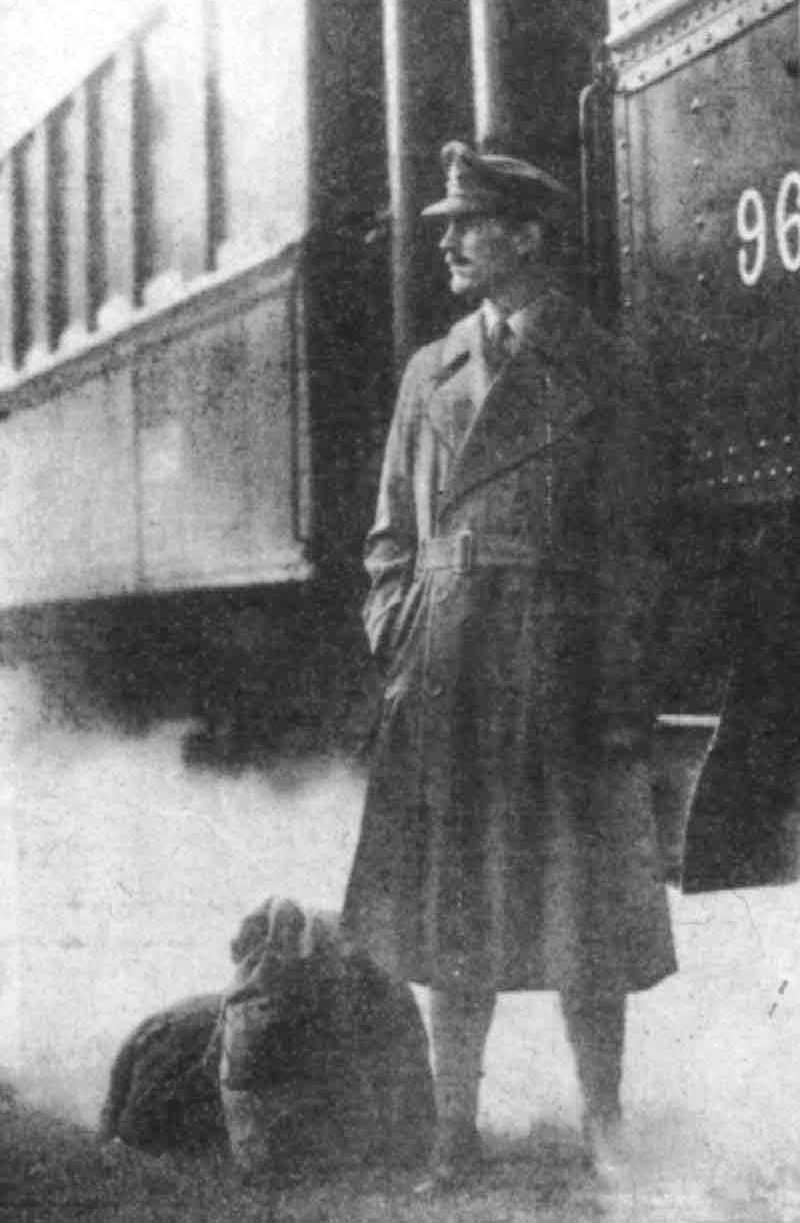
According to the Oxford English Dictionary, the term “trench coat” first appeared in 1914. And there is no doubt that the trench coat evolved into the form we know it today during World War I, when British officers wore it, well, in the trenches. But it wasn’t entirely new.
The first ancestor of the trench coat appeared in 1820, when an English inventor named Thomas Hancock and a Scottish chemist named Charles Macintosh treated long cotton coats with rubber and marketed them as “macks”. They were not entirely successful. The same characteristics that kept rain out kept sweat in. The rubberized material was smelly even before it got sweaty, and it had a tendency to melt in the sun. Even with those drawbacks, “macks” were popular with military officers and the huntin’ and fishin’ set who wanted to stay dry.
Inspired by the obvious market for waterproof outdoor wear, textile manufacturers continued to develop better materials. By the mid-1850s, two manufacturers, Aquascutum and Burberry, had succeeded in developing fabrics that both repelled water and breathed and used them to create high-end gear for outdoor sports. The Burberry fabric, known as gabardine, proved particularly successful. (One Burberry’s ad for a waterproof gabardine fishing suit touted its “practical impermeability to wet, cold winds, and fish hooks.”) Unlike other waterproof materials, it was made by coating the thread prior to weaving rather than coating the completed fabric. Gabardine outerwear was popular with aviators, explorers and adventurers as well as outdoorsmen. When Sir Ernest Shackleton went to Antarctica in 1907, his team wore Burberry coats and carried tents made of Burberry gabardine.
When the first Anglo-Boer War began in 1899, many British officers unofficially adopted Burberry’s knee-length gabardine coat in place of the regulation wool great coat, which were long and heavy. Half-way through the war, Burberry became an official supplier to the British Army and created a coat made to military specifications: the Tielocken. It looked a lot like the classic trench coat, complete with a double breasted front and a tied waist belt.
By 1914, the Tielocken had evolved to meet the needs of trench warfare.** It was short enough that it wouldn’t trail in the mud, with a slightly flare below the belted waist that made it easy to move in. The belt had D-rings to hook accessories on, It had a small cape across the shoulders that allowed water, to drip off, large deep pockets to hold maps, flasks, and other necessities, and and cuffs that could be tightened for further protection. Some coats had a removable liner, that could serve as bedding in a pinch. And just in case anyone forgot that the trench coat was an officer’s prerogative, straps across the shoulders were a convenient place to display epaulettes with the rank of the wearer.
Swashbuckle, anyone?
*For anyone who’s interested, the book is Ronald Weber’s News of Paris: American Journalists in the City of Light Between the Wars. It is both well-researched and delightful to read. For my purposes, it has lots of details about being a working journalist in the 1920s and 1930s and vivid sketches of some of the men who crossed Sigrid Schultz’s path.
** Or at least the needs of officers. Enlisted men were still issued the traditional wool great coat, which was warm but badly designed for trench warfare. In fact, men often cut off the bottom of the coats so they wouldn’t drag in the mud. Rank also had its disadvantages. Once the German realized that trench coat meant officer the distinctive silhouette made it easier for snipers to pick them off.
Treasures in the Paper Pile, Part 1: Jeanne the Hatchet
In recent weeks I’ve been working my way through some of the paper stashes that have accumulated in the corners of my office in anticipation of the arrival of a new desk which will give me room for two computer screens.* In the course of sorting, I’ve run across a couple of women warriors I had forgotten about.
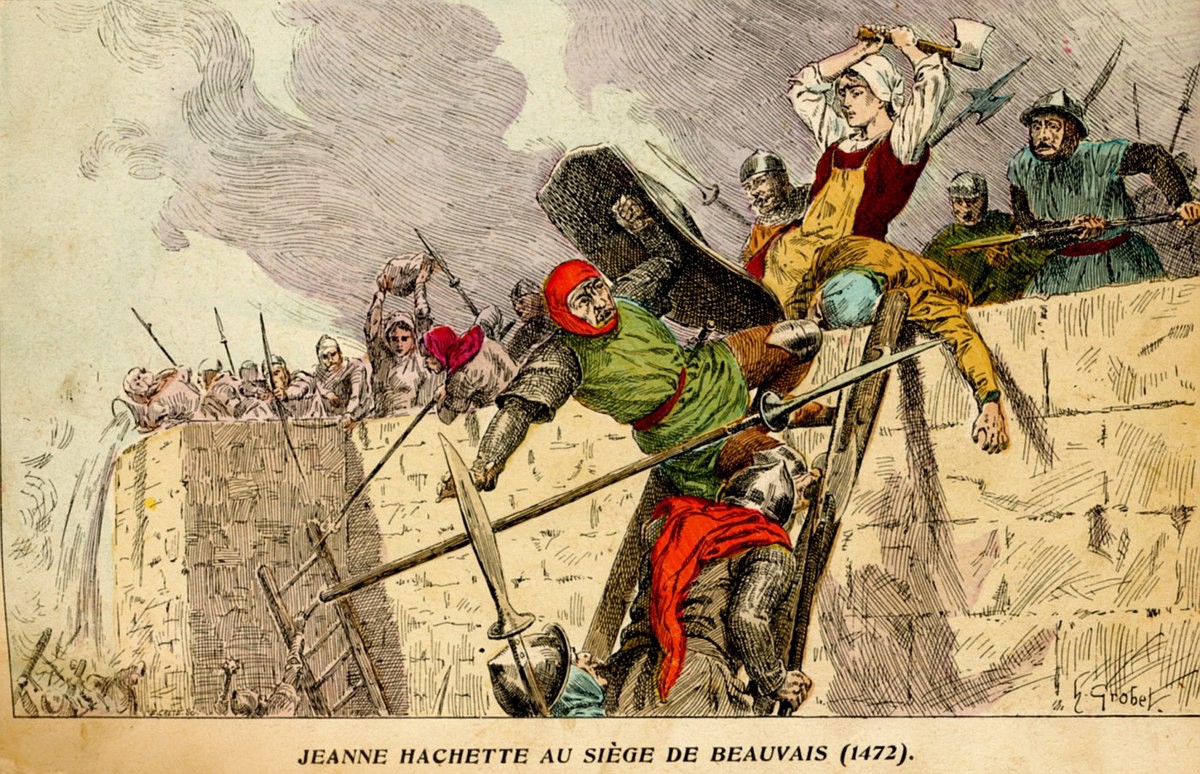
Allow me to introduce you to Jeanne Laisne,** who earned the nickname “Jeanne Hachette” (Jean the Hatchet) in 1472 for her role in defending the city of Beauvais against the armies of Charles the Bold, the duke of Burgundy, who had joined forces with other disaffected noblemen against King Louis XI of France.
The vanguard of the Burgundian army arrived on June 27. Charles had taken—and ravaged—three French towns before he reached Beauvais. The city was well fortified but had no artillery and few soldiers. With only the townspeople and a handful of soldiers to defend the walls, the duke expected the residents would surrender without a fight.*** That turned out to be a bad assumption.
When the city refused to surrender, the Burgundian commander ordered a simultaneous attack on two of the city gates. The duke’s soldiers rushed into the gap made when their cannon blew a hole in one gate, but the townspeople defended the breach valiantly. Men fought on the walls. Women threw flaming torches down on their enemies, catching the city gate on fire in the process. A few women took part in hand-to-hand combat at the breach.****
The Burgundian forces were on the verge of overrunning the city’s defenses when Jeanne entered the battle—armed with, you guessed it, a hatchet. Just as she arrived, a soldier planted the Burgundian flag on the battlements. She wrested it from him and hurled him off the wall. Her actions rallied the garrison, who then held off the besiegers until reinforcements arrived.
The siege continued for almost a month. ( In contrast to the usual siege experience, the besiegers grew short of supplies while the besieged had no trouble obtaining provisions.) On July 22, Charles the Bold gave up and headed west toward Normandy, burning and pillaging villages and fields around Beauvais as he went.
A grateful Louis XI rewarded Hachette for her act of bravery with a lifetime exemption from paying taxes—definitely worth more than a medal. As late as 1907, the town of Beauvais celebrated Hachette’s actions with an annual parade led by the city’s women—the Procession of the Assault. Prior to the onset of Covid, Hachette was still celebrated with an annual festival and reenactment. I suspect when the current troubles are over, she will be again.
*The universe working the way it does, my computer has started exhibiting some serious unhappiness, which means the new computer will probably get here before the new desk. *Sigh*
**Or perhaps Jeanne Fourquet. Both names appear in accounts of the incident.
***It is amazing how often this assumption appears in the accounts of cities under siege that I read in the course of writing Women Warriors.
****Some modern accounts claim Hachette organized the city’s female defenders. As best I can tell, this is wishful thinking.