




Road Trip Through History: Chickamauga and Chattanooga
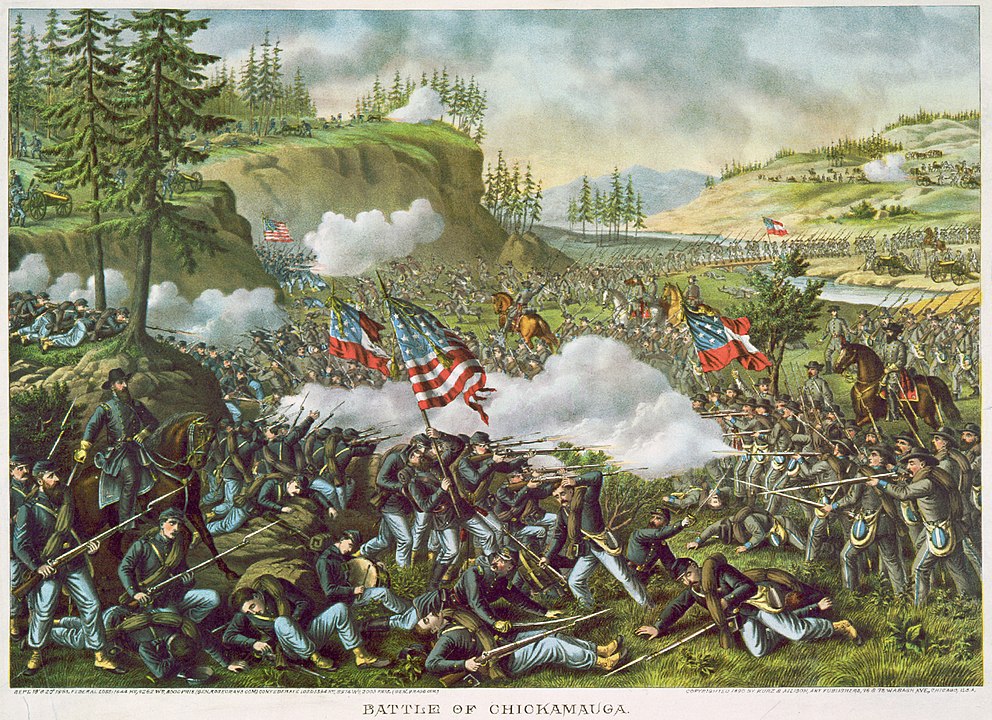
Recently My Own True Love and I made a difficult trip from Chicago to Atlanta and back. Normally, we would have flown, but with the continuing threat of Covid we chose to drive. And since we were driving, we decided to make a couple of history nerd stops to soothe our souls. After all, the Chickamauga and Chattanooga National Military Park (in the northwest corner of Georgia, near the Tennessee border) and its smaller sister park of Lookout Mountain (in Tennessee) were more or less on the way.
The National Park Service did not disappoint.
We stopped at the Chickamauga and Chattanooga National Military Park on the way down and at Lookout Mountain on the way back. For purposes of this blog post I’m treating them as one park because they are all part of one big story.
Before we visited the parks I knew two things about the Civil War battles for the control of Chattanooga:
- Chattanooga was an important railway center and the gateway to the Confederacy from the West. Control of Chattanooga would give the Union greater control over its supply chain and access to the industrial centers of the Confederacy.
- The battle of Chickamauga was one of the bloodiest battles of the war. (I knew this thanks largely to reading this short story by Ambrose Bierce in high school. (1) )
Both of those things are, in fact, true. (2) Our visit to the park added story, depth and color to those dry bones.
We began our visit by joining a caravan tour of the Chickamauga battlefield led by a park ranger/historian.(3) He was a good story teller and brought the battle to life. He didn’t just recite troop movements, though he did give a clear description of what men did at each step of the battle and why. He put the battle into historical context. He told stories about the people who fought, and about civilians whose lives were affected by the battle. (5) He ended the program with a discussion of the subsequent battle for Chattanooga, in which the Confederate general snatched defeat from the jaws of victory.
An excellent short film at the main park and exhibits at the visitors’ centers at both parks reinforced and expanded on the ranger’s talk. (The film made me cry.)
I’m not going to recap the action of the battles here. There are plenty of places where you can get that information. Here are the things, large and small, that caught my imagination:
- The Confederates, led by Gen. Braxton Bragg, won the battle of Chickamauga but that victory didn’t accomplish anything. At the end of the battle, the Union army, led by Gen. William Rosencrans, retreated to Chattanooga–which was the prize the two armies were fighting to control. Instead of attacking the battered Union forces, Bragg chose to besiege Chattanooga at a distance. The idea was that the cold, tired and hungry Confederate army would starve the cold, tired and hungry Union army into submission. After a month, General Grant arrived with reinforcements and set up a supply line into the city. The soldiers called the trains that brought in the supplies the Cracker Train, after the hardtack that was one of their main provisions. My guess is I will remember the Cracker Train long after I’ve lost all the other details of the battle.
- One of Abraham Lincoln’s brothers-in-law, Benjamin Hardin Helm, was a Confederate general who died at Chickamauga. (In fact, Lincoln had five brothers-in-law in the Confederate army.) Helm was a West Point graduate. Lincoln had urged him to remain in the Union army and greatly mourned his death. After his death, Helm’s wife lived for a time in the White House at the invitation of her sister, Mary Todd Lincoln. This must have been uncomfortable for all concerned. After several months, Emilie Todd Helm returned home to Kentucky. The ranger made the point that Mary Todd Lincoln suffered loss after loss in her years as the First Lady, with Lincoln’s death being the last and most devastating. Beyond that, I was struck by the fact that the truism that the war divided families went all the way to the White House.
• The ranger and the various exhibits all described generals Bragg and Rosencrans as being eccentric, but they never said in what way. There are so many ways to be eccentric. I want to know more.
• The Battle of Lookout Mountain–which became known as the Battle Above the Clouds–ended with a frenzied charge by Union troops up the fog-enshrouded mountain. Looking down the side of the mountain, I could not imagine how they did it.
• The Chickamauga and Chattanooga National Military Park was the first national military park to be created, at the instigation of veterans from both sides of the battle.
Definitely worth a stop if you are a history buff.
1) Unlike Stephen Crane, who wrote The Red Badge of Courage, Bierce actually fought in the war. But I digress.
2) This is not always the case with the things I think I know going in.
3) In case you haven’t done one of these, the ranger leads a caravan of people driving their own cars through the battlefield, like a weird funeral cortege. (4) At critical points, everyone piles out for a brief lecture.
(4) Not entirely inappropriate here given the breathtaking number of deaths that occurred on the battlefield.
(5) As far as I’m concerned, that’s the way military history should be told. Otherwise you’re just moving tin soldiers around on a topographic model of a battlefield.
Note: Thanks to sharp-eyed reader, Jack French, who pointed out that I didn’t tell you what states the parks are in. I’ve added the info, and I offer you this link to the NPS website that includes information about both parks: https://www.nps.gov/chch/index.htm
From the Archives: Road Trip Through History–Jamestown Settlemen
Sometimes life makes it impossible to write blog posts on a dependable basis. This is one of the those times. For the next little while, I’m going to run pieces from years past. I hope you enjoy them, and I’ll be back as soon as I can.
Next up, a post from November 2011:
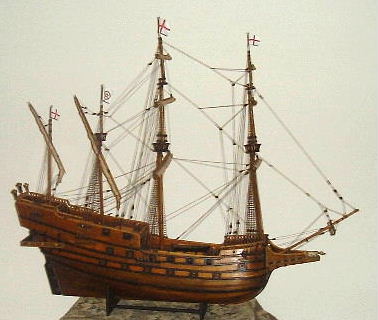
Scale model of the English galleon Dainty, built in 1588. (The original ship, not the model)
For reasons too complicated to go into here and now, I‘ve been yearning to walk the deck of a late sixteenth-century sailing ship. No late sixteenth-century vessels were available, so My Own True Love and I headed for the next best thing: the replica ships at Jamestown Settlement, located ten miles away from colonial Williamsburg.
Once there, I headed straight for the working replicas of the Susan Constant, the Godspeed and the Discovery: the ships that brought English settlers to Jamestown in 1607. Let me tell you, those ships are very small. (For those of you who are sailing types, they are 120 tons, 40 tons, and 20 tons respectively. For those of you who aren’t sailing types, they are really small, really-really small, and frighteningly small.) They sailed from London* just before Christmas and arrived on the coast of Virginia in April: they spent three weeks of the journey stuck in the English Channel due to bad weather. Passengers slept in the hold on top of the cargo and weren’t allowed on deck without the captain’s permission. The smell! The claustrophobia! The impossibility of getting away from other people for an hour or two! (Talk about introvert hell.)
Jamestown Settlement has more than just reproduction seventeenth century sailing ships. ** Once we’d learned everything about the ships that we could think to ask, we moved on to reproductions of James Fort ca. 1614and a seventeenth century Powhatan Indian village, both of them manned by yet more patient and well-informed costumed interpreters. We ended the day with a couple of hours in the site’s exhibition galleries, leaving no for time for the archaeological site at Historic Jamestown, just down the road.
Tomorrow? Colonial Williamsburg.
*According to a costumed interpreter dressed as Sir Walter Raleigh, the ships didn’t actually sail down the Thames, they were pulled by men on shore.
**Though really, how much more do you need for a day of history geek entertainment?
From the Archives: Road Trip Through History – The Battle of Hastings
Sometimes life makes it impossible to write blog posts on a dependable basis. This is one of the those times. For the next little while, I’m going to run pieces from years past. I hope you enjoy them, and I’ll be back as soon as I can.
Next up, a post from November 2012:

Image courtesy of Antonio Borillo
On October 13, thousands of history enthusiasts from around the world arrived at the British town of Battle to re-enact the Battle of Hastings. (You know, William the Conqueror, 1066, and all that.)
My Own True Love and I weren’t there.* Just as well. The weather was cold and wet. The battlefield conditions were so muddy that the organizers called off the second day of the battle because the ground was too muddy for vehicles to get in and out. (I suspect any number of Anglo-Saxon and Norman soldiers at the original battle would have been pleased if someone had called off the second day of the real battle.)
When we arrived, a week later, the battlefield was still a muddy mess. We happily went through the excellent introductory exhibit, learning about Anglo-Saxon England, the Duchy of Normandy, and why William the Bastard of Normandy** thought he had a claim to the English crown.***
Then we headed to the battlefield, audio tours in hand. Before we got to the first point on the tour, we were slipping in the mud on the path. My Own True Love’s shoes sprang a leak. Defeated by the mud, we retreated to the café, where we drank coffee, listened to our audio tours, and envied the rubber boots worn by the squadrons of British school children trooping past.
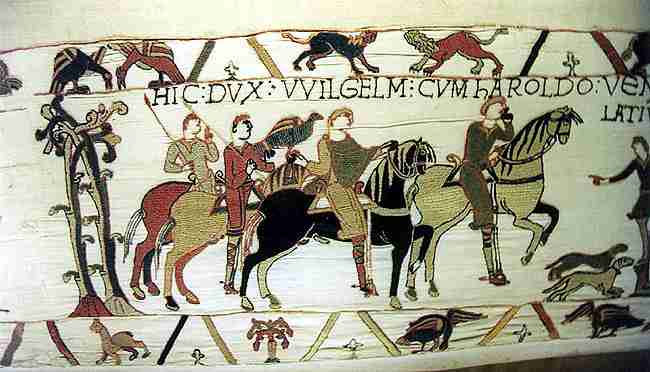
You can get a detailed account of the battle here. These are the elements that struck me:
- Both sides were descendents of Viking conquerors. The rulers of England were the descendents of King Canute of Denmark. The Normans were Norwegian Vikings with a French accent.
- The battle was a classic stand off between infantry and armed horseman: immovable object vs. irresistible force.. The English army, on foot, depended on the strength of its shield wall. The Normans enjoyed the mobility of cavalry. William stumbled on a tactic that the Mongols (armed horsemen par excellence) would later use to confound Western armies. When his men panicked and retreated, exultant English troops broke out of formation to pursue them. William saw what was happening and ordered his flank to cut the English off. The pursuers were surrounded and slaughtered.. The first time was an accident. William learned; apparently the English didn’t. When William ordered a feigned retreat to replicate his success, the English pursued again and were slaughtered again.
- The Battle of Hastings changed history, but it wasn’t the only time France invaded England. Who knew?
Next stop, Brighton.
* We missed several special history nerd events as we drove along Britain’s southeast coast–always a week too late or a week too early. We did, however, manage to arrive in Bath on the day of a major rugby match.
** The name was a legal description, not a character assessment.
*** William was a shirttail relative to Edward the Confessor, whose death in 1066 was the catalyst for the invasion. William’s great grandfather was Edward’s maternal grandfather.