




Déjà Vu All Over Again: The Bonus Expeditionary Forces March on Washington
And while we’re talking about failures of compassion and the Great Depression, as I believe we were, consider the example of the Bonus Expeditionary Forces’ march on Washington—a story with uncomfortable modern-day echoes
Bonus payments to World War I veterans were a hot political subject in the years after 1919. Congress passed bills approving bonuses twice. First President Harding and then President Coolidge* vetoed those bills. In 1926, Congress overrode Coolidge’s veto and passed what became known as the Bonus Act.
From the veterans’ perspective, the act had a catch. Bonuses would not be paid out until each veteran’s birthday in 1945–26 years after the end of the war.** In theory, veterans could borrow against their bonus, beginning in 1927. That probably seemed like a generous option at the time, but by the end of 1929 banks were short on money to lend, even when backed by the security of the U.S. Government.
In May 1932, an unemployed veteran named Walter W. Walters organized other jobless veterans into a group that called themselves the “Bonus Expeditionary Forces” (BEF). Their goal was to get their bonus money immediately, when they desperately needed it.
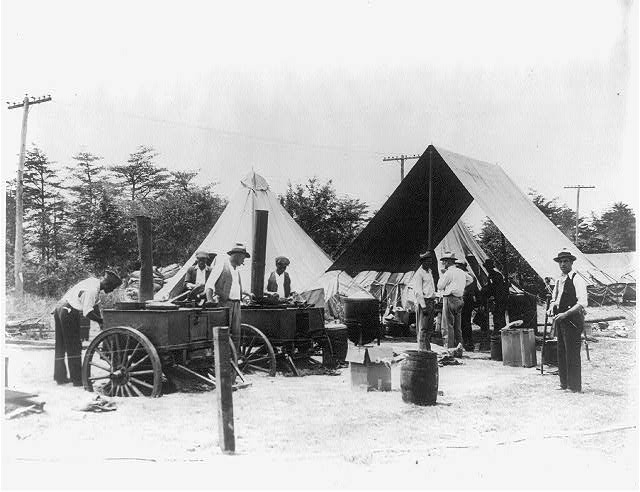
The veterans set up camps around Washington D.C., including a large shantytown on the Anacostia Flats, across the river from Washington’s Navy Yard that was the “hooverville” to end all hoovervilles. Walters organized the camps on military lines and demanded that his forces indulge in “no panhandling, no drinking, no radicalism.” His announced intention was that the BEF would stay until the veteran’s bill was passed. By the end of June, between 20,000 and 40,000 desperate and hungry men occupied Anacostia Flats, many accompanied by their families.
Democratic Congressman Wright Patman of Texas, himself a WWI veteran, took up the cause and sponsored a bill that would give veterans an immediate bonus payment. The House of Representatives pass the bill on June 15. President Hoover’s vow to veto the bill was not put to the test, because it was defeated in the Senate two days later.
On July 28, the D.C. police attempted to remove about fifty protestors who had settled in vacant government buildings on Pennsylvania Avenue. Several of the protestors rushed the police and began throwing bricks. (You can tell this is going end badly, right?) In the ensuing riot, the police shot into the crowd and killed two protestors.
Then the army got involved.
Under orders from President Hoover to drive the protestors back across the river, General Douglas MacArthur formed a cordon around the protestors. Armed with tanks, fixed bayonets, and tear gas, the army drove the crowd of protestors across the Anacostia River to their main encampment. No shots were fired, but hundreds were injured.
With the area cleared, Secretary of War Patrick Hurley sent messages to MacArthur, twice, telling him not to pursue the BEF over the bridge because the president was worried that the government’s reaction might look overly harsh*** MacArthur ignored both messages. HIs troops pressed across the river, where they set fire to the shanty town.
The Bonus Expeditionary Force was effectively defeated by the Army they had served.
The Army tried to claim the operation as a success, but it didn’t play well in the press. The Washington Daily News, which generally supported Hoover, railed against the “pitiful spectacle” of “the mightiest government in the world chasing unarmed men, women, and children with Army tanks. If the Army must be called out to make war on unarmed citizens, this is no longer America.” The New York Times, which was not pro-Hoover on the best of days, agreed: “Flames rose high over the desolate Anacostia Flats at midnight tonight and a pitiful stream of refugee veterans of the World War walked out of their home of the past two months, going they knew not where.”
The image of “pitiful” veterans under attack by the Army also didn’t help Hoover’s performance at the polls that November, when Franklin Delano Roosevelt was swept into office.
*I’m getting curious about “Silent Cal”—so far every time he pops up in the story he’s vetoing something.
**And, ironically, the year World War II would end, producing a new crop of veterans to care for.
***Yah think?
The Paradox of Herbert Hoover
If there is one thing I have learned over and over in the years that I’ve been writing History in the Margins it is that the history “everyone” knows is often wrong, or at best sadly incomplete. That’s as true for a professional historian, once she opens the gate and wanders out of her field, as it is for any one else.
Consider the case of Herbert Hoover. Up until a few months ago, what I knew about Herbert Hoover could be summed up in three sentences.
- He was a successful mining engineer with an international reputation.
- He was president of the United States when the Great Depression began in 1929.
- And he failed so miserably at providing relief in the early years of the Depression that people dubbed the shantytowns that housed the newly homeless and destitute “Hoovervilles.”
I was left with the impression that Hoover was uncaring and/or incompetent. (I never consider the odd move from “successful mining engineer” to “incompetent”.
In recent months, as I started reading about the years between the two World Wars, I began to find references to Hoover organizing an American relief mission to bring aid to starving millions in central Europe and the new Soviet Union. It turns out that when Hoover took office in 1929, he was known as the Great Humanitarian for his work during and after World War I.
In World War I, Hoover organized the Commission for Relief in Belgium (CRB), which provided millions of tons of food for occupied Belgium and made sure that the German army didn’t take it.* Funded by both private donations and government grants, the commission was an independent organization. Once the United States entered the war, he headed the Food Administration, where he successfully provided supplies to the Allied Powers, stabilized food prices and prevented food shortages at home. Not a small matter since the war had created a food crisis in the combatant nations.**
More impressive, after the war, he headed the American Relief Administration (ARA), which rebuilt infrastructure and provided food to feed our former enemies in Central Europe. When government funding for the program ended in 1919, Hoover transformed the relief program into a charitable organization, raising millions of dollars from private donors. When he extended the aid program to help famine-stricken Russia in 1921, critics in Congress asked why he was helping Bolshevism. His answer: “Twenty million people are starving. Whatever their politics, they shall be fed.”
In 1927, now Secretary of Commerce, he was the obvious choice to lead the federal response to the Great Mississippi Flood. Chairing a special relief committee, he once again orchestrated a combination of federal and private funding to help the displaced, including the construction of 100 tent cities. (An odd parallel to Depression shanty towns.)
How do you get from “they shall be fed” to “hoovervilles”?
Not surprisingly, the answer is that while Hoover did fail at providing relief during the Great Depression, he wasn’t as uncaring as what I’ve dubbed comic book history*** would suggest. As president, he did not have the independence that he enjoyed in Belgium and Central Europe. (One British official described the CRB as a “Piratical state organized for benevolence.”) On the one hand, he moved quickly to presented Congress with programs to promote fiscal stimulus, including a relief program that included help for farmers facing mortgage foreclosure, banking reform, a loan to the states for feeding the unemployed, and an expansion of public works. (In a stand-off that looks entirely too familiar to a modern reader, many of his proposals stalled or were diluted in Congress.) On the other hand, Hoover took the position that caring for the millions affected by the Depression must be a local and voluntary responsibility—a position that seems at odds with his call for feeding starving millions in Russia in 1921 and yet is entirely in keeping with his success in combining private and public funds to create solutions.
Hoover’s opponents in Congress successfully painted him as cold, callous, and incompetent—though it is not clear that they did much to stem the economic crisis either. The Great Humanitarian became the scapegoat of the Great Depression.
*Belgium was caught between the German army, which refused to feed the population of the occupied nation, and its British ally, which refused to allow imported food through its blockade. With friends like that….
**I’m currently reading about food shortages in Germany and Austria during the war. Definitely not pretty.
***Historical stories that are emotionally satisfying but factually untrue. They just keep coming. Here’s a link to the post in which I first discussed this: History, Myth, and the Gettysburg Address.
From the History in the Margins Archives: The Great Silence

Whether you know it as Armistice Day, Poppy Day, Remembrance Day or Veterans’ Day, November 11 is a time to honor those who died in war and thank those who served.
The day of remembrance has its roots in the end of World War I. The war ended on November 11, 1918. When the word reached England that the the armistice had been signed, the country broke out into a spontaneous party. (The Savoy Hotel alone lost 2700 smashed glasses to the celebration.) No stiff upper lip allowed.
When the first anniversary of the Armistice drew near, dancing in the streets of a post-war world no longer seemed appropriate . Neither did letting the day go unnoticed. Some assumed that special church services were the proper response. Australian soldier and journalist Edward George Honey wrote a letter to the London Evening News suggesting a moment of silence “on the eleventh hour of the eleventh day of the eleventh month”. He asked for “Five silent minutes of national remembrance…Church services too, if you will, but in the street, the home, the theatre, anywhere, indeed, where Englishmen and their women chance to be, surely in this five minutes of bitter-sweet silence there will be service enough.”
Honey asked for five minutes; he got two. King George V called for all Britons to stop their normal activities “so that in perfect stillness, the thoughts of every one may be concentrated on reverent remembrance of the glorious dead.”
If you can, at the eleventh hour of the eleventh day of the eleventh month–pause for a moment. If you can’t? Thank a veteran. Buy a poppy, if you can find one. Pray for peace.