




From the Archives: The Nile
It is inevitable, at some point after I’ve returned from a trip I run out of blog-post steam. The notes I have made for myself about future posts no longer fire my imagination, or I don’t have enough information to turn them into stories.[1]
Before I give up and move on to the other stories that are clamoring for my attention, I’d like to share a review I did in 2014 about the account of another writer’s boat trip through history.
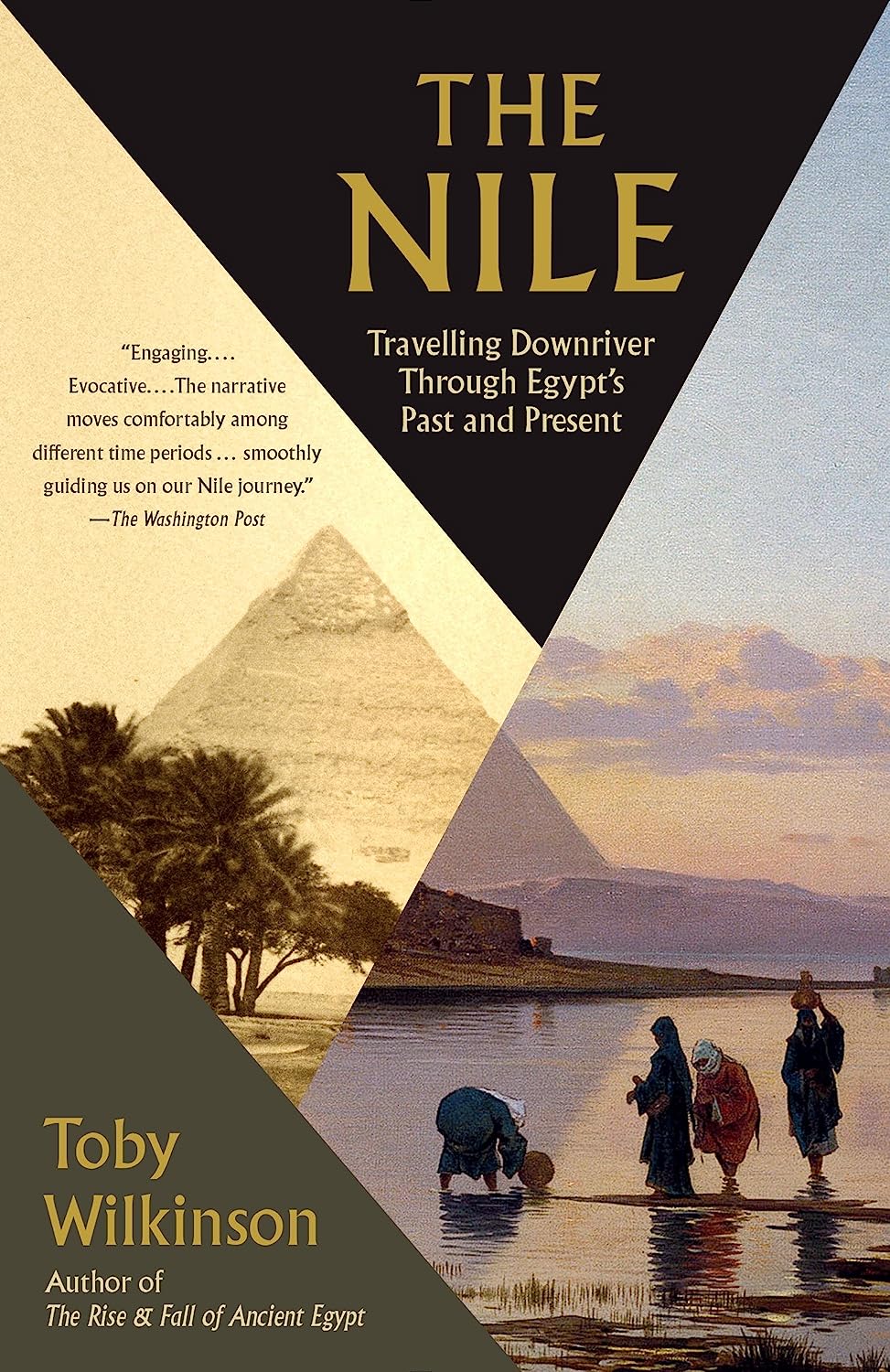
In The Nile: A Journey Downriver Through Egypt’s Past and Present, popular Egyptologist Toby Wilkinson leads the reader on a historical travelogue that moves from Aswan, home of the river’s First Cataract, to Cairo’s Gezira Island, from Paleolithic rock drawings to the Arab Spring.
The voyage that shapes The Nile is not simply metaphorical. Wilkinson floats down the river on a dahabiyah–a large luxury boat descended from the royal barges of the pharaohs. Aware that he is simply the latest in the historical line of travelers drawn to Egypt by its climate and its ancient civilizations, Wilkinson engages with their commentary as well as his own observations, creating a palimpsest of Nile voyages in the process. (Ancient Greek historian Herodotus and 19th-century British journalist Amelia Edwards are particular favorites.)
Because Wilkinson organizes his work by geography rather than chronology, his narrative is anecdotal almost to the point of stream of consciousness. His combination of scholarship and storytelling allows him to draw unexpected relationships through time. The ruins at Kom Ombo lead to a discussion of the crocodile god, Sobek, then on to ancient Egyptian tales about the dangers of crocodiles, a modern Crocodile Museum, and the impact of both 19th-century Western tourism and the Aswan Dam on the crocodile population in Egypt. Occasionally such temporal leaps are disorienting, but for the most part they are illuminating. Once a reader has learned to navigate the rapids, The Nile is worth the effort.
[1] For instance: Egypt used the (unwritten) Nubian language as a military code in its war with Israel in 1973. A fascinating tidbit, but not enough to turn into a post. (And I really tried. Many rabbit holes were explored before I gave up.)
From the Archives: Word with a Past–Parchment
And speaking of papyrus, as I believe we were, here’s a story that I first shared in 2013 in which papyrus played a critical role. It’s one I’ve always enjoyed. I hope you do,too.

For hundreds of years papyrus was the principal material on which books (or at least hand-copied scrolls) were written. Since it could only be made from the pith of freshly harvested papyrus reeds, native to the Nile valley, Egypt had a monopoly on the product–and a potential monopoly on the written word.
In the second century BCE, the kingdoms of Egypt and Pergamum* got into an academic arms race.
The library at Alexandria had been an intellectual power house since it was founded by King Ptolemy I Soter in 295 BCE. Ptolemy set out to collect copies of all the books in the inhabited world. He sent agents to search for manuscripts in the great cities of the known world. Foreign ships that sailed into Alexandria were searched for scrolls, which were confiscated and copied.**
Thirty years later, King Eumenes of Pergamum founded a rival library in his capital. Both kingdoms were wealthy and the two libraries competed for sensational finds.
In 197 BCE, King Ptolemy V Epiphanies took the rivalry to a new level by putting an embargo on papyrus shipments to Pergamum. The idea was that without papyrus, scholars in Pergamum could not make scrolls and therefore could not copy manuscripts. The Pergamum library would be crippled.
In response, Pergamum turned to a more expensive, but more durable, material made from the skin of sheep and goats. We know it as parchment, from the medieval Latin phrase for “from Pergamum”.
Librarians are a resourceful lot.
* “Where?” you ask. Here:
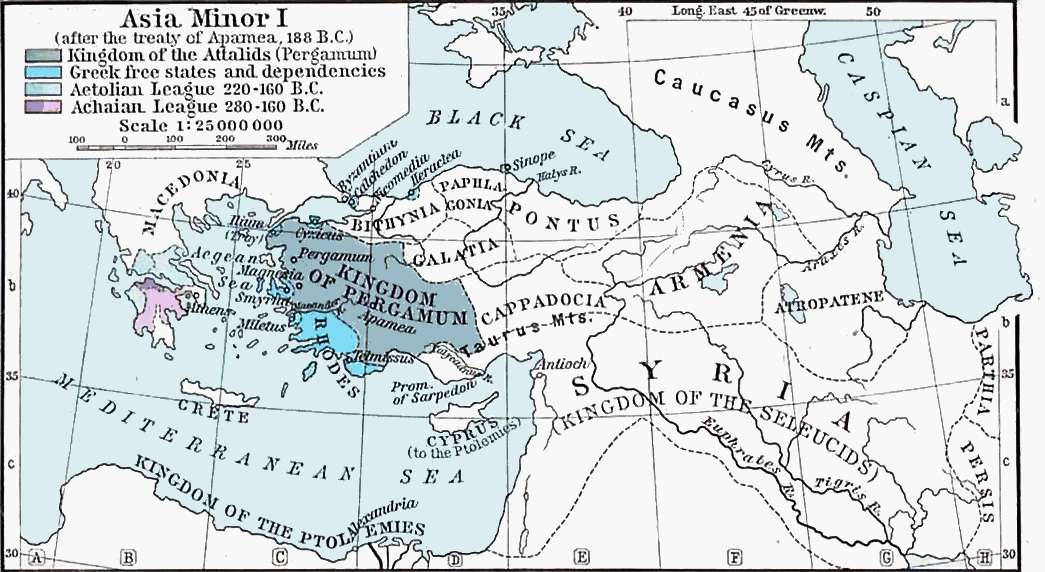
As you can see, not a small place.
** Alexandria kept the originals*** and gave the owners the copies. Piracy of intellectual property is not new.
*** According to Galen, they were catalogued under a special heading: “books of the ships”.
Boat Trip Through History: A Stop at the Papyrus Institute
Over the years, I have gone to many, many living history sites at which people in period costume demonstrate blacksmithing[1], quilting, weaving, making soap, and cooking in a pre-modern kitchen. Even when it is a traditional skill that I have seen demonstrated many times before, I always come away with a sense of amazement.
I did not expect to have a similar experience at the Papyrus Institute.
In many ways, the Papyrus Institute reminded me of the rug workshops that are an unavoidable stop in any country with a handwoven rug industry, in which the “lesson” about rug weaving is only a pitch for selling rugs.[2] And in fact, the “institute” was clearly designed to sell tourists the works made on papyrus that hung on its walls[3] —better quality and much more expensive than those sold in the small bazaar that surrounded every monument we stopped at but still obviously designed for the tourist trade.
There was no attempt to evoke the past. In fact, the counter at which a staff member demonstrated making papyrus reminded me of a high school science lab station, as did the demonstrator’s presentation style. He spoke briefly about the symbolic significance of the papyrus plant as the heraldic emblem for Lower (i.e.) Egypt.[4] Then he took us through the steps of making papyrus paper —slowly, carefully, calmly.[5] Fibrous layers were removed from the stem of the plant in strips. The strips were soaked and then laid side by side in two layers: one layer laid lengthwise, then topped by another layer at right angles to the first. The two-ply stack was then pressed together; as it dried the glue-like sap of the plants cemented the layers together, creating a sheet of paper.[6]
To my surprise, it was absolutely fascinating.

Payprus document ca 1900 BCE
Image courtesy of the Metropolitan Art Museum
A few other papyrus tidbits:
- The earliest extant piece of papyrus is a blank scroll from around 2900 BCE.
- The first examples with text date from about 2500 BCE, which is about the same period as the earliest known statue of a scribe.
- Although paper is the best known use of the papyrus plant, ancient Egypts, also used it to make small boats, mats, boxes, baskets, sandals, and ropes, similar to the way birch bark was used in North America.
- Papyrus could be erased and reused.
[1] Eternally fascinating as far as I am concerned Almost magical.
[2] We made that stop several days prior to visiting the Papyrus Institute. Watching a rug maker at work was interesting the first time I saw it, but it doesn’t continue to grip me the way blacksmithing does.
[3] And yes, I succumbed to a very appealing landscape that I need to have framed.
[4] It is worth pointing out that the Nile flows north to the Mediterranean, not south. So when you take a boat ride down the Nile, you go north. This may feel wrong, but it is true. Look at a map if you don’t believe me.
[5] One of the variations of a mantra that our guide repeated many many times a day as we walked on uneven surfaces through a gauntlet of vendors selling papyrus bookmarks and fake alabaster statues. (In retrospect, I regret not buying a pack of the bookmarks, which were ten for a dollar. I go through a lot of book marks)
[6] I am missing a step or two, but you get the idea.