




1918: A Year in Review
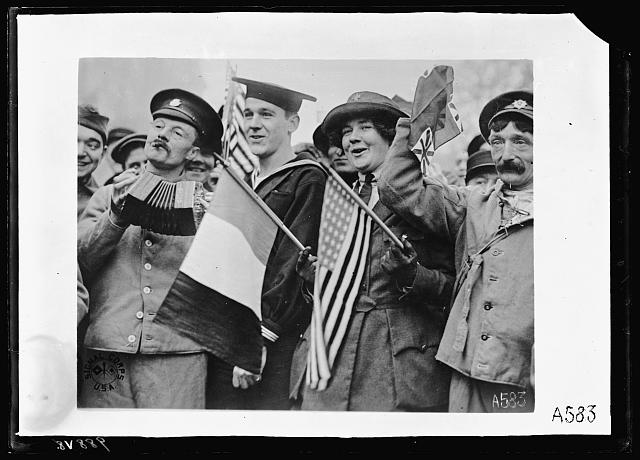 As you already know if you hang out here in the Margins, or elsewhere in Historyland, the Big Picture historical event of 1918 was the end of World War I on November 11—one large event made up of many smaller events that I am not going to discuss in detail here because this is a general review of 1918, not a post on the last year, or 100 days, or final months of the war.
The end of the war wasn’t the only event in 1918 worth remembering. Here are a few of the high points, the low points, and the things that caught my imagination:
Having withdrawn from the war following the overthrow of the Provisional government in November 1917, Bolshevik Russia found itself at war with the various factions of anti-Soviet resistance that made up the White Russians. (Not all of them royalists.) (1)
And speaking of Russia in 1918:
In July, the Russian imperial family, Tsar Nicholas, his wive, and five children, were assassinated and buried in an unmarked grave that would not be discovered until 1991.
Russia finally adopted the Gregorian calendar, making life a little easier for historians.
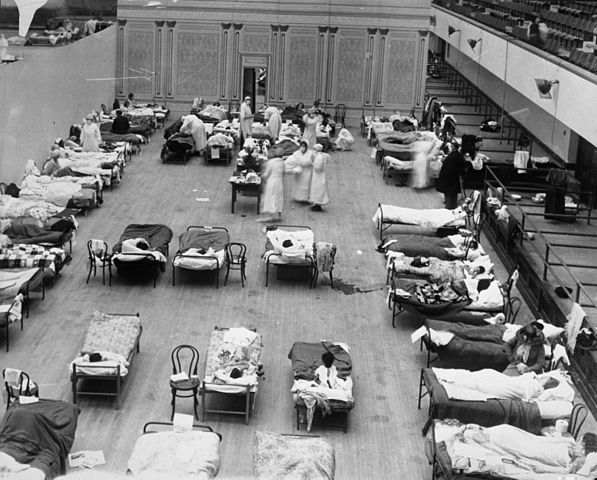
The Spanish flu of 1918 was the deadliest epidemic in history. The virus infected an estimated 500 million people around the world—roughly one-third of the population—and killed between 20 and 50 million people. More people than died in World War I. Count your blessings for modern medicine.
British women over the age of 30 received the right to vote, two years before women’s suffrage was ratified in the United States.
The avant-garde American literary magazine The Little Review began to serialize James Joyce’s Ulysses in March 1918. Serialization continued through December 1920, when the publishers were taken to court for publishing obscenity and lost. Not all the issues reached their intended readers because the Post Office seized and burned several issues.

AT & T introduced the first dial telephones, which allowed users to place some calls without intervention from operators. Telephone operators threatened to go on strike. The worry that changes in technology will affect jobs is not a new one.
If you’re interested in a closer look at 1918, I once again recommend you check out Mary Grace McGeehan’s blog, My Year in 1918: A Journey to the World of 100 Years Ago. It’s been a fascinating journey to follow her as she follows the news, literature and popular culture as if she were reading in 1918.
(1) I am disappointed to report that the White Russian cocktail has nothing to do with the the White Russian army. The cocktail wasn’t invented until 1949.
Cornelia Fort: Eyewitness to Pearl Harbor
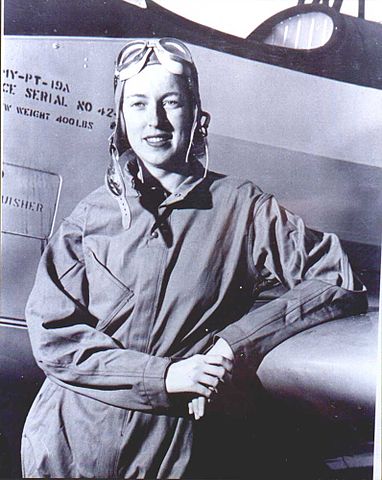
Cornelia Fort was a certified civilian flight instructor who worked for the Andrews Flying Service in Honolulu, a Nashville debutante who had kicked her way into the male dominated world of general aviation. (1) She was only 22 and already an experienced pilot with hundreds of flight hours to her credit.
On December 7, 1941, Fort was in the air with a student pilot, a defense worker named Suomala who was practicing landings prior to taking his first solo flight. As was typical at the time, they had no radio, so the only way to avoid other aircraft coming and going at Honolulu’s John Rodgers Airport was to scan the sky around them
Prior to what was scheduled to be Suomala’s final landing before soloing, Fort scanned the sky. She saw a military plane heading in from the ocean. She was so accustomed to military traffic from the nearby military bases that she nodded to Suomala to turn into the first leg of his landing pattern. She looked again and saw another military aircraft headed right for them. She grabbed the controls away from her student, jammed the throttle open, and pulled above the oncoming plane. It passed under them, so close that their celluloid windows rattled.(2)
Fort glanced down to see what kind of plane it was. Instead of the insignia of the US Army Air Corps, painted red balls shone on the wings in the morning sun: the “rising sun” emblem of the Japanese. With a chill tingling down her spine, she looked west to Pearl Harbor, where she saw billowing black smoke and formations of silver bombers. Something detached itself from one of the planes and she watched as the bomb fell and exploded in the middle of the harbor.
She landed the plane at John Rodgers as quickly as she could, surrounded by machine gun fire. As they touched down, Suomola asked “When am I going to solo?” (Fort later said she wasn’t sure whether he didn’t understand what was happening or was trying to lighten the situation with humor.) A contemporary newspaper account reported her answer as “Not today, brother.” A few seconds later, the shadow of a plane passed overhead and bullets spattered around them. Pilot and student sprinted for the cover of the hanger.
Once inside, Fort tried to warn others that the Japanese were attacking. She was met with disbelief and laughter. The men she worked with tried to pass it off as some sort of maneuvers that she had misunderstood. Fort was “damn good and mad.”(3) She was about to tell them off when a mechanic from another hanger ran in and told them that strafing planes had just shot another pilot and his student as they ran for cover.
As scores of Zeros roared by, some no more than fifty feet off the ground, Fort and her companions took shelter in the hangar. When she examined her plane the next day, she found it riddled with bullets.
Newspapers soon picked up the story of Fort’s encounter with the Japanese–it would have been a good story no matter who was involved. But a pretty young female aviator gave it an additional human interest element. For a time, she was part of the speaking tour that sold war bonds. But she was determined to use her flying skills for the war effort. Lamenting the fact that she she couldn’t be a fighter pilot and face the Japanese in the air again, she was the second woman to volunteer for the Women’s Auxiliary Ferrying Squadron (WAFS).
For several months she delivered small training planes(4) up and down the east coast. In February, 1943, Fort and several other WAFS was assigned to Long Beach California to deliver the much larger BT-13s. They were thrilled with the “promotion” to larger planes, but some of them remained frustrated by the fact that they were not allowed to become fighter pilots. Determined to acquire some of the skills needed, Fort and a few of her companions began to experiment with formation flying, an activity that was forbidden during delivery flights. On March 21, 1943, while participating in a forbidden stint of formation flying on a delivery, Fort’s plane was destroyed in a mid-air collision, making her the first WAFS pilot to die while on duty.
What a waste.
(1) Her father made her brothers promise never to fly. He never thought to ask for the promise from his daughter. Her brothers were royally pissed off when they found out she had been taking flying lessons in secret.
(2) Fort’s written account of the incident claims that at this point she felt “a distinct feeling of annoyance that the Army plane had disrupted our traffic pattern and violated our safety zone.” My guess is that she swore like a fighter pilot–or at least gave vent to a string of the “dangs” and “sssssss–sugars” that passed for profanity among women of the Middle South at the time.
(3) And can you blame her?
(4) PT-19s, for the aviation fans among the Marginalia
1818: A Year in Review
 The year 1818 began and ended with the introduction of two very different works of art, both of which have become a permanent part of the popular culture. Mary Shelley’s Frankenstein was published on January 1st. On Christmas Eve, in the small Austrian village of Oberndorf bei Salzburg, young curate Joseph Mohr and schoolteacher/organist Franz Xaver Huber wrote Silent Night. *
Some other high (or low) points of 1818:
- Elisha Collier and Artemis Wheeler received patent for a repeating flintlock pistol, with a five-shot cylinder in both Britain and the United States. Their design didn’t take off in the American market, but had some success in Britain. Despite the fact that you’ve never heard of them, Collier and Wheeler helped shaped their world. In 1830, one Samuel L. Colt filed for a patent based on their designs. His mass-produced revolvers were prized weapons in the American Civil War and the handgun of choice in the American west. More important in the bigger picture, he paved the way for the interchangeable parts system of manufacturing.
- Congress adopted the flag of the United States as having thirteen red and white stripes, representing the thirteen original colonies, and one star for each state. (There were twenty at the time,)
- The Convention of 1818 settled the border between Canada and the United States at the 49th parallel.
- In India, the British East India Company defeated the Maratha Empire. Officially subordinate to the crumbling Mogul empire, the Marathas had dominated the Indian subcontinent in the seventeenth and eighteenth centuries. The Third Anglo-Maratha War (1817-1818) was the final and decisive conflict between the British East India Company and the Maratha Empire. The British victory left the East India Company in effective control of most of India.
- In Africa, Shaka united the Zulu nation. Under his leadership, the Zulu would become the dominant military force in the Natal region of South Africa.
- Karl Marx was born: not a big event in itself.
*I must admit, I took a moment to search for a clip of Frankenstein singing Silent Night, which seemed like it should surely exist. I found nothing, but I offer the idea to any of you with video skills.