




From the Archives: Word with a Past–Parchment
And speaking of papyrus, as I believe we were, here’s a story that I first shared in 2013 in which papyrus played a critical role. It’s one I’ve always enjoyed. I hope you do,too.

For hundreds of years papyrus was the principal material on which books (or at least hand-copied scrolls) were written. Since it could only be made from the pith of freshly harvested papyrus reeds, native to the Nile valley, Egypt had a monopoly on the product–and a potential monopoly on the written word.
In the second century BCE, the kingdoms of Egypt and Pergamum* got into an academic arms race.
The library at Alexandria had been an intellectual power house since it was founded by King Ptolemy I Soter in 295 BCE. Ptolemy set out to collect copies of all the books in the inhabited world. He sent agents to search for manuscripts in the great cities of the known world. Foreign ships that sailed into Alexandria were searched for scrolls, which were confiscated and copied.**
Thirty years later, King Eumenes of Pergamum founded a rival library in his capital. Both kingdoms were wealthy and the two libraries competed for sensational finds.
In 197 BCE, King Ptolemy V Epiphanies took the rivalry to a new level by putting an embargo on papyrus shipments to Pergamum. The idea was that without papyrus, scholars in Pergamum could not make scrolls and therefore could not copy manuscripts. The Pergamum library would be crippled.
In response, Pergamum turned to a more expensive, but more durable, material made from the skin of sheep and goats. We know it as parchment, from the medieval Latin phrase for “from Pergamum”.
Librarians are a resourceful lot.
* “Where?” you ask. Here:
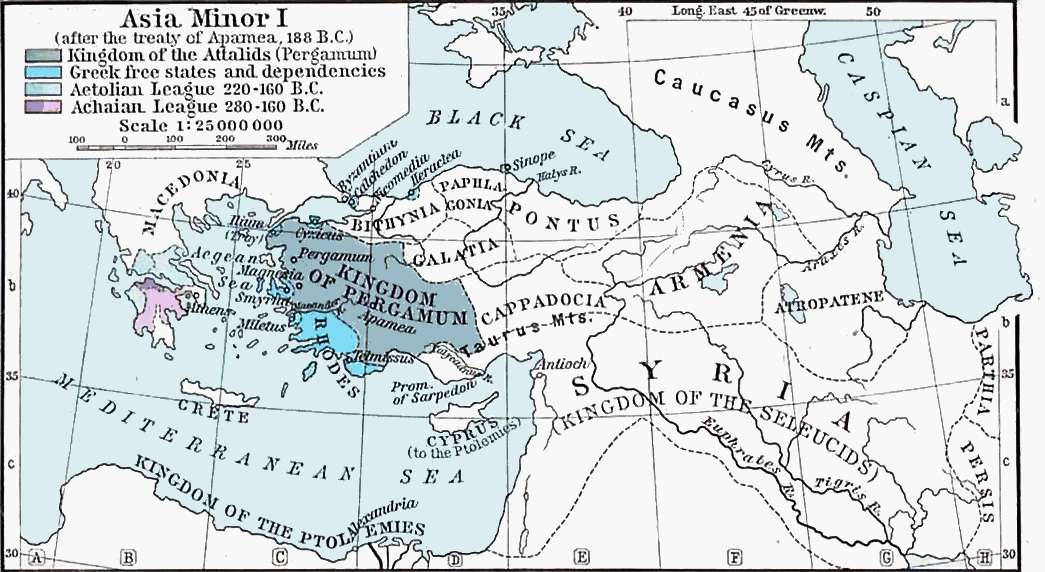
As you can see, not a small place.
** Alexandria kept the originals*** and gave the owners the copies. Piracy of intellectual property is not new.
*** According to Galen, they were catalogued under a special heading: “books of the ships”.
Boat Trip Through History: A Stop at the Papyrus Institute
Over the years, I have gone to many, many living history sites at which people in period costume demonstrate blacksmithing[1], quilting, weaving, making soap, and cooking in a pre-modern kitchen. Even when it is a traditional skill that I have seen demonstrated many times before, I always come away with a sense of amazement.
I did not expect to have a similar experience at the Papyrus Institute.
In many ways, the Papyrus Institute reminded me of the rug workshops that are an unavoidable stop in any country with a handwoven rug industry, in which the “lesson” about rug weaving is only a pitch for selling rugs.[2] And in fact, the “institute” was clearly designed to sell tourists the works made on papyrus that hung on its walls[3] —better quality and much more expensive than those sold in the small bazaar that surrounded every monument we stopped at but still obviously designed for the tourist trade.
There was no attempt to evoke the past. In fact, the counter at which a staff member demonstrated making papyrus reminded me of a high school science lab station, as did the demonstrator’s presentation style. He spoke briefly about the symbolic significance of the papyrus plant as the heraldic emblem for Lower (i.e.) Egypt.[4] Then he took us through the steps of making papyrus paper —slowly, carefully, calmly.[5] Fibrous layers were removed from the stem of the plant in strips. The strips were soaked and then laid side by side in two layers: one layer laid lengthwise, then topped by another layer at right angles to the first. The two-ply stack was then pressed together; as it dried the glue-like sap of the plants cemented the layers together, creating a sheet of paper.[6]
To my surprise, it was absolutely fascinating.

Payprus document ca 1900 BCE
Image courtesy of the Metropolitan Art Museum
A few other papyrus tidbits:
- The earliest extant piece of papyrus is a blank scroll from around 2900 BCE.
- The first examples with text date from about 2500 BCE, which is about the same period as the earliest known statue of a scribe.
- Although paper is the best known use of the papyrus plant, ancient Egypts, also used it to make small boats, mats, boxes, baskets, sandals, and ropes, similar to the way birch bark was used in North America.
- Papyrus could be erased and reused.
[1] Eternally fascinating as far as I am concerned Almost magical.
[2] We made that stop several days prior to visiting the Papyrus Institute. Watching a rug maker at work was interesting the first time I saw it, but it doesn’t continue to grip me the way blacksmithing does.
[3] And yes, I succumbed to a very appealing landscape that I need to have framed.
[4] It is worth pointing out that the Nile flows north to the Mediterranean, not south. So when you take a boat ride down the Nile, you go north. This may feel wrong, but it is true. Look at a map if you don’t believe me.
[5] One of the variations of a mantra that our guide repeated many many times a day as we walked on uneven surfaces through a gauntlet of vendors selling papyrus bookmarks and fake alabaster statues. (In retrospect, I regret not buying a pack of the bookmarks, which were ten for a dollar. I go through a lot of book marks)
[6] I am missing a step or two, but you get the idea.
Boat Trip Through History: The Temples at Abu Simbel
When we sat down to review the materials from the tour company for our Egypt trip, my BFF from graduate school and I had to make several choices about optional excursions that weren’t included in the basic trip.[1] The biggest of those excursions was an all-day trip to the temples at Abu Simbel. (Including a couple of flights in a prop plane!) As far as we were concerned, it was an immediate yes. It was definitely worth it.

Unlike most the of the Egyptian temples we saw, which were built from blocks of stone transported from the quarries of Gebel Silsila,the temples of Abu Simbel were carved out of the mountainside. They were commissioned in the thirteenth century BCE by the pharaoh Ramses II, aka Ramses the Great,[2] as a monument to himself and the first of eight Royal Wives, Queen Nefertari (b. 1301 BCE).[3] (They married before he became pharaoh and the sources suggest it was a genuine love match.)
Time passes even if you’ve styled yourself “the Great.” Over the centuries the temples fell into disuse and were slowly buried by sand.
Abu Simbel was rediscovered[4] in 1813 by Swiss explorer Johann Ludwig Burkhardt (1784-1817), who saw the top frieze of the main temple sticking out from the sand. Five years later, excavation of the temples began after Italian archaeologist Giovanni Belzoni[5] (1778-1823) located an entrance to the temple.
The temples at Abu Simbel are astonishing. Ramses II’s temple is dedicated to the sun gods Amon-Re and Re-Horakhte. (Nefertari’s smaller temple is dedicated to the worship of the sky-goddess Hathor. )Two enormous seated statues of Ramses II sit on either side of the main entrance to the temple. Three consecutive inner halls, decorated with pictures celebrating events in Ramses reign, extend 185 feet into the cliff.[6] The truly extraordinary feature of the temple is that it was designed in such a way that the first rays of the morning sign penetrate its inner chamber twice a year near the equinoxes— highlighting the faces of three of the four gods portrayed therein, Amon-Re, Re-Horakhte, and Ramses II in his persona as the living incarnation of Re-Horakhte on earth. The fourth guard, Ptah, the god of darkness remains unlit.

The fact that the temples can still be seen is equally astonishing.[7]
In the 1960s, the pending construction of the Aswan High Dam,threatened Abu Simbel and other Nubian antiquities with inundation in the giant artifical reservoir that the dam would form, now known as Lake Nasser. UNESCO spearheaded an international effort to save the monuments, described by André Malraux, the French Minister of Culture as “a kind of Tennessee Valley Authority of Archeaology.” It was the organization’s first major campaign since its formation in 1945. Some thirty countries formed national committees to support the operation; more than fifty countries donated money to the effort.
Several plans for saving Abu Simbel were proposed and rejected before a solution was accepted. It required engineering on a heroic scale: The team dug away the top of the cliff and then dismantled the temples, cutting them into more than one thousand blocks, each of which weighed some thirty tons. They reassembled the temples on an artificial cliff that was 180 miles inland and 64 miles above the original site, carefully aligned to reproduced the biannual entrance of light into the inner chambers.
Relocating Abu Simbel was the most dramatic portion of the Nubian Campaign. Over the course of twenty years, forty separate technical missions, drawn from across the world, saved a total of twenty-twomonuments and complexes from inundation. The last monuments to be moved were the temple complex at Philae, built in honor of the goddess Isis around 370 BCE.
In 1979, the rescued monuments were designated a UNESCO world heritage site.
[1] Though in all fairness, there was nothing basic about any of it.
[2] What made him great? In part the fact that he really, really, liked to build monuments to himself telling us how great he was. Victorian travel writer Amelia Edwards summed it up in her 1877 account A Thousand Miles Up the Nile: “We know now that some of the pharaohs were greater conquerors. We suspect that some were better rulers. Yet next to him, the other seemed like shadows…His features are as familiar to us as those of Henry VIII or Louis XIV.” —Two other rulers with big egos, I might point out.
[3] Not Nefertiti (ca 1370-1330 BCE), who was the great royal wife of King Akhenaten.
[4] A world that always sets off warning bells for me. Obviously local residents were aware that something was there.
[5] Using the term archaeologist to describe Belzoni is a bit of a stretch. He had a passion for collecting antiquities, without regard to their significance, and caused plenty of damage to the sites in the process of getting them.
[6] Roughly the height of the Leaning Tower of Pisa or the Cinderella Castle at Disney World. Or if you insist on the usual comparison: a little more than the width of a football field.
[7] If you want to read a detailed account of the story of how the temples were saved, I strongly recommend Empress of the Nile by Lynne Olson.