




History in the Margins Turns Six, or Time Flies When You’re Having Fun

After several hours of surfing the web, I realized that it is impossible to improve on this picture from last year. Thus are traditions born.
Happy birthday to us!
Six years ago, I started writing History in the Margins with a blog post that asked the question “Why another history blog?” * It was a question I had struggled with for a good year before I decided to jump into the blogosphere. I didn’t have a time or place that I wanted to focus on. What I did have was a vague sense of the kind of stories I wanted to tell and the voice I wanted to tell them in. I felt strongly that as a society we need to hear the stories that don’t get told in high school history classes: the history of other parts of the world as well as history from the other side of the battlefield, the gender line, or the color bar.
Over the last six years, my basic idea about what History in the Margins should be hasn’t changed much. The only thing that has changed is the number of people who hang out here in the Margins. I am honored that you take the time to read my posts and thrilled that some of you write emails or leave comments in response.
It’s become a tradition that I give away books to celebrate the blog’s birthday. If you’re interested in throwing your hat into the medium-sized mixing bowl, comment here on blog or on Facebook or send me an email before midnight on May 28. Tell me which book you’re most interested in, what kind of stories you’d like to see more of here on the Margins, or what type of history you enjoy.
Here’s what I’m giving away:
Louis S. Warren. God’s Red Son: The Ghost Dance Religion and the Making of Modern America
Michael Stokes Paulsen and Luke Paulsen. The Constitution: An Introduction
Nicola A. Phillips. The Profligate Son: A True Story of Family conflict, Fashionable Vice and Financial Ruin in Regency Britain
Hugh Kennedy. Caliphate: The History of an Idea
Keith Jeffrey. 1916: A History
David Lough. No More Champagne: Churchill and His Money
(*ahem*) Pamela Toler. Heroines of Mercy Street**
Let the party begin! Unlike Mr. Churchill, surely we have champagne somewhere around here. Or at least a couple of funny hats.
*My second post was titled “Sylvester II: Scientist, Pope, Wizard–Vampire?” That’s the kind of risk you can take when you are sure that only six people are reading and all of them love you dearly.
**I would be a bad bad author if I didn’t include my own book here, right?
And Speaking of Napoleon in Egypt…
While writing my last blog post I was stunned to realize that I’ve never written about Napoleon’s invasion of Europe here on the Margins. I’ve hinted around the edges of the subject in posts on the Rosetta Stone and Tipu Sultan. But I’ve never written about the invasion itself. Which is kind of amazing given that the image on the header of History in the Margins (and on my website and on my business cards) is from Jean-Léon Gérôme’s Bonaparte Before the Sphinx (1886)–a painting that I think is a brilliant illustration of the complex relationship between Europe and the rest of the world during the long eighteenth century.
Here goes:
In December, 1797, France was poised to invade England. The revolutionary French Republic had made peace with Spain, Russia and Holland.* General Bonaparte was negotiating with Austria. Russia had not yet declared war. Only England and Portugal stood armed against France.
In February, after inspecting preparations for the invasion, Bonaparte wrote to the five-man committee who governed revolutionary France (hereafter referred to as the Directoire) and proposed France invade Egypt instead. He argued that the military and financial resources available for invading England were utterly inadequate.** The best way to attack England was through the East. The conquest of Egypt would not only weaken the Ottoman Empire, but would cut England’s access to India, thereby weakening Britain.*** The Directoire agreed.
The Egyptian campaign was a military disaster. (When Napoleon failed, he failed on the grand scale. )
The Army of the Orient sailed for Egypt on May 19, 1798. After capturing Malta, the French landed on the beach at Marabut**** on July 1. Without issuing supplies or giving his men time to recover from a grueling sea voyage, Bonaparte marched them across the Libyan Desert. They attacked first Alexandria and then Cairo. Both cities fell quickly. Always a master of the political spin, Bonaparte reported glorious victories to the Director. He left out the fact that French morale was low. One officer wrote home “…it was thirst which inspired our troops in the capture of Alexandria. At the point the army had reached, we had no choice between finding water and perishing.”
The morale of the conquering army would sink further. On August 1, 1798, Admiral Horatio Nelson annihilated the French fleet at Abukir By. He left behind a squadron of three battleships and three frigates to patrol the coast from Damietta to Alexandria, effectively cutting off all communication between the Army of the Orient and France.
Stranded with no news or supplies from France and an empty treasury, Bonaparte chose to lead with his chin. He moved the war into Syria, leading 13,000 men against the Ottoman Empire. He only got was far as Acre before he was turned back by a combined force of British and Ottoman troops. Bonaparte camouflaged the humiliation of the retreat in his reports to the Director with the news of a stunning victory against the Ottomans at Abukir.
Bonaparte slipped away from Egypt on August 18, 1799, without notice to either his staff or his successor. He reached France only a few days after the news of his victory at Adukis, in time to seize power in the coup of November, 1799. He left behind a deficit of twelve million francs and an occupying army demoralized by devastating losses, illness, and lack of supplies.
So much for following Alexander’s path to the east.
*That wouldn’t last.
** Check your atlas if you don’t have the relative positions of England and Egypt in relation to France firmly in your head. Then try to follow the reasoning.
***He did not mention his personal dream of following in Alexander the Great’s footsteps and conquering India.
****An islet down the coast from Alexandria. You might as well keep your atlas out if you are map-minded.
Word With A Past: Guerrilla Warfare
Guerrilla tactics are probably as ancient as war itself. The word itself dates from the Napoleonic wars, a product of the Peninsular War of 1808-14 in Spain—the most prolonged and, with the exception of Napoleon’s invasion of Russia, most destructive campaign of the period.
Napoleon’s invasion of Spain had its official roots in long-simmering tensions between King Carlos IV of Spain and his son Ferdinand. (Though it’s hard to believe that Napoleon wouldn’t have invaded eventually even without an excuse.) Fearful that his father intended to remove him from the succession, Ferdinand asked for help from Napoleon in deposing his father.*
Carlos IV and his wife were not popular with their subjects. In March 1808, a popular uprising forced Carlos to abdicate in favor of Ferdinand. The new king arrived in Madrid on March 24, one day after the French commander Joachim Murat entered the city at the head of the French army. Popular feeling against Carlos IV’s corrupt government was so strong that many Spaniards greeted the French as liberators.
By the end of April, it was clear that the French had come to conquer Spain, not to liberate it. Both Carlos and Ferdinand, held captive in the French city of Bayonne, abdicated. By the time Napoleon named his brother Joseph the king of Spain on May 10, the country had already risen in rebellion.
-
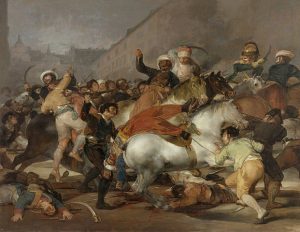
- Francico Goya. The Second of May
-
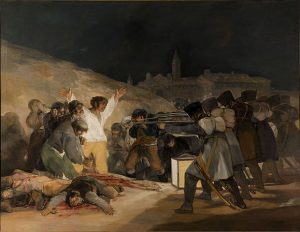
- Francisco Goya. The Thrid of May
On May 2, rumors began to spread that the French planned to forcibly remove the remaining members of the royal family to Bayonne. Violent protests erupted in Madrid. A Mamluke cavalry unit, a souvenir of Napoleon’s invasion of Egypt,** charged the protesting crowd, which was armed with little more than cudgels and knives.*** Once the protestors were dispersed, Murat’s men rounded up everyone they could find who was armed. Executions lasted through the night and well into the morning.
The brutal repression of the May 2 protest fueled Spanish resistance. For six years, Spanish patriots, men and women alike, fought against the French occupiers in small irregular bands and provided critical support to the British Army in the Peninsular War against France. They were termed guerrillas—a diminutive of the Spanish word for war, guerra.
Guerrilla warfare: a little war, often pursued with big aims.
*This should be filed in the Big History Binder labeled “what were they thinking???”
**More useful than a t-shirt or a scale-model of the Pyramids.
***Unfortunately, variations on this show up more in history with some regularity. And not just in the distant past. Or in other countries.