




City of Light, City of Poison
One of the advantages (or disadvantages depending on the day) of hanging out with writers and spending time on the internet fringes of the publishing industry* is that you have advance warning of books before they reach the bookstores. Sometimes the wait is torture.
Holly Tucker‘s latest book, City of Light, City of Poison: Murder, Magic and the First Police Chief of Paris, was worth the wait.

Tucker walks the tightrope between scholarship and storytelling with practiced bravado.
City of Light, City of Poison is as tightly structured as an Agatha Christie mystery. She opens with a letter from a dead man and the hint of a past mystery. She follows newly appointed police chief Nicolas de la Reynie step-by-step as his investigation of two brutal murders leads him to discover a deadly network of witches, poisoners, and blasphemers with connections perilously close to the king himself.*** (His investigation also causes him to invent a seventeenth century version of forensic science, including chemical–or at least alchemical–analysis of poisons.) She places his investigation inside the sometimes vicious politics of Versailles with a sure hand. The story had me in its grip from page one. In fact, I read it when I should have been reading books related to my work.****
In a fascinating epilogue, she draws aside the curtain and shares her process of research and writing with the reader, leaving no doubt about the rigor of her scholarship.
Tucker’s last book, Blood Work, was excellent. This book is in a different league altogether. With City of Light, City of Poison she enters the rare list of authors who write historical non-fiction that is truly as gripping as a novel.*****
*Some writers plunge neck deep into publishing news and gossip. To me that feels like plunging up to your neck in swampy water, with a strong possibility of leeches.** I prefer wading in at the edges of a clear mountain river. But I digress.
**If you’re picturing Hepburn and Bogart in The African Queen you’ve got the idea.
***I now have even more admiration for my colleagues at Shelf Awareness who review fiction. Avoiding spoilers while maintaining a sense of the story is hard work.
****I’m paying for it now, but it was worth it.
*****Erik Lawson, David McCullough, Barbara Tuchman, Simon Winchester–like that.
What Makes a Mosque, Part Five: America’s Oldest Mosque

By Jonathunder – Own work, GFDL 1.2, https://commons.wikimedia.org/w/index.php?curid=49833486
If you listen to the news, you’d think that Islamic immigrants to the United States are something new. They’re not.
Beginning in the 1880s and ending only when the United States closed the door on non-European immigrants in 1924, Muslims from Ottoman-controlled Syria joined the rush to emigrate to America. Like their European counterparts, most of the Syrians who came to America were single young men who intended to work for several years and then go home to find wives. Like their European counterparts, most of them made a home and stayed.
The majority of the Syrian immigrants settled in northeastern cities. A few found their way further west. Cedar Rapids, Iowa, became the unlikely home of a growing Islamic community.
The Syrians who settled in the Midwest worked as peddlers, selling dry goods and notions to farm wives in the days before Montgomery Wards and Sears put their catalogs in every rural mailbox. As soon as they could afford it, they sent for their brothers, and then their wives, to join them. The most successful accumulated enough money to open small stores and to stake a new immigrant to his first peddler’s pack. By the 1920s, Arab-owned shops were common in the upper Midwest. In Cedar Rapids alone there were 50 Arab-owned groceries.
The Islamic community of Cedar Rapids soon grew too large to hold the Friday prayer in individual homes. In 1920, they rented a hall and converted it into a mosque. Like the congregation of every storefront church in America, the Muslims of Cedar Rapids dreamed of the day they would worship in a building designed for the purpose. In 1929, they began to build the second American mosque.* The Depression slowed them down, but didn’t stop them. In the best American tradition of barn-raising, young men from the congregation did much of the work themselves. In 1934, the mosque was complete.
The builders of the mosque may have come from the Middle East, but the new mosque was pure Midwest: a small white clapboard building with a cinder-block foundation. The only thing that distinguished it from a country church or a one-room schoolhouse was the small green dome over the front door. Even the crescent-topped spire looked more like a church steeple than a minaret.
In their own way, the Muslims of Cedar Rapids built a domed mosque in the Ottoman tradition. Every Ottoman mosque provided essential social services to the community it served. In sixteenth century Istanbul, that meant attaching a public bath or a soup kitchen to a mosque; in twentieth century America it meant a basement social hall for weddings, parties, and bingo. Move over, Suleyman.
Today there are more than one thousand mosques in America.They range in style and size from unobtrusive storefront prayer rooms to the Islamic Cultural Center on Embassy Row in Washington, D.C. Most are located in buildings originally designed for another purpose: office buildings, bowling alleys, abandoned stores. Like mosques built in Istanbul, Timbuktu, or Jakarta, those built specifically as mosques are constructed in styles and materials that reflect the local community’s ideas about what a mosque should look like. Some use traditional designs borrowed from Islamic lands. Some re-interpret traditional design with American elements. Others are blazingly modern. The one thing they all have in common, with each other and with every other mosque around that world, is that one wall that directs the faithful towards Mecca.
*The first mosque was built in Ross, North Dakota earlier that year. It is no longer standing.
What Makes A Mosque, Part 4: A Mosque in Malaysia
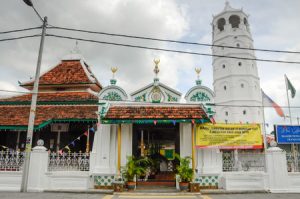
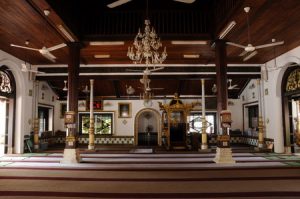
Nothing about the Tengkera Mosque of Malacca City says “Islam” to a Western observer. Its three-tiered roof and elaborate entrance gate would be at home in any Chinatown in America. The freestanding octagonal tower looks more like a pagoda than a minaret. Built in 1728, the Tengkera Mosque reflects the melting pot character of the Melaka Sultanate during its heyday.
The city of Melaka was founded in 1402 by a fugitive Hindu prince from Sumatra who subsequently converted to Islam to please a powerful father-in-law. Prince Paramesvara chose his location well. He built his new city on the deepest natural port on the Straits of Melaka, which controlled the trade routes between India and China. By the end of the fifteenth century, Melaka had become an important international trading hub, home to merchants from China, Sumatra, India, and the Middle East.
As the city grew, the size of its foreign immigrant community increased. Each group of immigrants brought new building materials, construction techniques, and architectural styles with them. The result was a building style that one architectural historian has called “Straits Eclectic”: traditional South East Asian timber architecture with Indian and Chinese accents.
Unlike their counterparts in the Middle East and India, the Melaka sultans did not build monumental state mosques. The earliest mosques in the region were nothing more than a pavilion on a raised platform with a thatched roof and one solid wall on the side that faced toward Mecca. Over time, the pavilion developed into a small square building topped with a steeply pitched three-tier tile roof.
In many ways, the final form of the Melaka-style mosque is nothing more than a pavilion with a Chinese party hat. Each tier of the roof is supported by a square of wooden pillars, with the prayer hall centered under the top tier of the roof. The wall of the prayer hall that faces toward Mecca is always solid but the other walls are often nothing more than an open row of pillars. Often there is an open space between roofs to allow air to circulate. On the exterior, the tile roofs sweep upward and end in an elaborate finial.
An elegant solution for a climate very different from the Arabian deserts where Islam was born.