




Pippi Longstocking Goes to War
(Okay, I admit it. That’s an inaccurate, click-bait of a title.)
-
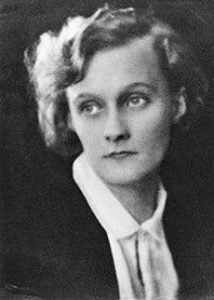
- Astrid Lindgren, 1924
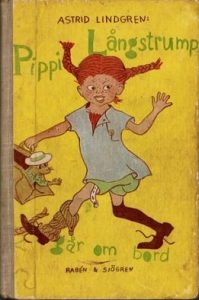
Today Astrid Lindgren is famous as the creator of Pippi Longstocking: the red-headed quirky rebel who proclaimed herself the strongest girl in the world.* In World War II, Lindgren was a 30-something housewife and aspiring author. Her war diaries, published posthumously in Sweden and recently translated into English, are a fascinating account of life in neutral Sweden during World War II.
If you read War Diaries, 1939-1945 hoping to get insight into the creative process behind Pippi Longstocking, which was published just before the end of the war. you will be disappointed. There are few references to her writing. If you want a wartime narrative written by an intelligent observer that offers a different perspective than the British accounts most familiar to American readers, Lindgren’s your girl.
The diaries are a mixture of the personal and political. Marital problems, concerns about her son’s difficulties at school and rumors about increased rationing are intermixed with her determination to document the course of the war. She lists the menus for birthday dinners and holiday celebrations, commenting each time on how lucky Sweden is to have abundant food and fearing that each feast will be the last. She pastes in newspaper clippings of critical events.
She also adds privileged information that adds depth to her reporting. Lindgren worked on the night shift for a government security agency responsible for censoring correspondence sent from or to other countries. Although her work was so hush-hush that her children did not know what she did, she had no hesitation about copying and commenting on sections of the letters in her diaries, including letters describing the transportation of Jews to concentration camps in Poland as early as 1941.
Lindgren’s War Diaries tell the story of the war as seen through the veil of Swedish neutrality—a veil that Lindgren recognized was perilously thin. She records her relief and guilt over Sweden’s relative prosperity, her shame over allowing German troops to travel through Sweden, and her fear that Russia will prove to be a greater threat to Sweden than Germany. For those of you who are serious World War II buffs, it may all be alte wurst. For me, it was a new approach to a familiar topic.**
*One of a long string of red-haired literary rebels and misfits who inspired and comforted a certain red-haired future history buff.
**I’m beginning to see a theme here. Sometimes I think I know nothing at all about history.
Much of this review appeared previously in Shelf Awareness for Readers
Mercy Street, Round 2
 Back in November I promised you that I wouldn’t clutter History in the Margins with little bits of news and speaking gigs. And I intend to keep that promise.
But I want to give the Marginalia a heads up that the PBS series Mercy Street will air a second season starting on January 22. Which means I will be starting another round of speaking and promotion related to the book.
The first gig will be on January 18: an interview on Civil War Talk Radio. Gerry Prokopowicz of East Carolina University hosts a weekly hour long interview with authors, historians, museum curators and the like about the Civil War. I’ll be in good company. Think Doris Kearns Goodwin, Jeff Shaara, Ken Burns.* The show is internet-based. Programs are archived so you can listen to me, or Ken Burns,** at your leisure.
On February 2, I’m scheduled to speak at the Pritzker Military Library here in Chicago. If you’re in the Chicago area, I’d love to see you there. If not, the talk will livestream. The woman who runs the program tells me I don’t have to perfect, I just have to be awesome. No pressure there.
If you want to know what I’ll be doing when going forward, the schedule will be on the newsletter.** It’s also on the events page on this blog.
It’s going to be Big Fun!
*Be still my nerdy fangirl heart.
**Episode 104. October 15, 2004.
***Feel free to sign up if you haven’t already. (Click here)
Victoria: The Novel
I don’t normally review novels here on the Margins. In fact, I seldom review novels, period. I read constantly for my work: Big Fat History Books, erudite (and sometimes not so erudite) articles, the first hand accounts on which Big Fat History Books depend.* When I read for fun, I read fiction. I try not to let the line blur.
Today I’m making an exception.**But recently I had the opportunity to interview Daisy Goodwin about her newest novel, Victoria, and the BBC series she created based on the same material.*** The book was not only a delight, it forced me to think about the line between history and fiction.
Here goes:
Daisy Goodwin, author of The American Heiress and The Fortune Hunter, has a reputation for making the nineteenth century come alive. Her historical novels feature impeccable research, an eye for telling details, and strong female protagonists. In her latest novel, Victoria: A Novel of a Young Queen, she tells the story one of the strongest and least Victorian female characters of the era—Queen Victoria herself.
Alexandrina Victoria came to the throne less than a month after her eighteenth birthday. No one expected her to be a powerful, or even competent, ruler. Not only was she young, but she was tiny, virtually unknown, and woefully inexperienced. Her childhood had been more than sheltered—prior to her accession to the throne her mother, the Duchess of Kent, and her mother’s favorite, Sir John Conroy, controlled every aspect of the princess’s life. Drina, as her mother called her, was not allowed to play with other children, attend social events, or even walk down the stairs unsupported.
The young queen stepped into her new role as the most powerful monarch in the world with determination and dignity. Her first act was to insist that she be called Victoria. A seemingly small decision, but one with enormous symbolic significance. In rejecting her mother’s childhood nickname for her, Victoria declared her independence.
As Goodwin makes clear, that independence was regularly challenged at the beginning of Victoria’s reign. The young queen was surrounded by people who wanted to co-opt her for their own ends. Her mother and Conroy struggled to retain positions of power in Victoria’s household. Her paternal uncle, the Duke of Cumberland, schemed with Conroy to have her declared insane so he could be named regent. Her maternal uncle, King Leopold of Belgium, hoped to become the power behind the British throne—a position he would have held as the husband of Victoria’s late cousin, the Princess Charlotte. Even Lord Melbourne, who became Victoria’s most trusted advisor, began their relationship with the intention of creating a queen from a girl with no political education.
Victoria takes place over the first two years of Victoria’s long reign, from the moment she learns she is queen through her marriage proposal to Prince Albert. Goodwin tells the story primarily from Victoria’s perspective, drawing on the queen’s voluminous personal journals.**** The result is a compelling account of a young woman navigating her way through political intrigue, family drama and unexpected romance.
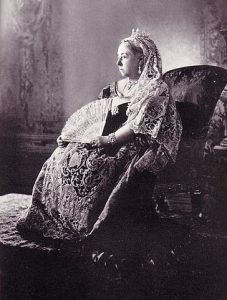
Goodwin brings a firm understanding of the historical events surrounding Victoria’s accession to the story, but the power of the book comes from her treatment of personal relationships and her exploration of Victoria’s character. The portrait of Victoria that Goodwin paints is a far cry from the popular image of the queen as a stout old woman who was not amused.***** Goodwin’s Victoria is by turns innocent, shrewd, and passionate. She loves to dance, has an eye for a good-looking man, and is, in fact, often amused.
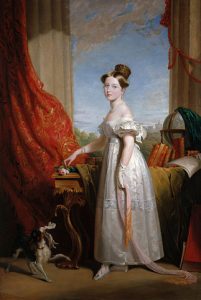
Goodwin leads the reader through Victoria’s development as both ruler and woman. At the beginning of the novel, Victoria still talks to the doll that is the closest thing she has ever had to a childhood companion and is overwhelmed by the boxes of correspondence that arrive on her desk as soon as the death of her uncle, King William IV, is announced. Over the course of the book, she learns the business of government, finds allies (sometimes in unexpected places) and discovers how fragile royal popularity can be. She recreates the physical trappings of royalty to fit a woman who was less than five feet tall. (It’s hard to be dignified when your crown is too big and you sit on your throne like Edith Ann on her sofa.) She identifies with Queen Elizabeth I and sees her as a role model.
Goodwin skillfully walks the fine line between history and fiction in her portrayal of the relationships between Victoria and those around her. She takes the historical facts of Victoria’s troubled relationship with her mother, her loathing for Conroy, and the friendships she develops with her ladies-in-waiting—friendships strong enough to precipitate the political crisis known as the Incident of the Bed Chamber—and brings them to life in ways that illuminate Victoria’s choices. She makes a more daring choice in her treatment of the relationship between Victoria and her favorite Prime Minister, Lord Melbourne. The nature of that relationship has been a matter for speculation almost from the beginning. Goodwin comes down heavily in favor of an unrealized romance between the two. Her treatment of the romance is historical fiction at its best: woven from hints and details to create a believable whole. Whatever the truth of Victoria’s relationship with Melbourne, Goodwin’s treatment of it provides a bittersweet bridge to Victoria’s undoubted romance with the man who would become her husband, Prince Albert.
Ultimately, Victoria is a coming-of-age story. Its emotional arc is summed up in two sentences early in the in the novel. Goodwin uses a real-life scandal from early in Victoria’s reign, the Flora Hastings incident, as a turning point in the queen’s development. As Lady Flora lays dying, she tells the young queen who has wronged her, ” Your subjects are not dolls to be played with. To be a great Queen, you must be more than a little girl with a crown.”
It’s a lesson that Goodwin’s Victoria takes to heart.
*I’m not complaining. It’s a great gig.
**If any publicist who’s offered me a review copy of a historical novel and gotten a polite “no thank you” is reading this, all I can say is my blog, my rules.
***The first episode airs in the United States on January 15. Check your local PBS station for details. I plan on watching.
****She wrote more than 62 million words of diary entries over the course of her lifetime. My hand aches at the thought.
*****In all fairness, she probably didn’t say this. In fact, she was adamant that she didn’t say this. And while we’re defending misquoted queens, Marie Antoinette probably didn’t say “let them eat cake.”