




Road Trip Through History: The American Cemetery
People often visit the English Cemetery* when they go to Florence. The final resting place of prominent nineteenth century inglesi, including Elizabeth Barrett Browning, the cemetery is by all accounts a beautiful park in a city that already teems with beauty.
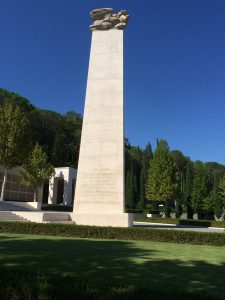

It was on our list of possibles, but when push came to running out of time we chose the American Cemetery instead. Where the English Cemetery holds the graves of self-selected nineteenth century expats, the American Cemetery honors an involuntary group of expatriates: 4398 American soldiers who died in the Allied campaign to liberate Italy in World War II. The cemetery site was taken by the US Fifth Army on August 3, 1944 and was subsequently granted for use as an American burial ground by the Italian government **
When I think of Florence and history, I think of the Renaissance. I don’t think about World War II. This is, of course, ridiculous. When you are in Florence, subtle reminders of the war are everywhere. Stories of museum curators and librarians who protected treasures of Renaissance art. Bridges that no longer exist because retreating German forces destroyed all of the bridges across the Arno except for the Ponte Vecchio, which was spared at the last minute.*** (Instead they blocked access by destroying the medieval buildings at either end of the bridge.) Tales of collaboration, resistance and the tricky balancing act in-between.
There is nothing subtle about the American Cemetery, which is made up of seventy acres of beautifully maintained graves and an imposing monument that tells the story of the Allied push from northward from Rome to the Alps. It is breath-taking, impressive, heartbreaking. But the thing that got me right in gut was the guest book. Most of the visitors who signed in were not American but Italian. And in the comments section one of them wrote a single word–grazie. Thank you.
*Yet another historical misnomer, like Prince Henry the Navigator or the Silk Road. The cemetery was founded in 1827 by the Swiss Evangelical Reformed Church and originally named the Protestant Cemetery. But the over the course of the century the size of the Anglo-Florentine community grew. So did the number of English (and American) Protestants who needed a final resting place.
** The American Battle Monuments Commission maintains American cemeteries and memorials, including the cementery in Florence, in sixteen countries.
***Tour guide history attributes this to a personal order from Hitler. I suspect this is comic-book history, but I don’t really know.
From the Archives: Why You Can’t Vote
If you’ve been hanging around the Margins for a while, you’ve read this one before. I think it’s worth repeating.

From sixth century Athens on, who has the vote and why has been a touchy and evolving subject in democracies. People who already have the vote have hesitated to extend it to others for two basic reasons. Those with the vote don’t think those without the vote have the capacity to make good choices. Those with the vote fear they will lose power.
Over the centuries, people in power have come up with plenty of reasons not to extend the franchise to those who don’t yet have it. Here are a few of the classics:
You can’t vote because
- You’re a slave
- You’re a woman
- You don’t own property
- You don’t own enough property
- You don’t practice the right religion
- You are the wrong race or ethnicity
- Your father or grandfather couldn’t vote
If you’re lucky enough to have the vote, use it.
Word(s) With A Past: Left and Right as a Political Metaphor

As some of you may have noticed, here in the United States we’re coming to the end of a long, weird election season. A lot of labels have been thrown about with little reference to what they mean or why. At some point, when I had become almost numb from the rhetoric, it dawned on me that I had no idea why we refer to liberals as the left and conservatives as the right. * The answer turned out to be surprisingly simple.
In the early days of the first French Revolution,* members of the newly formed National Assembly chose their own seats. As we all tend to do, they chose to sit next to people who shared their basic values. Most of the more radical Revolutionaries sat together on the left of the newly elected president of the assembly. Supporters of the monarchy, presumably more conservative in the modern sense of the word,** clustered to his right. More than 200 years later, a chance decision about seating remains one of our principal political metaphors.
* I think this response is closely related to the times when I struggled with a word so long that ALL the spellings look wrong. (This doesn’t just happen to me, right?)
**An event to which the word simple is seldom applied.
***Though my guess is that most of them would fail the “family values” test.
Photograph copyright: popaukropa / 123RF Stock Photo