




1624: The Year in Review
In 2013, I wrote my first A Year in Review post: for some reason that I no longer remember I had been spending a lot of time thinking/reading/writing about 1913 and wanted to share some of the highlights. Over the next few years, Year in Review posts became a standard part of December here on the Margins. I let them slip for the last two years, mostly because I was so deep in the life and times of Sigrid Schultz. It’s a shame: 1923, for example, was quite a year.*
This year, it’s time to renew the tradition, kicking off with 1624.
❦❦❦❦
In the New World:

Captain John Smith’s map of Virginia, dated 1624
The Virginia Company, which owned Jamestown, the first permanent English settlement in North America, was bankrupt. King James I of England** (and VI of Scotland) revoked the company’s charter on May 24 and made Virginia a crown colony. A year later the colony of Virginia butted heads with the crown for the first time. The colonists petitioned the king (now Charles I) for the right to retained their own legislature. Charles refused. Apparently legislation without representation was an issue earlier than I realized.
Also in Jamestown that year, William Tucker was born. He was the first known Black child born in English colonies of North America. He was the son of two Africans who were among the first group of Africans to be brought to North America in 1619 by Portuguese slavers. The group were technically sold to English settlers as indentured servants, but unlike their European counterparts they did not enter this indenture freely. Also unlike their European counterparts, their children were born into slavery. Slavery, too, was an issue in the North Americana colonies from the beginning.
The Dutch West India Company established its own trading post on the Atlantic shore. New Amsterdam was part of the larger colony of New Netherland which included what is now New York City and parts of Long Island, Connecticut and New Jersey.
Sir Thomas Warner founded the first British colony in the Caribbean on St. Kitts.
The Dutch seized the capital of Spanish/Portuguese Brazil, after two previous attempts in 1599 and 1604. Their goal was control over the lucrative sugar trade, which was a very big deal.
In the larger world:

Curious Japanese watching Dutchmen on Dejima Island. Katsushika Hokusa. ca 1802.
The Japanese Shogun expelled the Portuguese and cut off trade with the Philippines, the first step in closing Japan to the west. (Some historical timelines say the Japanese expelled the Spanish. This is technically true. Portugal became part of Spain in 1580. But Portugal’s presence in Japan occurred as part of the Portuguese maritime exploration and subsequent trade empire.)
The English and Dutch were expanding their territories in Asia as well as in the New World. The Dutch East India Company established trading posts on the coast of Taiwan. The English established trading posts in eastern India.
Thanks to well-chosen dynastic marriages and New World wealth, Hapsburg Spain was the Big Bad for the rest of Western Europe over the course of the seventeenth century. In 1624, France and the Netherlands signed the Treaty of Compiègne, a mutual defense treaty designed to isolate Spain. Egged on by Cardinal Richelieu of France, England, Sweden, Denmark-Norway, Savoy and Venice coordinated action against Spain. It all fell apart in 1625, when the Huguenot rebellion distracted Richelieu


Meanwhile in Eastern Europe, Hungarian King Bethlen Gabor and Ferdinand II, who was then ruler of the Hapsburg [!!] Duchy of Lower and Inner Austria and may have been the Holy Roman Emperor,*** signed the Treaty of Vienna, ending the Bohemian phase of the Thirty Years War**** and strengthening Ferdinand’s position the Hungary. This may feel like an obscure event from the perspective of those of us whose history classes focused on American history, but was actually a big deal.
On a smaller scale:

Frans Hals painted The Laughing Cavalier. (An occasional image helps me place things in history. Also, a painting I’ve always loved. )
English mathematician William Oughtred invited the slide rule, building on John Napier’s invention of logarithms and Edmund Gunter invention of logarthmic scales.
Unlikely as it sounds, the first successful submarine, designed by Dutch inventor Cornelius Drebbel was publicly tested in London on the Thames before an audience of thousands, including King James. The submarine was built on a wooden frame covered with leathered and powered by oars. It submerged for three hours and traveled from Westminster to Greenwich and back—six nautical miles each way. King James took a test dive, but the British Royal Navy wasn’t interested in exploring the technology further.

Van Drebbels’ submarine in the Thames
*The USSR was formed. King Tut’s tomb was opened. Hyperinflation made life difficult in Weimar Germany. It became legal for women to wear trousers in the United States. Etc, etc, etc.
**Also, and originally, James VI of Scotland.
***Untangling the Hapsburg dynasty and its march to what became the Austro-Hungarian Empire is complicated. I definitely don’t have a handle on it.
** Here’s the short version: Reformation vs Counter-Reformation. Here’s a slightly longer version: The Third Year’s War was actually a series of wars, in which Protestant and Catholic princes battled for control of the Holy Roman Empire. The conflict began when the Protestants of Bohemia rebelled against Emperor Ferdinand II, but soon spread throughout the empire and included most of the European powers at one point or another.
Counting My Blessings
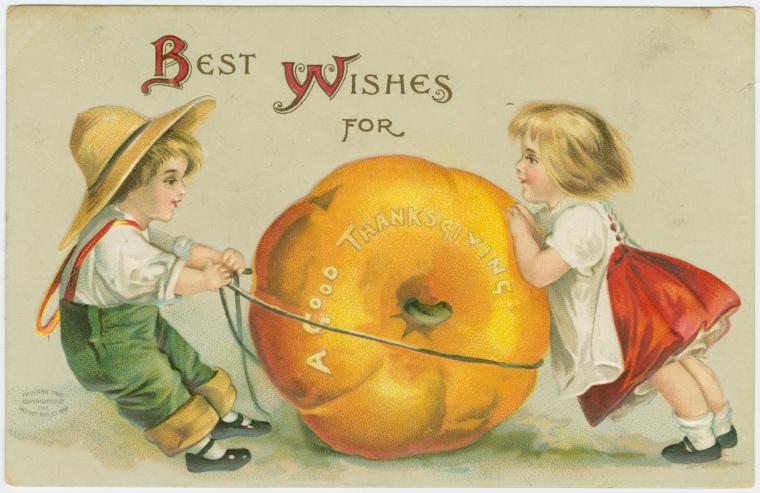
I keep looking for another vintage Thanksgiving postcard, but most of them have creepy children wielding axes. Not my vision of Thanksgiving.
It is Thanksgiving here in the United States, and I have a LOT to be thankful for this year, including the fact that I am at home cooking Thanksgiving dinner.*
In a few minutes I will begin several hours of peeling, chopping, stirring, and roasting, with an occasional pause to put my feet up and count my blessings. Before I head downstairs to pull the turkey out of the refrigerator,** I want to take a moment to thank all of you who read History in the Margins, share my posts with your friends, send me e-mails, ask hard questions, point out mistakes, give me ideas for new posts, and cheer me on. Without you, I’d just be talking to myself.
*A week and a half ago, we were making contingency plans for who was going to cook the heritage turkey that was due to arrive a few days before the holiday in case I had to be elsewhere.
**Yes, it is thawed.
_______________________
Speaking of sending me ideas, I am currently issuing invitations to my annual Women’s History Month series of mini-interviews. I have some great people on board already, but I need more. If you “do” women’s history in any format, or know someone who does, or have an idea of someone you would love to see in the series, drop me a line. I’ve interviewed academics, biographers, podcasters, historical novelists, tour guides, and poets, but would be happy to talk to people who explore women’s history through music, puppet shows, graphic novels, the visual arts, interpretive dance….
In which I finally review Headstrong: 52 Women Who Changed Science—and the World

Journalist Rachel Swaby’s Headstrong: 52 Women Who Changed Science—and the World is the source of one of my favorite descriptions of the work I do as a writer of women’s history: “revealing a hidden history of the world.”
Swaby was inspired to write her collective biography of groundbreaking women scientists by an obituary which appeared in the New York Times in March, 2013. The obituary began by reporting that Yvonne Brill made a mean beef stroganoff, that she followed her husband from job to job, and took eight years off to raise three children. Only then did the Times mention the reason she had earned an obituary: she was a brilliant rocket scientist who won the National Medal of Technology and Innovation for her development of a propulsion system that keeps satellites in their orbits, a system which became the international standard. As someone who also makes a mean beef stroganoff, I can assure you that the two accomplishments are not equivalent.
The Times quickly amended its article to begin with the rocket science after a loud public outcry, but the original obituary led Swaby to consider the way women’s careers and accomplishments in science have been, and unhappily continue to be, underreported. The result is Headstrong, a collection of brief biographies of women who have made lasting contributions to science. At the time the book came out in 2015, I had only heard of a handful of the women whose stories she tells: Rachel Carson, Rosalind Franklin, Irène Joliot-Curie,* Sally Ride, and Ada Lovelace. In the intervening years a number of others that Swaby introduced me to have become well-known, at least in those circles interested in women’s history. Others I know only from the pages of Headstrong.
The book is structured as a series of essays, perfect for dipping into when you need a bit of women’s history to remind you that we were there. (Swaby suggests that you read one a week over the course of a year. I was not that disciplined.)
If you know a girl who is interested in STEM and would like to know where she fits in a world that is still heavily male, Headstrong would be a nice place to start the search for role models.
*Who I knew only because she was the daughter of Marie Curie and, like her mother, won a Nobel Prize for chemistry. Swaby chose not to include Marie Curie because she is the woman “we talk about when we talk about women in science.”