




From the History in the Margins Archives: McCarthyism and the Red Scare, Part 2. Attacking “Communists”, and Anyone Else Who Got In His Way
If it seems to you that I’ve run a lot of posts from the archives lately, you would be right. At the moment, I am overwhelmed by life stuff and simply don’t have the bandwidth to write new posts on a consistent basis. Instead of letting the blog go dark, when I don’t have something new to say I will continue to share old posts that I feel you might enjoy or that seem relevant to the moment. Thanks for reading along. There will be new stories in the not too distant future. Honest.

Joseph Nye Welch, chief counsel for the US Army, being questioned by Joseph McCarthy
If you’re coming in late to the party, you may want to read the previous post. Here’s the short version: in 1948 Joseph McCarthy won a seat in the US Senate with a dirty campaign and began his senatorial career with a press conference calling for striking miners to be drafted, court-martialed, and then shot. Here’s what happened next:
By 1950, McCarthy’s Senate career was in trouble. The fact that he had lied about his war record during the election campaign had become public. Moreover, he was under investigation for tax offenses and for accepting bribes from Pepsi-Cola to vote in favor of removing wartime restrictions on sugar.
McCarthy directed public attention from his own problems by going on the attack. On February 9, 1950, while speaking to a group of Republican women in Wheeling, West Virginia, McCarthy announced that he had a list of 205 State Department employees who were “card-carrying” members of the American Communist Party,* some of whom were busy passing classified information to the Soviet Union.
When the Senate Committee on Foreign Relations asked McCarthy to testify, he was unable to provide the name of a single “card-carrying communist” in any government department. Undeterred by the absence of facts, McCarthy began an anti-communist campaign in the national media. His first step was claiming communist subversives had infiltrated President Truman’s administration. When the Democrats accused McCarthy of using smear tactics, he claimed that their accusations were part of the communist conspiracy.
As a result of McCarthy’s tactics, the Republicans swept the 1950 elections. Having watched him use scare tactics to discredit his opponents during the election, the remaining Democrats in Congress were reluctant to criticize him. McCarthy, whom the Washington press corps once voted “the worst US senator”, was now one of the most powerful men in Congress.
After being re-elected in 1952, McCarthy became the chairman of the Senate’s Committee on Government Operations, and more importantly of its permanent investigation subcommittee. In an ironic mirror image of Stalin’s trials of alleged counter-revolutionaries,** McCarthy used his position to hold hearings against individuals whom he accused of being communists and government agencies that he claimed harbored them. He attacked journalists who criticized his hearings. He campaigned to have “anti-American” books removed from libraries. He accused newly elected Republican president Dwight Eisenhower of being soft on communism.
McCarthy ran into trouble in April, 1954, when he turned his attention to supposed communist infiltration of the United States Army. The army fought back by providing information to journalists known to oppose McCarthy, including evidence that McCarthy had tried to use his influence to get preferential treatment for his aides when they were drafted. The end came with the decision to broadcast the “Army-McCarthy” hearings on national television. For thirty-six days Americans watched from their living rooms as McCarthy bullied witnesses and offered evasive answers to questions. At one point, after McCarthy attacked a young Army lawyer, the Army’s chief counsel, Joseph Nye Welch, demanded “Have you no sense of decency, sir?”
By the end of the hearings, McCarthy had lost most of his allies and the trust of the American people. Later that year, with a vote of sixty-seven to twenty-two,*** the Senate officially censured McCarthy for conduct “contrary to Senate traditions.” He remained in office, but had no power beyond his senatorial vote. (Which is not nothing.) He died before the end of his second term, leaving as his legacy a cautionary political tale of popular fear, demagoguery, abuse of power, and the value of a democratic system of checks and balances.
*Personally, I doubt that the American Communist Party issued membership cards at the time. It was a disorganized group prone to fracturing along theological lines.
**Ironic from an historical perspective. It is unlikely that McCarthy intended the irony.
***Alaska and Hawaii were not yet states. But unless I’m doing the math wrong that still means some senators must have abstained or taken a convenient bathroom break.
From the History in the Margins Archives: McCarthyism and the Red Scare. Part 1, Dirty Tactics
If it seems to you that I’ve run a lot of posts from the archives lately, you would be right. At the moment, I am overwhelmed by life stuff and simply don’t have the bandwidth to write new posts on a consistent basis. Instead of letting the blog go dark, when I don’t have something new to say I will continue to share old posts that I feel you might enjoy or that seem relevant to the moment. Thanks for reading along. There will be new stories in the not too distant future. Honest.

Senator Joe McCarthy* and the Red Scare of the 1950s have been on my mind a lot lately. McCarthy took the very real fear many Americans felt about the spread of communism** and turned them into an official witch-hunt for his personal political benefit.
Born to a Wisconsin farm family in 1908, McCarthy left school at fourteen. He worked as a chicken farmer and a grocery store manager before he went back to high school at the age of twenty. He went on to get a law degree from Marquette University. Up to this point, McCarthy’s career looks like a textbook example of the American dream.
In 1948, McCarthy was elected to the United States Senate in an upset victory over the incumbent senator, Robert LaFollette, Jr. LaFollette was a second generation progressive Republican senator.*** His seat in the senate seemed so secure that people said if “Little Bob” could be unseated anyone could be unseated.
McCarthy fought a dirty campaign. He lied about his war record, claiming to have flown thirty-two missions during World War II when he actually worked a desk job and only flew in training exercises. LaFollette was too old for military service when Pearl Harbor was bombed, but McCarthy attacked him for not enlisting and accused him of war profiteering. Ad hominem attacks make for sexy headlines. Fact checking does not. McCarthy won the election.
On his first day as a senator, McCarthy called a little-noticed press conference that was a dress rehearsal for his later performance as a demagogue. He had a modest proposal for ending a coal strike that was in progress: draft union leader John L. Lewis and the striking miners into the army. If they still continued to strike, he argued that they should be court-martialed for insubordination and then shot.
It was an ugly start to a career that would get even uglier.
*Not to be confused with Minnesota senator Eugene McCarthy (1916-2005), who was the opposite of the early Senator McCarthy in pretty much every way possible.
**Whether those fears were legitimate is another question all together.
***Yes, you read that correctly. A progressive Republican. So progressive that he was accused of being a fellow-traveler with communists. The world has changed.
From the History in the Margins Archives: History and a More Just Future
If it seems to you that I’ve run a lot of posts from the archives lately, you would be right. At the moment, I am overwhelmed by life stuff and simply don’t have the bandwidth to write new posts on a consistent basis. Instead of letting the blog go dark, when I don’t have something new to say I will continue to share old posts that I feel you might enjoy or that seem relevant to the moment. Thanks for reading along. There will be new stories in the not too distant future. Honest.
First up, a review of a book that I think is even more important than it was when I first told you about it two years ago.
Last December, My Own True Love and I stopped in Saint Louis on our drive from Chicago to my hometown in the Missouri Ozarks. We spent two hours at the Gateway Arch. The museum at the base of the arch had been completely renovated since our last visit, thirteen years previously. I was delighted to see that the story of westward expansion had been, well, expanded. Women and people of color were explicitly included,* as was the United States’ aggressive actions against Native Americans in general and against Mexico in the 1840s. The exhibit told the story of lost rights and imperial actions alongside stories of material progress, courage, and growth.
I talked about the changes in the way the National Park Service tells the story in some detail in a blog post about our visit. What I didn’t share in that post was the way the exhibits made me feel. By the end of that two hours, my head throbbed, my stomach hurt, and my heart ached. Holding the two stories side-by-side was painful. History is my passion. But over the last few years, I’ve also learned that history is hard. And I’ve come to believe that it should be.
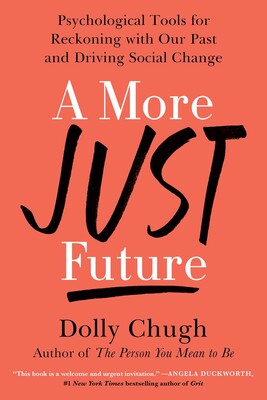
Which brings me to Dolly Chugh’s new book, A More Just Future: Psychological Tools for Reckoning with Our Past and Driving Social Change. Dolly deals directly, and brilliantly, with the discomfort increasing numbers of us are trying to come to terms with about the disjunction between the history we were taught and the history we weren’t taught. Her goal is to help us, and herself, “appreciate both the reality of our country’s mistakes and the grandeur of our country’s greatness”—a condition she defines as being a “gritty patriot”—and further, to understand the impact of our past on our present.
Dolly is a social psychologist, not a historian, so the focus of her book is not on the buried/forgotten/overlooked tales of our past,** though she uses some of those stories to illustrate her points. Instead she helps the reader understand why is it so difficult, emotionally and intellectually, to unlearn history—as individuals and as a country—and gives her (and by her, I mean me) tools for doing so.
A More Just Future is an important and wise look at confronting our whitewashed history and the emotional impact of doing so. It is also a delight to read. Trust me on this.
* A trend you’ve seen me applaud many times in these posts and in my newsletter over the last few years.
**Or more accurately, the stories left out of mainstream accounts of our collective history.
 credit-Jeanne Ashton
Just so you know: Dolly Chugh is a Harvard-educated, award-winning social psychologist at the NYU Stern School of Business, where she is a expert researcher in the psychology of good people. In 2018, she delivered the popular TED Talk “How to let go of being a “good” person—and become a better person.” She is also the author of the acclaimed book The Person You Need to Be and the popular newsletter Dear Good People. [Both of which I strongly recommend.]
You can find out more at DollyChugh.com.