



Hitlerland
My first step when I begin a new book is what I think of as a self-directed masters’ program. Since I am inevitably writing about something outside my academic field, I read deep and wide.* It is a wonderful part of the process—one I share with you as I wrap my head around the big picture, stumble across great stories, and read fascinating books.
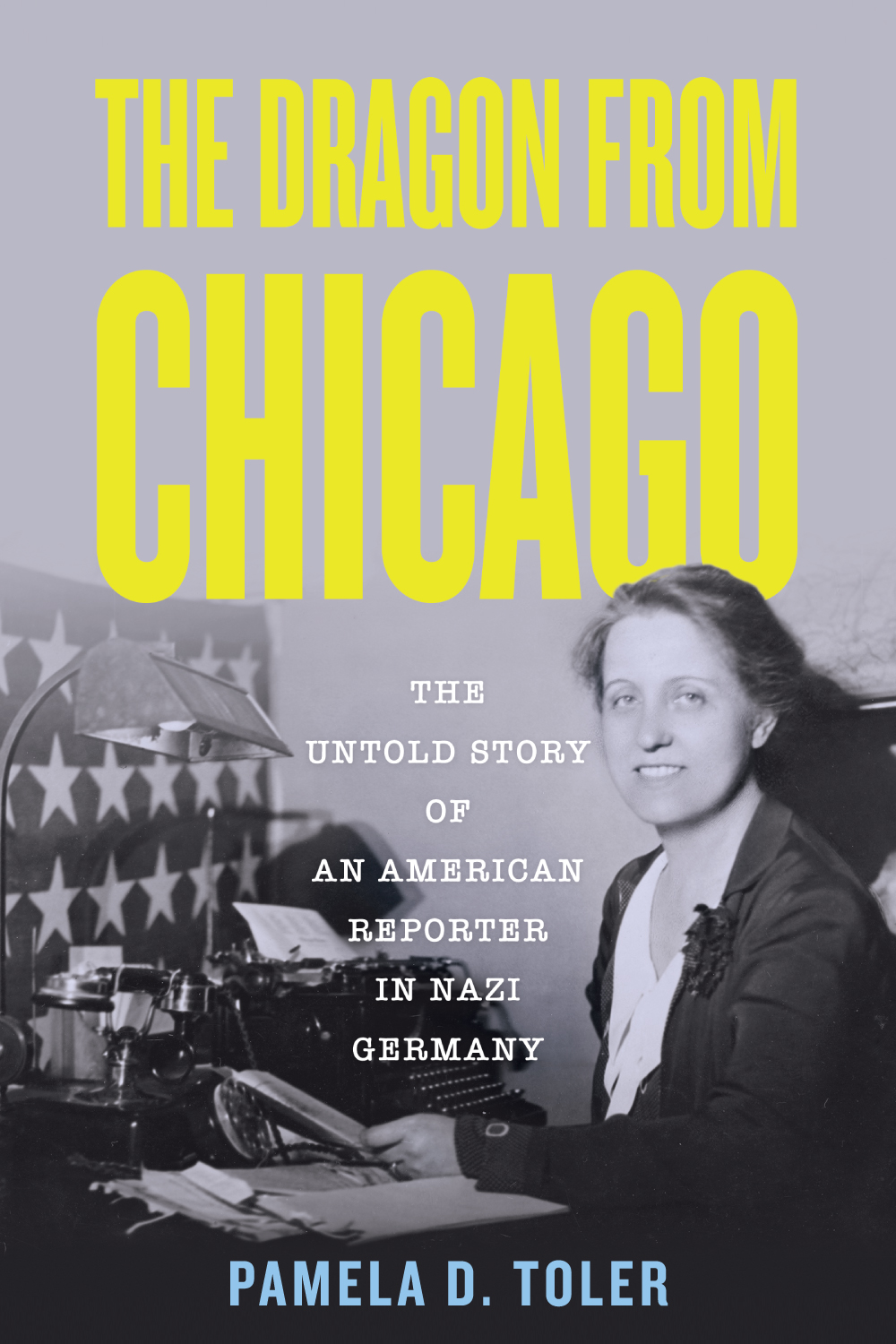
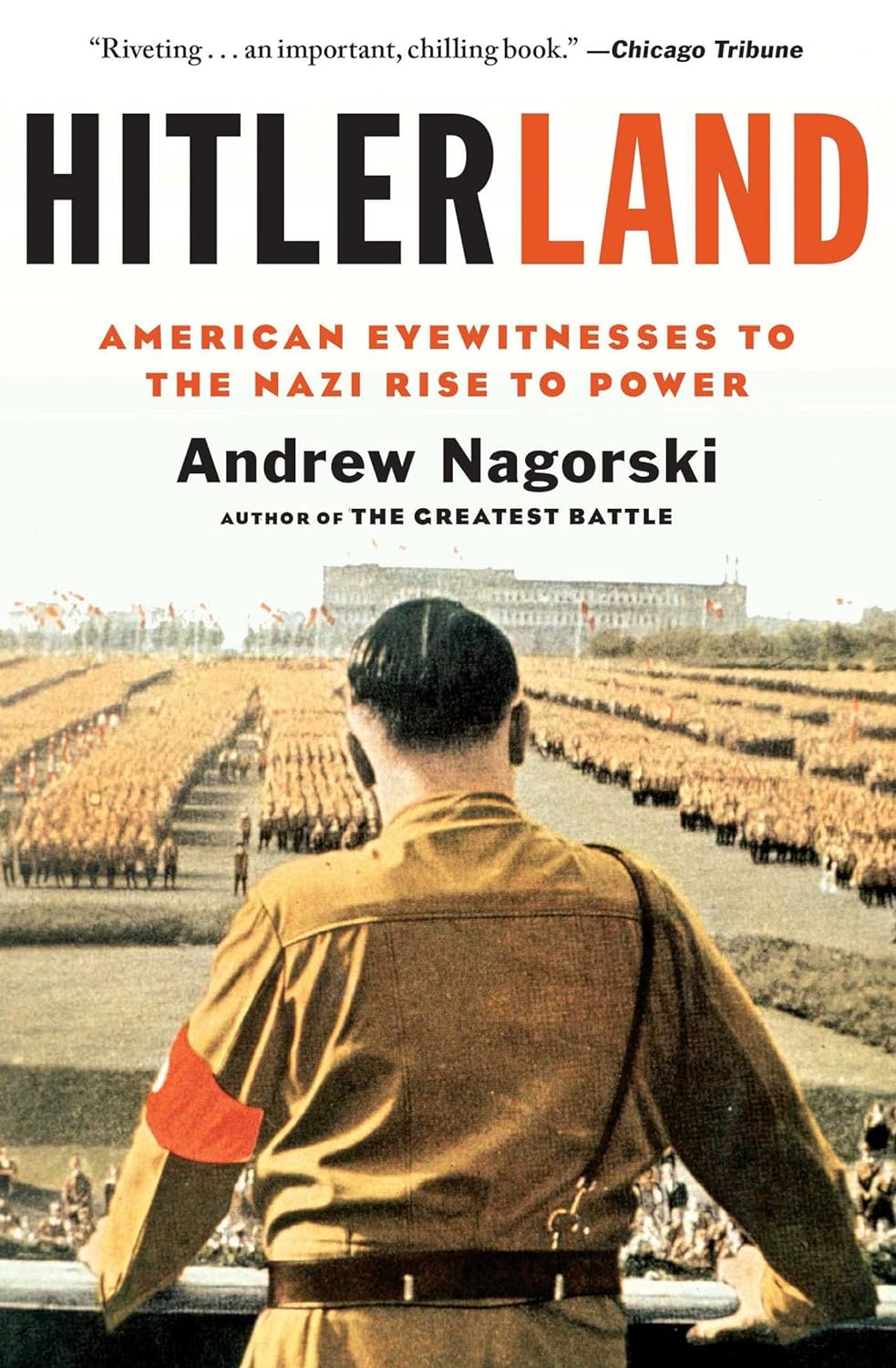
For some reason, I never told you about Andrew Nagorski’s Hitlerland: American Eyewitnesses to the Nazi Rise to Power, which was one of the first books I read as background material for writing The Dragon in Chicago. Actually, now that I think about it, Hitlerland was one of the first books I read as background material for writing my book proposal. I may not have shared it because I didn’t want to spill the beans about the book idea. Luckily it is never too late for a book review.
Nagorski, himself a foreign correspondent, opens Hitlerland with a two page synopsis of Sigrid Schultz’s life and career as the head of the Chicago Tribune’s Berlin bureau. He returns to Schultz on occasion as a touchstone, but he focuses on Americans whose experience of Nazi Germany was shorter and less informed that Schultz’s. He looks at accounts by Americans who worked or traveled in Germany in the 1920s and 1930s: diplomats, journalists, entertainers, scholars, students, and Olympic athletes. Not to mention Charles Lindbergh, whose visits in Germany between 1936 and 1939 at the invitation of the Nazi government were in some ways sui generis.
The final result is a startling picture of just how much Americans actually knew about what was happening in Germany, and how little many of them understood. It was relatively easy for Americans to travel to and in Germany in the years between the two world wars, and there was plenty of reason for them to do so. Berlin was a cultural hub that rivaled Paris in the 1920s, known as the “Golden Years.” But Nagorski makes it clear that many of them lived in relative isolation, spending time with other Americans. The result was a rosy view of Germany that led tourists and political junketeers to question the reality of the news reported by Sigrid Schultz and her colleagues.
An excellent introduction to a difficult subject.
*Actually, I do this when I write a researched-based article as well, though I try not to go quite as deep or as wide. Whenever I find myself slipping over the edge, I remind myself of what I think of as the Grange incident. (My apologies if you have heard this story before.) Early in my writing career, when I was pitching history-adjacent stories everywhere I could think of, I got an assignment to write an article on the history of the Grange** for Hobby Farms magazine. Newly out of my doctoral program, I plunged into a literature search. I soon began to panic at the amount of work I needed to do. Then I realized I had accumulated a list of 25 (very academic) books and articles as background pieces for a 250 word article.
**A national farming association founding in the mid-nineteenth century, the Grange was (and is) both a national lobby for the interests of small farmers and a community-based organization for farm families. In the past, Grange Halls were often the community centers in small rural towns. In short, the Grange was a Big Deal.
****
Just a reminder, The Dragon for Chicago is now available for preorder wherever you buy your books. If you want a signed copy, you can order it through my local independent bookstore here: https://www.semcoop.com/dragon-chicago-untold-story-american-reporter-nazi-germany Use the special instructions block at the bottom on the order page to request a signed copy and tell me how you want it signed.
Thanks to those of you who have already pre-ordered from any purveyor of books. It makes a difference.
From the Archives: City of Fortune
I am deep in reviewing the index for The Dragon from Chicago, which has turned out to be a much harder and more fiddly task than I anticipated.* Nonetheless, I full intended to give you a new blog post today. I really tried, but after an hour I was forced to admit that the idea just didn’t work. Instead, I offer you this post from April, 2012. Reading this twelve years later made me want to pull City of Fortune off the shelves for a re-read on this snowy April day. But I must remain strong. Index, here I come.
***
I thought I knew something about Venice. A floating city carved out of a malaria-ridden lagoon. Merchant city-state turned maritime empire, with one foot in the Muslim world. The European end of the desert caravan trade, with merchant entrepôts throughout the Levantine coast. Canals, gondoliers, masked balls, gold ducats. Glamor, wealth, decadence, decay. Or perhaps, in the words of Lerner and Lowe, “just a town without a sewer.”
Then I got a chance to review Roger Crowley’s City of Fortune: How Venice Ruled the Seas for Shelf Awareness for Readers and discovered I knew nothing about Venice.
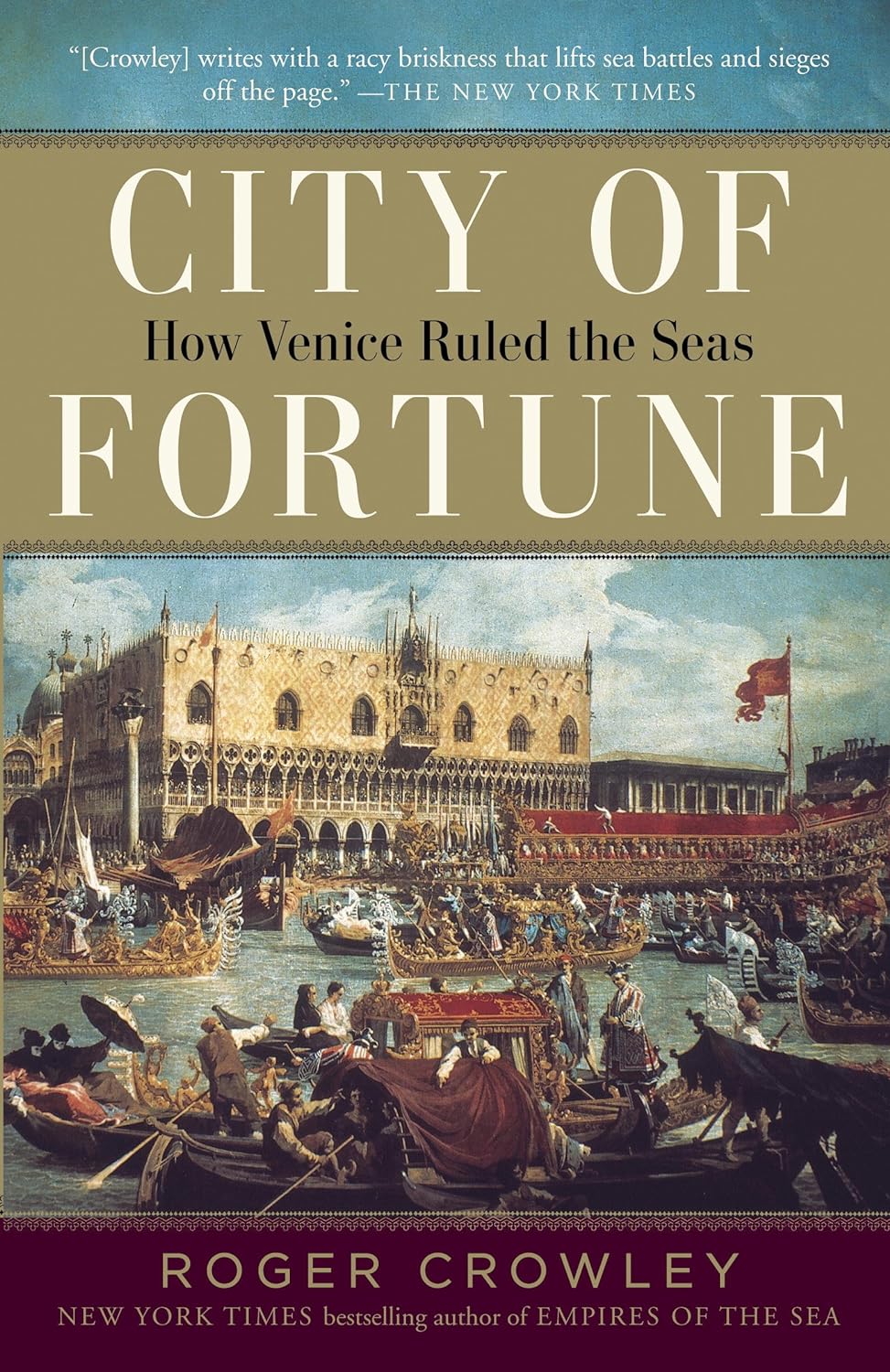
Roger Crowley returns to the medieval and early modern Mediterranean in City of Fortune, using three defining moments to tell the story of Venice’s development from a “smattering of low-lying muddy islets set in a malarial lagoon” to the greatest power in the region: the city-state’s pivotal role in the Fourth Crusade and the sacking of Constantinople in 1204; Venice’s bloody rivalry with Genoa for control of the East-West trade; and its desperate defense against the Ottoman Empire’s expansion into the Mediterranean in the fifteenth century.
As in his earlier books, Crowley’s fast-paced narrative style and vivid character sketches strike a nice balance between the big picture and the telling detail. He tells the story using a variety of voices. In addition to accounts by Venetian doges, merchants and city officials, he uses those written by–often hostile–outsiders, including the poet Petrarch, Pope Innocent III, Norman crusaders, and Cretan rebels.
Trade is the theme that ties Crowley’s story together. With no natural resources, no agriculture, and a small population, Venice depended entirely on trade for its survival. Its relationships first with Byzantium and later with the Islamic world were both the foundation of its prosperity and a source of contention with the rest of Christendom. Control of the western end of the overland trade caravans was the key to Venice’s success as “Europe’s first full-blown colonial adventure.” Crowley ends with the event that would bring Venetian maritime dominance to a close: the news that Portugal had found a sea route to India, rendering the Venetian empire suddenly obsolete.
*Writing the book is just the first of many steps that you take on the way to a published book. And all of them are time-consuming.
Women’s History Month is Over. What Next?
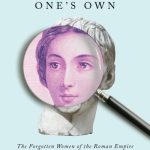
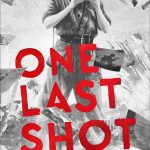

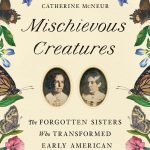
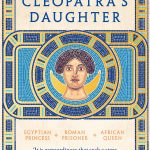

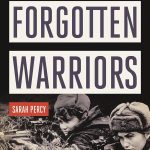






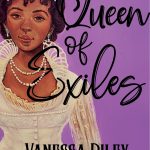
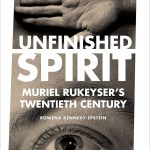
I always greet the end of Women’s History month with mixed feelings.
On the one hand, I am sorry for the fun to end. All through March, everywhere I go on the internet someone is posting something interesting about women whose stories need to be told or sharing their own introduction to women’s history, whether it happened in grade school,* in college, or yesterday. Or some combination of all three.** I learn about women I’ve never heard of, add books to my already overwhelming To-Be-Read list, and meet fellow travelers. Then April 1st comes and it is time to put away my party hat and noisemakers for another year. Though April Fool’s Day is consolation of its own sort: I am very fond of foolishness.***
On the other hand, I am ready for the fun to end. Putting together the interview series is a labor of love for me, and an act of generosity for the historians, novelists, poet and podcast hosts who take the time to answer questions about their work. It is also a lot is a lot of work. No matter how far ahead I start, I am always scrambling in the final week to get the last few posts up. Writing this wrap-up post is my last job for the month.
But that doesn’t mean that I’m setting aside women’s history. I’ve already started a list of people I’m excited to invite for next year’s interviews. I have books to review and authors to interview. I have a whole series of posts about women’s journalists to run in the months leading up to the release of The Dragon from Chicago.**** In short, to misquote Ebenezer Scrooge, “I will honor Women’s History Month in my heart and try to keep it all the year.” That is, after all, the goal: to reach the point where we don’t need Women’s History Month, or Black History Month, or any of the other heritage months that now fill our calendars because we have already integrated those stories into history as we teach and learn it.
We’re not there yet. We’re not even close. Getting there will take hard work on many fronts. And an occasional month of celebration.
* It turns out I wasn’t the only little girl eagerly reading what I now know are books in the Bobbs-Merrill Childhood of Famous Americans series.
**I love this essay by historical novelist Joan Fernandez: You’re Not Crazy
***Though I strongly dislike pranks, which I find inherently mean-spirited.
****August 6. Mark your calendars. (Not that I’m going to let you forget.)