



From the Archives: City of Fortune

I am deep in reviewing the index for The Dragon from Chicago, which has turned out to be a much harder and more fiddly task than I anticipated.* Nonetheless, I full intended to give you a new blog post today.  I really tried, but after an hour I was forced to admit that the idea just didn’t work.  Instead, I offer you this post from April, 2012.  Reading this twelve years later made me want to pull City of Fortune off the shelves for a re-read on this snowy April day.  But I must remain strong.  Index, here I come.

***

I thought I knew something about Venice. A floating city carved out of a malaria-ridden lagoon.  Merchant city-state turned maritime empire, with one foot in the Muslim world.  The European end of the desert caravan trade, with merchant entrepôts throughout the Levantine coast.  Canals, gondoliers,  masked balls, gold ducats. Glamor, wealth, decadence, decay.  Or perhaps, in the words of Lerner and Lowe, “just a town without a sewer.”

Then I got a chance to review  Roger Crowley’s City of Fortune: How Venice Ruled the Seas for Shelf Awareness for Readers and discovered I knew nothing about Venice.

Cover of City of Fotune, showing gondolas on a lagoon and a Renaissance palazzo

Roger Crowley  returns to the medieval and early modern Mediterranean in City of Fortune, using three defining moments to tell the story of Venice’s development from a “smattering of low-lying muddy islets set in a malarial lagoon” to the greatest power in the region: the city-state’s pivotal role in the Fourth Crusade and the sacking of Constantinople in 1204; Venice’s bloody rivalry with Genoa for control of the East-West trade; and its desperate defense against the Ottoman Empire’s expansion into the Mediterranean in the fifteenth century.

As in his earlier books, Crowley’s fast-paced narrative style and vivid character sketches strike a nice balance between the big picture and the telling detail. He tells the story using a variety of voices. In addition to accounts by Venetian doges, merchants and city officials, he uses those written by–often hostile–outsiders, including the poet Petrarch, Pope Innocent III, Norman crusaders, and Cretan rebels.

Trade is the theme that ties Crowley’s story together. With no natural resources, no agriculture, and a small population, Venice depended entirely on trade for its survival. Its relationships first with Byzantium and later with the Islamic world were both the foundation of its prosperity and a source of contention with the rest of Christendom. Control of the western end of the overland trade caravans was the key to Venice’s success as “Europe’s first full-blown colonial adventure.” Crowley ends with the event that would bring Venetian maritime dominance to a close: the news that Portugal had found a sea route to India, rendering the Venetian empire suddenly obsolete.

*Writing the book is just the first of many steps that you take on the way to  a published book.  And all of them are time-consuming.

Women’s History Month is Over. What Next?


I always greet the end of Women’s History month with mixed feelings.

On the one hand, I am sorry for the fun to end. All through March, everywhere I go on the internet someone is posting something interesting about women whose stories need to be told or sharing their own introduction to women’s history, whether it happened in grade school,* in college, or yesterday. Or some combination of all three.** I learn about women I’ve never heard of, add books to my already overwhelming To-Be-Read list, and meet fellow travelers. Then April 1st comes and it is time to put away my party hat and noisemakers for another year. Though April Fool’s Day is consolation of its own sort: I am very fond of foolishness.***

On the other hand, I am ready for the fun to end. Putting together the interview series is a labor of love for me, and an act of generosity for the historians, novelists, poet and podcast hosts who take the time to answer questions about their work. It is also a lot is a lot of work. No matter how far ahead I start, I am always scrambling in the final week to get the last few posts up. Writing this wrap-up post is my last job for the month.

But that doesn’t mean that I’m setting aside women’s history. I’ve already started a list of people I’m excited to invite for next year’s interviews. I have books to review and authors to interview. I have a whole series of posts about women’s journalists to run in the months leading up to the release of The Dragon from Chicago.**** In short, to misquote Ebenezer Scrooge, “I will honor Women’s History Month in my heart and try to keep it all the year.” That is, after all, the goal: to reach the point where we don’t need Women’s History Month, or Black History Month, or any of the other heritage months that now fill our calendars because we have already integrated those stories into history as we teach and learn it.

We’re not there yet.  We’re not even close. Getting there will take hard work on many fronts. And an occasional month of celebration.

* It turns out I wasn’t the only little girl eagerly reading what I now know are books in the Bobbs-Merrill Childhood of Famous Americans series.

**I love this essay by historical novelist Joan Fernandez: You’re Not Crazy

***Though I strongly dislike pranks, which I find inherently mean-spirited.

****August 6. Mark your calendars. (Not that I’m going to let you forget.)
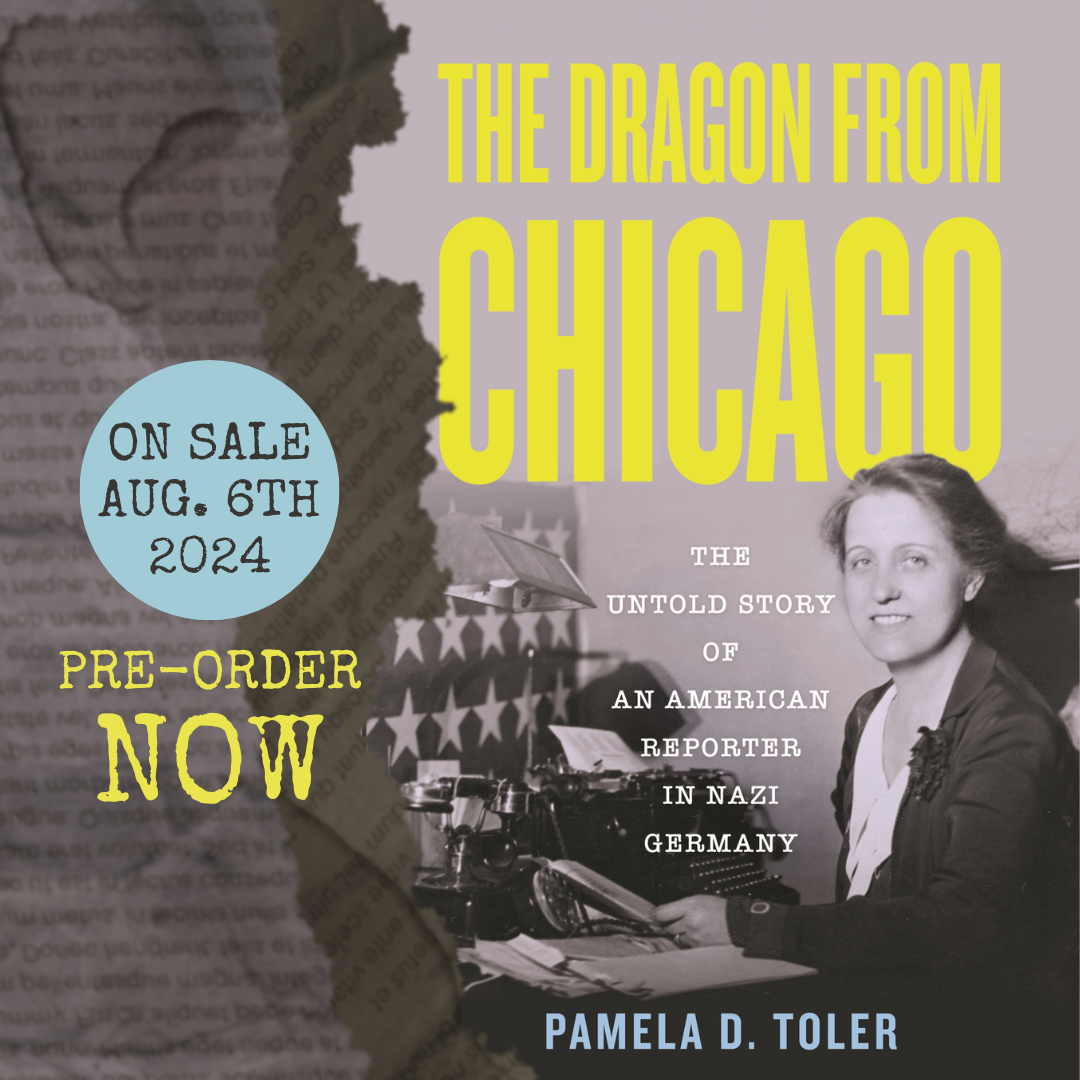
Cover for The Dragon From Chicago: The Untold Story of an American Reporter in Nazi Berlin by, well, me

Talking About Women’s History Month: Three Questions and an Answer with Rowena Kennedy-Epstein

Rowena Kennedy-Epstein is Associate Professor of Gender Studies and 20th/21st-Century Women’s Writing at the University of Bristol. She is the author of Unfinished Spirit: Muriel Rukeyser’s Twentieth Century (Cornell UP, 2022), which won the Modern Language Association Matei Calinescu Prize, and she has published three editions of Rukeyser’s witting: The Muriel Rukeyser Era: Selected Prose (Cornell UP, 2023), her novel Savage Coast (Feminist Press, 2013), and Barcelona, 1936 (Lost&Found 2011). A visiting scholar at the Oxford Centre for Life-Writing, she’s currently writing the first biography of Rukeyser (Bloomsbury USA), for which she was awarded a 2022-23 National Endowment for the Humanities Public Scholars Fellowship.

Take it away, Rowena!

What path led you to Muriel Rukeyser, and why do you think it’s important to explore her story today?

I think the “Rukeyser Era” had been percolating, because in my first weeks of graduate school in 2006 at the CUNY Graduate Center two different professors included her work on their reading lists. Ammiel Alcalay included the Life of Poetry (1949) in his seminar on American poetry and the Cold War—that course was the start of his extraordinary Lost & Found publishing project, which I think has really transformed the ways students engage with archives. At the same time, I was in Jane Marcus’s seminar on the Spanish Civil War (1936-39), and Rukeyser’s poem “Mediterranean” was on the syllabus. I think I ended up reading both works around the same week, and they are clearly connected, each beginning on the boat evacuating Barcelona at the start of the Civil War in July 1936. It was clear how vital that moment in Barcelona was to Rukeyser, and I began looking for more writing and scholarship about her time in Spain. But there was very little written about her that I knew how to access at the time—Adrienne Rich’s introduction to a selection, a collection of essays, some chapters in book, and a monograph from 1980.[1] Her Collected Poems had only just been republished that year, in 2006. When I went to speak to Jane about Rukeyser, she asked me what I thought about the poem. Without much understanding of why I would think this, I said I thought the poem “might be bad and I wasn’t sure I liked her writing at all.” I had just come out of an MFA program in poetry, and looking back I can see that we were still caught in the long backlash to second wave feminism, and to the writers that articulated the political realities of women’s lives, many of whom would cite Rukeyser as a major influence—the “mother of us all.”

Jane Marcus, whose ideas and criticism were forged in the second wave, responded with a howl of impatience when I used the word “bad” to describe Mediterranean. She said, in words more brilliant than I can recall now, that in order to do feminist and radical scholarship I had to evaluate texts not on the aesthetic, disciplinary and political terms defined by patriarchy to exclude women from public space but by looking at how women writers disrupt and defy those very orthodoxies. Better yet, she said, go to the archives and find those texts; teach them not just as a corrective or counter-canon, but as exemplary—as the very subject itself.[2] And so I went up the street to Rukeyser’s archive at the Berg collection of the New York Public Library. I began to find there a subject whose work demanded a new kind of narrative, whose writing—much of it unfinished or out of print—would make me understand how inculcated in patriarchy my thinking still was, our texts still were. It wasn’t long after that I followed Rukeyser’s trail to her other archive at the Library of Congress, where I discovered her lost novel about the Spanish Civil War, Savage Coast. I’ve written about the experience of encountering Savage Coast in the Library of Congress a few times—it was in a miscellany folder, filed away from her other Spanish Civil War writing—and it was unfinished, with the rejection letter (written by her mentor Horace Gregory) just siting on top, so it was the first thing I read. But what is poignant, now that I think about it, is how the language used in the rejection of the novel in 1936—that it was “BAD”—prefigured so strongly my own cursory assessment of Mediterranean in Jane’s office in 2006. As I began to read the novel right there in the archive I must have started to course-correct myself, to retrain the aesthetic judgments I held, seeking to understand how gender bias had formed responses to her writing but to also see how the forms she chose in her writing were already responding to the very same gendered assumptions. I could also see what critical sexism had done to this extraordinary novel, leaving it fragmented and unpublished, and forcing Rukeyser to work relentlessly, in every genre, to move her ideas into the world. Following this work—published and unpublished—through the archive has changed those narratives and it has changed me. Rukeyser’s politically engaged and formally experimental writing teaches us how to read and write against institutionalised power, and to imagine “some nameless way of living/of almost unimagined values.”

Writing about a historical figure like Muriel Rukeyser requires living with her over a period of years.  What was it like to have her as constant companion?

I never thought I would be working on one writer for over a decade! I’m still surprised that I am writing her biography now. There’s a great passage the Introduction to Andrea Dworkin’s Letters from a War Zone (1988),  in which she talks about about being Rukeyser’s assistant in 1972. I think it underscores why living with Rukeyser has been so rewarding and feels important. Dwrokin recalls:

Muriel gave me my first book party, to celebrate the publication of Woman Hating; and I thought that was it—I was a writer (sort of like being an archangel) forever. Everything she had tried to tell me was lost on me. She had tried to make me understand that, for a writer, endurance mattered more than anything—not talent, not luck; endurance. One had to keep writing, not to make a brilliant or distinguished or gorgeous first try, but to keep going, to last over hard time. Endurance, she would say, was the difference between writers who mattered and writers who didn’t. She had had rough years. I hope someday her story will be told. It is a heroic story. She knew the cost of keeping at writing in the face of poverty, ostracism, and especially trivialization. She knew how much worse it was to be a woman. She knew that one had to survive many desolations and injuries—one would be both bloodied and bowed; but one had to keep writing anyway—through it, despite it, because of it, around it, in it, under it goddam.

I did not know about her relationship with Dworkin until the writer Sophie Ward mentioned it—that I could know her work and still not know her yet felt fruitful; it also affirmed for me her centrality to American feminism and women’s writing. But Dworkin’s two simple sentences, “I hope someday her story will be told. It is a heroic story,” are poignant. The fact that Rukeyser’s biography has not yet been written, 44 years after her death, that so much of her story is still untold—not just her story but the stories of her innovative and radical milieu of women writers in the 30s and 40s and 50s that shaped the 20th-Century—compels me to keep working with her, to bring her writing into print, to tell those narratives, mainly because those are the stories I want to read. As Rukeyser wrote, you go to the “houses of the papers themselves” and write the book that you so badly need to read. Rukeyser made incredibly interesting choices in response to both personal circumstances and to the crises of her times—how she thought about gender and race, imperialism and anti-facism, motherhood and sexuality—and to have the chance to follow her thinking, decipher the work that she created in response to it, has been surprising and rewarding.

Unfinished Spirit is such an evocative title. Can you tell us how you came to it?

The title of the book comes from a line in one of Rukeyser’s Elegies, which she wrote throughout the 1940s, in a period of both personal and public crisis:

When you have left the river you are a little way
near the lake; but I leave many times.
Parents parried my past; the present was poverty,
the future depended on my unfinished spirit.
There were no misgivings because there was no choice, only regret for waste, and
the wild knowledge: growth and sorrow and discovery.
Muriel Rukeyser, “First Elegy: Rotten Lake” (1949)

As I wrote the book, I came to understand that the “unfinished” was not only representative of the state of a manuscript encountered in the archive, but an essential part of Rukeyser’s process—a process that remains “open” in the way the poet Lyn Hejinian has described a work that resists totality, a “rejection of closure,” which might be especially important for women writers who want to resist confining orthodoxies.  Rukeyser understood the gender politics of the unfinished—she often wrote about the disruptions of motherhood, the censure of critics and the sexism and homophobia of editors. But she also recognised something deeply promising in the kind of work that never ends—“where the process never stops,” she writes in the synopsis of an unfinished biography, “we are offered the continual opening of the spirit.”

I end Unfinished Spirit thinking about the process that we have to undertake to do this kind of feminist recovery work:

The unfinished work—messy, fragmented, diffuse, and hard to read, found in miscellany folders, in a folder in someone else’s archive—is, I think, the condition of women’s writing, and women’s lives, to a large extent. It should never be assumed that at anytime the fraction of work that women have had published is at all representative of what they have actually produced. We need continue to move away from the assumption that publication confirms authorship. For what happens between the moment of creation and the moment of publication is a series of negotiations with power structures that shapes not only the culture in any given period, but the forms of the works themselves, and then our responses to them (167).

[1] Louise Kertesz’s The Poetic Vision of Muriel Rukeyser (1980); a collection of essays, How Shall we Tell Each other of the Poet: The Life and Writing of Muriel Rukeyser (1999), edited by Anne Herzog and Janet Kaufman; Jan Heller Levi’s A Muriel Rukeyser Reader (1995),  and Adrienne Rich’s Introduction to the Selected Poems (2005).
[2] Jane  introduces her essay collection Art and Anger: Reading Like a Woman (1988) with the title “Changing the Subject.”

A question from Rowena: How do you deal with archival gaps when writing women’s lives?

I go into each project with the assumption that there will always be archival gaps. In fact, in some ways my last book, Women Warriors, was nothing but archival gaps. Which you could argue was the point.

My experience in the current book, The Dragon From Chicago, was much different. I had a great deal of archival material to work with as well as the articles Sigrid Schultz wrote for the Chicago Tribune. (Echoing a point Elaine Hayes  made several days ago, I am deeply grateful for the fact that the historical Tribune has been digitized, so I didn’t have to scroll through more than twenty years of microfilmed newspapers and suffer the inevitable migraines related thereto. I am even more grateful that I had access to the digitized files on-line through the Chicago Public Library during the pandemic.)

Even with a wealth of material, there were holes. I took different paths, depending on what was missing. In some cases, I discussed what sources are available and what questions they leave unanswered. Occasionally I speculated on possible answers to unanswered questions, based on the archival information we do have and information about the lives of others at the time. I read as many memoirs by people who had been in the period as I could get my hands on. In the case of the missing second half of a very interesting letter, I spent a lot of time trying, without success, to find where the recipient’s papers were held. And in one case the gap seemed so egregious that after I turned in my draft I went back to the first archives I had visited to see if there was something I’d missed in my previous visits. (There was. A single sentence that told me how she felt about something I knew was important to her. Which was both wonderful and worrying.)

And yet, holes remain.

***

Interested in learning more about Rowena Kennedy-Epstein and her work?

Visit her faculty page: https://research-information.bris.ac.uk/en/persons/rowena-kennedy-epstein

***

Alas, this is the last interview for Women’s History Month this year. Thanks to all of you who contributed, and all of you who read. Come back next week for life as usual here on the Margins.