



Talkies, or “You Ain’t Heard Nothin’ Yet”
Recently I’ve been dipping into the early days of talking pictures. As usual, a very specific question led me down unexpected rabbit holes. For once, I wasn’t surprised by the depth of my ignorance. Everything I knew about the first “talkies” came from the film Singin’ in the Rain—a movie that I love but that I assumed was not a good historical source.*
Here are some bits that caught my imagination:
- The Jazz Singer (1927), which in the shorthand version of film history is considered the first commercial talking picture, in fact used elements of both silent and talking pictures. Recorded using “sound on disc” technology, the sections of the film that included sound were relatively short, and were mostly devoted to Al Jolson singing—an obvious intermediate step between phonograph records and silent movies. The recordings also caught several improvised comments by Jolson, which the director chose to keep in the final soundtrack and which generated much of the excitement about the film. In my opinion, one of those lines sums up the place of The Jazz Singer in film history: “You ain’t heard nothing yet!” I can’t help but wonder if Jolson wasn’t thinking of the process of making films when he said it.
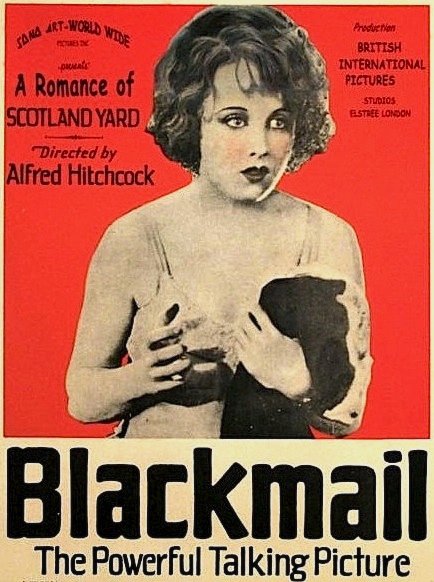
- Singin’ in the Rain used one piece of “talkie” history to great affect, revealing one of early Hollywood’s technical secrets in the process. To my surprise, the use of aspiring actress Kathy Seldon (Debbie Reynolds) to dub the lines for silent film Lina Lamont (Jean Hagen) because Lamont’s voice was, let’s just say unpleasant,** reflected a real technique used when silent film actors attempted to make the leap to sound. The technique was used not only to cover for voices that were too shrill, too nasal, too soft or just, “too,” but also to hide strong European accents. Only two years after The Jazz Singer, Alfred Hitchcock used the technique effectively in Blackmail (1929), in which actress Joan Barry dubbed lines for Czech Anny Ondra, whose accent was considered unacceptable for English-speaking audiences.***
- Introducing sound into movies using the first viable “sound-on-disc” and “sound-on-film” technologies**** forced movie makers to find a way to mask unwanted sounds. Ironically, the biggest problem was the sound of the cameras themselves. At first cameras were isolated in heavy sound-proof cabinets, sometimes called “iceboxes,” to mute the sound of their motors, which limited directors’ ability to move their cameras. I don’t remember seeing such a thing in the on-set scenes in Singing in the Rain. Perhaps it’s time to watch it again?
*Though in fact, Singin’ in the Rain came out only 25 years after The Jazz Singer, something I hadn’t realized until I went down this particular rabbit hole. The film’s creators may have known more about movie history than I gave them credit for.
**In an interesting twist, Hagen “dubbed” her own spoken lines. .
***This surviving clip of a sound test with Hemingway makes it clear that her accent was, in fact, quite light. (It also makes clear that Hitchcock was a bit of a jerk.)
****Sound-on-film ultimately won, but for a time movies were produced in both formats to accommodate the fact that theaters had different set-ups. During this period, some studios also produced parallel silent versions of films because smaller theaters were slow to catch up.
From the Archives: Blood Sisters
I have started and abandoned three blog post topics this morning. Two of them were based on pieces of information that turned out to be not quite correct when I looked at them more closely. And the third was a little known moment within a well-known story: the moment was too small to support a post by itself and the well-known story was too well known to re-tell here. *Sigh*
Luckily I had reason to rummage on my bookshelves recently in response to a request for books about historical women prior to 1700. I now have a list of books that I’ve reviewed here on the Margins that I would be happy to recommend to anyone. I will fall back on them when and as needed in the coming weeks. (Thanks, Linnie.)
First up, Blood Sisters by Sarah Gristwood, which I reviewed in 2013. (The news referred to in the first sentence is no longer new, though it was the subject of a film, The Lost King, which was released in March, 2023. Apparently Richard III is able to generate endless controversy.)
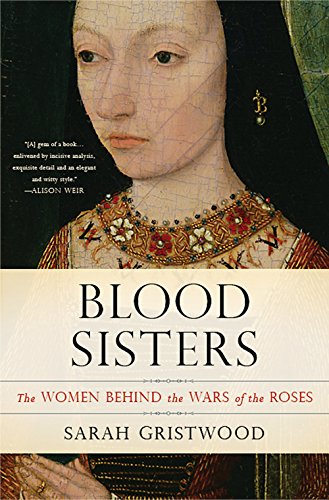
With the discovery of Richard III’s bones under a Leister parking lot, the Wars of the Roses are in the news again. Historians and hobbyists alike are arguing the relative claims of Lancaster and York across the media. In Blood Sisters: The Women Behind the Wars of the Roses, Sarah Gristwood tells the familiar story of the so-called “Cousins’ War” from a new perspective.
As Gristwood points out, most histories of the period echo the “patriarchial assumptions” of the time and focus on its male protagonists. In Blood Sisters, kings and kingmakers take a back seat to their mothers, wives, sisters and daughters. Some, like heiress Anne Neville, were passed from one royal family to another like pieces of property. Others were actively involved in the politics of the time, using husbands and sons as their path to power. Whether pawns or players, all were caught up in the web of changing alliances, family loyalties and political machinations that defined the war. Gristwood pieces together their stories from their household accounts, their occasional letters, and their appearances in the accounts of others.
At its heart, Blood Sisters is about relationships. Gristwood describes the events surrounding the Wars of the Roses and the resultant rise of the Tudor dynasty as a family saga whose protagonists were tied together in numerous ways. By focusing on the lives of the Plantagenet women, she illustrates the complexities of those ties–creating a larger picture of the Wars of the Roses in the process.
Josephine Baker–a Graphic Biography
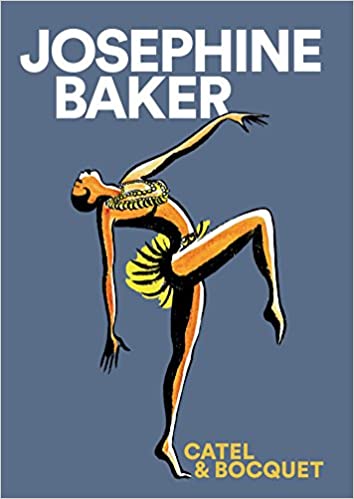
It took me several months to work my way through Catel Muller and José-Louis Bocquet’s graphic biography of Josephine Baker. Not because it wasn’t interesting or well done, but because it is the graphic equivalent of a Big Fat History Book, with 460 pages of densely packed graphic story and another 100 pages of supporting material, notably a useful timeline and a series of biographical essays about other characters who appear in the book, sometimes for only a single panel. The essays are arranged in the order in which they appear in the main story, beginning with Baker’s mother and ending with The Rainbow Tribe, Baker’s multi-ethnic family of twelve adopted children.
Josephine Baker is a cradle-to-grave biography of a complex personality who led a long and action-packed life. The visual language of the work is sophisticated. Physical settings are rendered in meticulous, carefully researched detail. By contrast, action scenes are starkly black and white, with the background and characters alike rendered in a abstracted, almost comic book style. Baker seems to vibrate with energy, dominating every panel she appears in. Against all odds, Catel gives the reader an almost tangible feeling for Baker as a dancer.
The biographical essays are a critical element of the book: both its strength and an illustration (hah) of the form’s limits. Once I discovered them, I read the essays in conjunction with the related chapter, but it was inherently awkward—a break in the narrative flow of the story. In interviews, Catel and Bocquet make it clear that the essays are not an afterthought. They were intended to flesh out the story in a way that was impossible to do within limits of a graphic work. At its best, graphic non-fiction uses visual elements to tell a story in a new and powerful way. In Josephine Baker, Catel and Bocquet have attempted to straddle the divide.
****
And speaking of complex personalities who lived a long and action packed life: