




Talking About Women’s History: Three Questions and an Answer with Laurie Wallmark
If you’ve hung out here at the Margins, you’ve probably read one of my occasional paeans to the biographies of kick-ass women that were in the library in my elementary school. (In fact, now that I think about it, the subject came up in a Q & A with Kip Wilson earlier this month.) They inspired my life-long interest in women’s history.
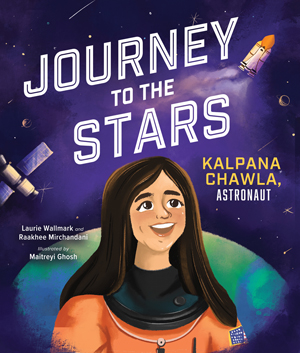
Today’s guest, Laurie Wallmark, writes similar biographies, aimed at slightly younger readers, with the twist that she focuses on women in STEM which means she may well be inspiring young engineers, scientists, coders, and astronauts as well as baby historians. Before she began writing, Laurie worked as a software engineer, a computer science professor and the owner of an internet-based bookstore. (Before Amazon! )
She is the author of seven picture book biographies of women in STEM: THE QUEEN OF CHESS (Little Bee, 2023), HER EYES ON THE STARS (Creston Books, 2023), CODE BREAKER, SPY HUNTER (Abrams, 2021); NUMBERS IN MOTION (Creston Books); HEDY LAMARR’S DOUBLE LIFE (Sterling Children’s Books, 2019); GRACE HOPPER: QUEEN OF COMPUTER CODE (Sterling Children’s Books, 2017); and ADA BYRON LOVELACE AND THE THINKING MACHINE (Creston Books, 2015).
Take it away, Laurie!

The biographies you write all deal with women in STEM. How do you make complex ideas understandable to young readers?
When I was in grad school (MFA in writing), I wrote my thesis on how to explain STEM (Science, Technology, Engineering, and Math) in picture books. The title of my thesis? “It’s Complicated (Not Really).” There are so many techniques an author can use to provide kids the tools they need to understand complex STEM ideas and concepts. It’s up to the author to choose the ones that will work for each situation. From word choice to in-text definitions, analogies to relatable context, even the most difficult information can be made understandable. For example, in my book Numbers in Motion, I say that partial differential equations define the rules about how something changes. That’s all that the reader needs to know. They don’t need to understand the complicated mathematics behind these equations.
How do you choose subjects for your biographies?
There are two main questions I ask myself when choosing a subject. First, do I think the person’s life and accomplishments will be interesting to and second, will it have meaning for a child. If not, why write it?
After that, I consider additional questions. Is there enough source material available? Are there already recent books written about the person. Finally, am I drawn to learning more about the person? After all, in writing a biography, you have to spend a lot of time immersing yourself in the person’s world.
Do you think Women’s History Month is important and why?
In a perfect world, we wouldn’t need a month dedicated to the history of a specific group (like women, Black people, LGBT people, etc. ) The story of their lives would be part of the general history that kids learn about. But, let’s just say we don’t live in a perfect world. The accomplishments of underrepresented groups are often overlooked or minimized. Having months like Women’s History Month, gives educators an opportunity to shine a light on the achievements of members of these groups.
A question from Laurie: Do you think that by having a month dedicated to women’s history, it gives people an excuse to ignore women’s contributions during the rest of the year?
Maybe it’s wishful thinking on my part, but I think that is less and less true with time.
Since Women’s History Month was created in 1987, at least two generations have grown up learning about women’s history each year in school. Numbers of them have gone on to highlight women’s history in exciting ways outside of March—some of whom have appeared here on the Margins over the years. And it is clear they have an audience.
***
Want to know more about Laurie Wallmark and her work?
Check out her website: https://www.lauriewallmark.com/
Like her on Facebook: Laurie Wallmark – author
Follow her on the platform previously known as Twitter: @lauriewallmark
Follow her on Instagram: lauriewallmark https://www.instagram.com/lauriewallmark/
Follow her on Bluesky: @lauriewallmark.bsky.social
***
Tomorrow it will be business as usual here on the Margins with a blog post from me. Then we’ll be back on Monday with Jennifer Lunden, author of Americana Breakdown.
Talking About Women’s History: Three Questions and an Answer with Marcia Biederman
Once a mystery novelist, Marcia Biederman now writes meticulously researched nonfiction that reads like a detective story. As a longtime freelancer for the New York Times, she wrote more than 150 pieces for the Times on everything from ice dancing to automobile wheel repair. She was a staff reporter for Crain’s New York Business, and her work has appeared in New York magazine, the New York Observer, the Christian Science Monitor, and Newsday. Before discovering her passion for history, biography, and true crime, she published three mystery novels and contributed a short story to Best of Sisters in Crime, edited by Marilyn Wallace.
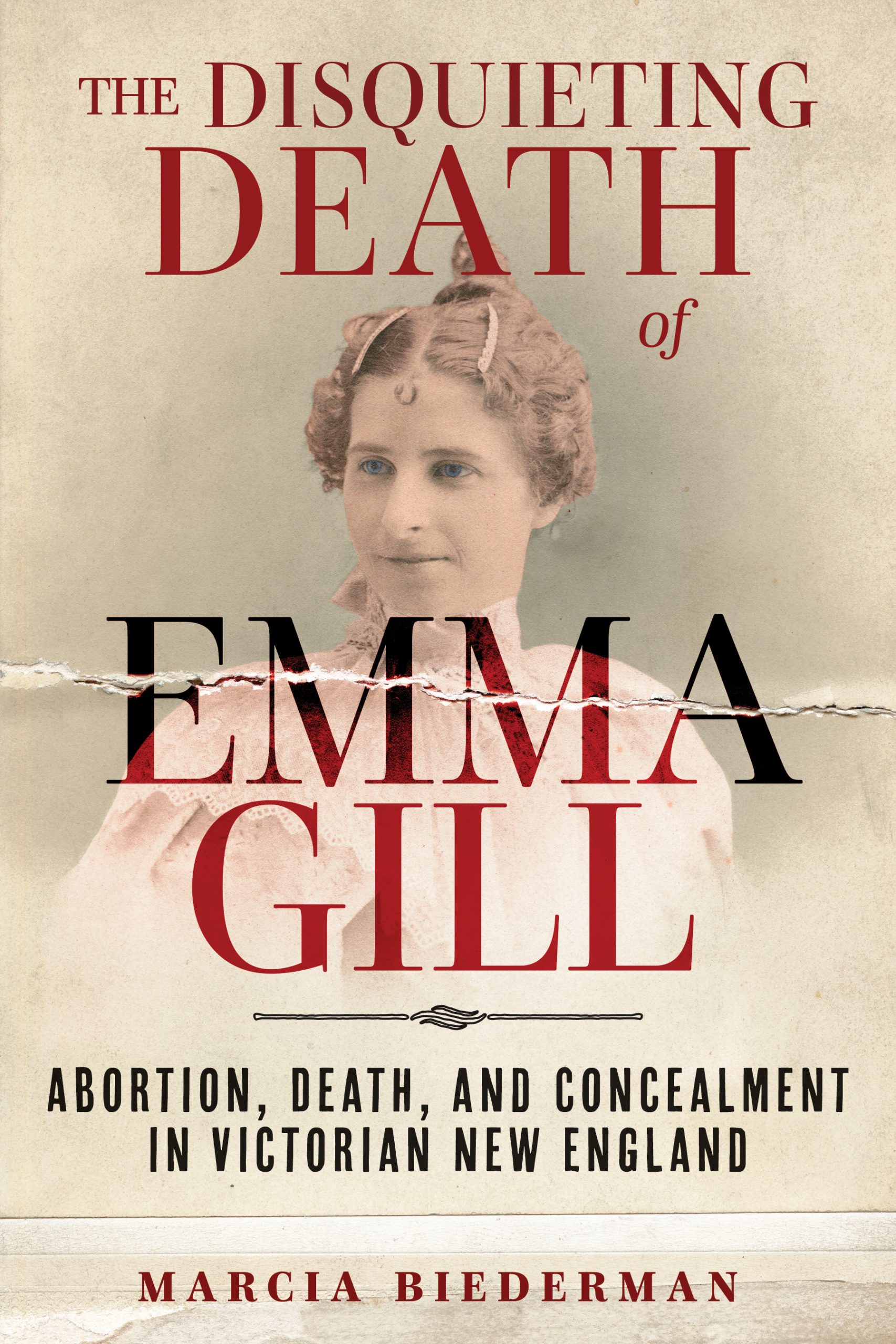
The Disquieting Death of Emma Gill: Abortion, Death, and Concealment in Victorian New England, is Marcia Biederman’s fourth nonfiction work about women whose stories should be better known. Her previous books are A Mighty Force, about Pennsylvania coal town physician Elizabeth Hayes; Scan Artist, about speed-reading entrepreneur Evelyn Wood; and Popovers and Candlelight, about New York restaurateur Patricia Murphy.
Take it away, Marcia!

What path led you to Emma Gill’s story? Why do you think it is important to tell her story today?
More than four years ago, I was researching a different topic when I stumbled across an 1898 edition of the Los Angeles Herald headlined, “The Mysterious Tragedy of Bridgeport.” There are many American cities named Bridgeport, but a quick scan confirmed this was about my hometown – Bridgeport, Connecticut, where I was born and raised. Robustly illustrated with drawings of suspects, victim, and crime scene, the piece told a story I’d never heard.
A young woman’s mutilated remains had been found in a pond. A medical examination immediately indicated that the woman had died of an infection following an abortion – a serious crime at that time in Connecticut, and, indeed in every state – with the body cut up afterward to conceal what had happened.
Immediately, I was hooked. In that piece, abortion wasn’t mentioned directly, but there were multiple mentions of the “midwife” under suspicion. Bridgeport seldom makes national news now, and it never did. This had to be big.
Digging further, I found this was more than just a police-gazette-style story. The yellow press – the Hearst chain, etc. – was all over it, but reputable papers like the Hartford Courant and the New Haven Register provided more sober coverage. The Bridgeport Herald, now extinct, astounded me by calling for sex education for girls, criticizing prudishness, and writing that Nancy Guilford – the suspected abortion provider, who eluded the police for weeks – “simply was unfortunate in getting caught in an unlawful act which is being repeated weekly in every city in this state.”
Statements like that floored me. They also spurred me on to write the book. As I began my research in late 2019, Roe v Wade was still the law of the land, but I knew it was under attack. In many parts of the country, opponents of reproductive rights had closed abortion clinics or made it impossible for them to open. Years ago, I’d read a book by the historian James C. Mohr, Abortion in America, which talked about how widespread abortion became in the nineteenth century, moving from the margins into the mainstream (yet here I am, being interviewed by History in the Margins!)
State legislatures responded by tightening laws against abortion, but the cases were hard to prosecute, and many people tolerated, or even welcomed, criminal abortion providers in their midst. As I recently wrote in a newspaper op-ed, only Robin Hood had more accomplices. If abortions led to lethal infections — always a risk in the era before modern antibiotics — the patient’s family would help conceal the cause of death. At least that was true in the Connecticut and Massachusetts cities where Nancy Guilford’s practices flourished until the disposal of a body went terribly wrong in two separate cases and Guilford served long prison sentences, only to get right back to it after release.
Emma Gill was a name that didn’t pop up until I was far into my research. The case remained unsolved for months, and Nancy Guilford remained at large, because no one could identify the dead woman. Fingerprinting identification was not yet available, so the police put the severed head on display in the city morgue. Hundreds of Bridgeport residents filed past it, but no one recognized the face. Emma Gill, as it turned out, was from Southington, near Hartford. In the meantime, mailbags full of tips arrived at the Bridgeport police department. Everyone, it seemed, had a sister, wife, or neighbor who’d been away from home for a few days and who – according to her siblings, spouse, or co-worker – might well have gone for an abortion, despite the fact that the procedure was strictly illegal.
As I discovered more about Nancy Guilford and her husband – old-stock white Protestants – it became clear to me that abortion was as American as apple pie. While I was halfway through the writing, I became more determined than ever to tell this story. Writing for the Supreme Court majority in the Dobbs decision that overturned Roe, Justice Samuel Alito stated that the right to abortion is not “deeply rooted” in American history or traditions. My book proves him wrong.
Are there special challenges in writing about a historical event with echoes in current politics?
Yes. Abortion is one of the most controversial topics of our time, so there are special challenges even when writing about events that happened 125 years ago — not so much in writing the book as in selling it to publishers and marketing it. I’m fortunate to have Chicago Review Press as my publisher. Before they offered me a contract, an acquisitions editor at a much larger publishing house became interested and set up a Zoom call to discuss it. Initially, only the editor, my agent, and I were going to be on the call, but one of the editor’s superiors invited herself at the last minute and dominated the conversation. The editor started by asking if I thought of Nancy Guilford, the abortion provider at the center of the book, as a “delicious villain.” Now, as a criminal who enriched herself by fulfilling a need, Nancy was a seriously flawed person who sometimes set her own interests above those of her patients. She was also married to a genuine villain and, at least for a while, did bad things to cover for him. The fact that they were both engaged in crime made it difficult for her to leave him, though she tried.
As I began to explain these nuances, I could tell that the editor’s superior was losing interest. They never made an offer. When my book finally found a home, I was never asked to reduce complexities to simplicities. My editor trusted me, and no higher-up was trying to trim history to certain specifications.
As for marketing the book, there are benefits as well as drawbacks, depending how blue the state. Before publication, I was able to place op-eds related to the book in two Connecticut news outlets, the Hartford Courant and the CT Mirror, and in the New York Daily News. However, in Pennsylvania, a reporter who regularly contributes to two small newspapers was able to place a feture about the book in only one of those outlets. The other paper told her they were afraid of pushback from the antiabortion movement, which is active there.
On the plus side, a wonderful Manhattan bookstore, P&T Knitwear, arranged my book launch as a benefit for The Brigid Alliance, an organization that brings people from states with abortion bans to New York for care. We already know that the past can inform the present. It can also raise some money for it!
When did you first become interested in women’s history? What sparked that interest?
My local library, like many libraries known to baby boomers across the country, had a special case for several dozen books officially titled the Bobbs-Merrill Childhood of Famous Americans series. We called them “the orange biographies” for the color of the bindings. I devoured the ones about women as young girls: Amelia Earhart, Jane Addams, Dolly Madison. Supposedly they were nonfiction, but the dialogue and many events were made up. Today we’d call them historical fiction. Still, there was enough true stuff there to get me interested.
In addition, I formed a long-time obsession with Louisa May Alcott after discovering an abridged version of Little Women in the comic book racks at my neighborhood newsstand. I identified with Jo, obviously a stand-in for the author, and devoured what I could about her creator. I especially loved John Matteson’s 2008 biography, Eden’s Outcasts, about Louisa’s relationship with her father, Bronson Alcott.
Hence, it was great fun to discover an indirect connection between Louisa May Alcott and the people and events in my latest book, The Disquieting Death of Emma Gill. The abortion provider at the center of the book, Nancy Guilford, learned “the criminal operation,” as it was then called, by assisting her husband, Henry Guilford. But how did Henry learn it? Henry claimed to have a medical degree, although I could find no evidence of that. Nonetheless, newspaper reports show that he worked as an in-house doctor at one of the Health-Lift exercise salons popularized by one of Louisa May Alcott’s cousins, a Harvard-trained physician and bodybuilding enthusiast named George Barker Windship.
Related to Louisa through the Mays, her mother’s side of the family, weightlifting George and his scribbling cousin had much in common. According to her biographer Matteson, Alcott was a dedicated runner. Jo March, of course, was an athletic type, and in Eight Cousins, Alcott presented a male character, a kindly uncle, who encouraged girls to dress in less restrictive clothing and exercise more.
When Louisa’s strongman cousin, George, died suddenly of a heart attack at age 42, the Health-Lift craze screeched to a halt. People lost faith in the exercise machines, some modified for use by women, a significant portion of the clientele. My research suggests other reasons for the sudden plunge in popularity. At least two people involved in Massachusetts abortion trials had worked at Health-Lift gyms. Henry Guilford, a “doctor” for one of the gyms, may have learned his trade there. When the gyms closed, he and his wife, Nancy, opened their own abortion practice in Worcester, Massachusetts. All this gave me a whole new perspective on the Alcott family tree.
A question from Marcia: Can you think of any other books (or works about history in any format – biopic, documentary) in which a tale from the past strongly resonates today, whether about reproductive rights, banned books, vaccinations, trans rights, threats to democracy, etc.?
I spent much of the last four years in a deep research dive on Germany in the 1920s and 1930s, the isolationist movement in the United States during the same period, and the challenges journalists faced in reporting both stories. It was uncomfortable reading. All too often, what I was reading in the morning’s paper—or at least the on-line versions thereof— echoed the stories from the past that I was researching.
For example, watching our current debates over support to Ukraine, I keep thinking about Lynn Olson’s Those Angry Days: Roosevelt, Lindbergh, and America’s Fight Over World War II, 1939-1941. In it, Olson explores how the issues of interventionism and isolationism split American society in the years before the United States entered World War II. She centers the story on the larger than life figures who embodied the two positions: President Franklin Roosevelt and Charles Lindbergh. (Neither man comes out looking good.) But the story is more than a Clash of Titans. Olson takes us through the conflict in step-by-step detail, looking at grassroots activism as well as the actions of those in power. She introduces the reader to individual members of Congress who took positions on both sides of the conflict, bringing them to life in unexpected ways. She looks at high-ranking officers in the American military who were anti-intervention and who actively worked to undermine Roosevelt’s pro-British policies. She outlines the workings of a covert British operation which created false news, dug up dirt on isolationist Congressmen, and helped form the OSS, precursor to the CIA. She describes the formation and actions of isolationist groups like the America First Committee and the American Mothers Neutrality League and their interventionist counterparts, the White Committee (officially the Committee to Defend America by Aiding the Allies) and the Century Group.
It was a dirty fight on all sides, until the attack on Pearl Harbor made the debates largely irrelevant.
***
Want to know more about Marcia Biederman and her work?
Check out her website: https://marciabiederman.com/
Follow her on Instagram: @squiremarcia
***
Come back tomorrow for three questions and an answer from children’s author Laurie Wallmark, who writes about women in STEM.
Talking About Women’s History: Three Questions and an Answer with Richard Miller
Richard Joel Miller was born in Portman Square in London, England. He developed an interest in chemistry when his father gave him a chemistry set for his fifth birthday. Following an unfortunate series of events involving explosions in the family garage, his interests (much to his parents’ relief) shifted to the finer points of biochemistry, and a desire to use science to understand the workings of the brain. Richard obtained his PhD from Cambridge University and then joined the faculty of the University of Chicago in 1975. After 25 years he transferred to the Department of Pharmacology at Northwestern University, where he is now Professor Emeritus.
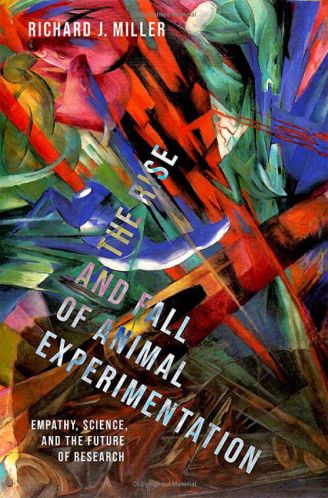
Richard has published over five hundred scientific papers and four books in the areas of biochemistry, physiology, pharmacology, and neuroscience. In his latest book, The Rise and Fall of Animal Experimentation (OUP), Richard looks back over decades of research, examining the use of animals in science and exploring: Why do we do it? Is it successful, i.e. does it further translational medicine? Is it ethical? He also discusses the ever-increasing use and potential of human stem cells and related technologies in creating experimental models, making animal-based research ultimately obsolete.
Take it away, Richard!

Did you expect women to play a role in your study of animal experimentation when you began your work?
What was the most surprising thing you’ve found about women’s involvement in animal rights activists while doing historical research for your work?
When I first began this project I didn’t really have any expectations about the role of women in the history of animal experimentation and the animal rights movement. I must admit that it wasn’t something I had really thought about. But, as it turned out, there was a lot to learn. Of course, to begin with, as you go through the history of animal experimentation which began in antiquity, you only read about men. It’s men who performed the experiments. Moreover, nobody had much to say about animal rights. Once you get to the 16th century, there was Montaigne who wrote eloquently about the reasons why we should respect the intelligence and feelings of animals. Then in the 17th century there was Margaret Cavendish, the first women to write about these topics, followed by others in the 18th century. Suddenly, in the 19th century, there were a huge number of women involved in the animal rights movement; actually, I think it was mostly women! Why was this?
The animal rights movement started in England where the first laws to protect animals were presented to Parliament at the start of the 19th century, although none of them got anywhere for several decades. There weren’t any women Members of Parliament (MPs) in those days. On the other hand, women were starting to speak out about their roles in society in general and so became associated with a whole group of causes that concerned “rights”, including the anti-slavery movement, animal rights and suffragettism. Most of the women you read about were simultaneously active in all these movements. They had to find ways of supporting their beliefs outside of Parliament. Hence, it was women who founded many of the animal welfare movements such as the societies that opposed vivisection. In fact, it was a woman named Frances Power Cobbe (1822–1904), who initiated the antivivisection movement in Great Britain. A prolific author, she published numerous essays on animal rights and feminist philosophy. In 1875, she founded the Victoria Street Society which became the Society for Protection of Animals against Vivisection. The efforts to promote animal rights in England soon spread to the USA and the Continent. Queen Victoria, who was a great animal lover, joined the antivivisection movement, which gave it a lot of credibility and made it fashionable.
What really surprised me was just how radical these women were both in the context of animal welfare and suffragettism. These days you hear about members of groups like PETA acting as agent provocateurs, infiltrating laboratories, and reporting on what they see. The female antivivisectionists in the late 19th and early 20th centuries did precisely the same things. There was a famous incident when two women antivivisectionists infiltrated a medical school demonstration where a dog was being dissected and then wrote a book about it called The Shambles of Science. The book provoked all kinds of grass roots activism. A statue was put up in Battersea Park celebrating the dog, leading to riots involving thousands of people who were pro or anti-vivisection. This became known as “The Brown Dog Affair”. These women really put themselves in harm’s way and were incredibly brave and energetic in pursuing their goals. It was fantastic. I never knew anything about all of this, and I was extremely impressed.
You write about a number of women ranging from the seventeenth century polymath Margaret Cavendish, Duchess of Newcastle through twentieth century animal rights activists. Do you have a favorite, or two?
Well, yes, you do have to like “Mad Madge” (Margaret Cavendish) in the 17th century, for one. She was an amazing person. She wrote about cruelty to animals, and did a lot of other things as well, including writing the first science fiction novel-The Blazing World, together with a great deal of poetry and essays on natural philosophy (science). Notably she published her works under her own name, something that was unheard of for women at that time. She was fearless. She made waves. Everybody turned out to see what she was wearing, and they were frequently shocked. Once she was even seen wearing a man’s coat! People just couldn’t believe it. She was the Vivienne Westwood of her day; a punk goddess, avant la lettre.
Margaret Cavendish was also the first woman to attend a meeting of the Royal Society, the world’s original and most prestigious scientific society where she engaged with some of the greatest scientists of the day like Sir Robert Boyle. In the 18th century, following Cavendish, other women began to publish under their own names and would comment negatively on the use of animals in laboratories. Susanna Centlivre, for example, in her play The Basset Table, introduced Valeria, a virtuosa (female scientist) who performs cruel experiments on dogs.
Less famous than Margaret Cavendish, but of great importance, was Lizzy Lind Of Hageby. She was born in Sweden in 1878 to an aristocratic and extremely wealthy family but settled in England following her education at Cheltenham ladies’ college. Lizzy lived the rest of her life in England, mostly in London, where she shared her home with another women, Leisa Schartau, also originally from Sweden. Leisa shared Lizzy’s views on many topics. For example, they wrote about the training of medical students:
“What is the influence on students who attend demonstrations where live animals, cats and dogs and rabbits, are cut open before the class to demonstrate some scientific theory? There are very few who would not acknowledge that it is far, far better to make boys and girls humane and merciful men and women, with hearts and well as heads, than to make them learned and intellectual, but heartless and cruel.”
It should be remembered that ideas connected with spiritualism and theosophy were extraordinarily influential in the late 19th and early 20th centuries. These included the goal of uniting all men and women equally at the spiritual level in their search for divine wisdom. Both Lizzy, Leisa and the majority of their female associates were devoted followers of Henrietta Blavatsky and her theosophical ideas. Madame Blavatsky’s successor as head of the Theosophical society, Annie Bessant, was also an active participant in the drive for animal rights. Indeed, many of the women who were active at this time promoted “rights” of many types as well as other ideas. These included human rights, animal rights, suffragettism, theosophy and spiritualism. They also invariably promoted other ideas which would seem outmoded to us today, such as strong opposition to vaccination (yes, it’s nothing new) and germ theory. They also shared a general belief in animal telepathy.
Lizzy was an absolutely incredible person. She had a brilliant intellect, and was indefatigable. She founded the Animal Defense and Antivivisection Society and helped to found similar societies all over the world, organizing many international meetings on the topic of animal rights. She was extremely active at the personal level and often put herself in danger physically in public in support of the causes she believed in; she was involved in the riots that accompanied the Brown Dog Affair, as discussed above. She would also give frequent public lectures and debated representatives of universities and hospitals who supported vivisection. She always won these debates as she was an extremely effective public speaker. And her achievements in the sphere of animal rights weren’t the only things she did. She had great sympathy for suffering of all sorts, both humans and animals, and, for example, went to Europe during the First World War where she opened institutions to take care of wounded soldiers and others to rehabilitate horses. If that wasn’t enough, she wrote numerous books, including the first biography of her Swedish compatriot the playwright August Strindberg. When she died in 1963, she left her fortune to the Animal Defense Trust, which she founded, and which continues to offer grants for animal-protection issues, so that her influence lives on today. Just thinking about all her accomplishments leaves me breathless.
What unsung woman activist from the past would you most like to read a biography of, and why?
There are certainly a large number of women whose roles in the history of the animal rights movement have not been well researched, but there is one in particular I would like to mention. Before I do, however, let me explain the situation with respect to the use of animals for laboratory research in 19th century science. Using animals for vivisection is something that goes back to the work of people like William Harvey in the 17th century when he discovered the circulation of the blood; his research was based primarily on animal vivisection. In the 17th century science was only practiced by relatively few wealthy gentlemen like Harvey. But, by the 19th century science had become a profession and so the number of scientists had increased enormously. The tradition of vivisection was mostly advanced in France. The most important of all the French physiologists in the 19th century was Claude Bernard. He is considered one of the greatest physiologists of all time and he introduced many key concepts into biology and medicine. One key idea was that of homeostatic regulation, that tissues always respond to changes in other tissues in an attempt to maintain a state of equilibrium. Bernard’s most productive experimental paradigm was vivisection, particularly of dogs. Nevertheless, whatever his scientific achievements, there is no doubt as to the profound cruelty of the procedures he carried out. Indeed, the burgeoning anti-vivisection movement of the time, particularly in England, took notice of what Bernard was doing and his work became controversial.
One thing to note is that Bernard didn’t come from a rich family and his scientific research cost a good deal of money. So, he made sure that he married a wealthy woman. In those days, once married, all of a wife’s money became the property of her husband. The woman Bernard married in 1843 was Marie-Françoise (“Fanny”) Bernard (née Martin) whose dowry was used to finance his research. It was an arranged marriage but, unfortunately, vivisection became a point of contention between the couple. Fanny and the couple’s two daughters, Marie-Claude (1849-1922) and Jeanne Henriette (1847-1923) were absolutely horrified by Bernard’s nightly expeditions around Paris trapping stray animals for his vivisection studies. It is said that they once discovered a neighbor’s missing dog on his operating table. The couple ended up divorcing, something that was very difficult to do in a Catholic country like France. Fanny Martin became committed to the animal rights cause, joining the Société Protectrice des Animaux (Society for the Protection of Animals), which was founded in 1846. Fanny Martin and her daughters also opened and ran an animal shelter where they would rescue dogs and cats. Fanny and her youngest daughter helped to create a dog cemetery in Asnières and were active in the emerging French antivivisection movement in many ways. Fanny Martin became one of her ex-husband’s fiercest opponents.
Unfortunately, history has ignored Fanny Martin. She is really only discussed in the context of the fact that she was Claude Bernard’s wife and her antivivisection sympathies, from the point of view of scientists, are considered to be aberrations. However, Fanny Martin exhibited incredible bravery in opposing her husband at a time when such thing was simply not done. Moreover, it wasn’t just the fact that she stood up personally against Claude Bernard and the whole of the scientific edifice that supported animal experimentation, but the fact that she was extremely active in promoting the movement in France. Sadly, nobody has written a proper biography of Fanny Martin. It’s a great shame because she was really a hero of the animal rights movement.
A question from Richard: As we have seen, women played an essential role in the birth of the animal rights movement , particularly promoting animal issues outside the government (e.g. Parliament).Do you think that women have a unique role to play in the animal rights movement these days, considering the position of women in 21st century society?
[Pamela takes a deep breath and blows it out slowly] I know so little about this subject that I am diffident about offering an opinion at all. But here goes, based on the largely female staffs of the veterinary offices and animal shelters that I know, I suspect that women also make up a disproportionately large percentagel of the animal rights movement today. But honestly, I’m just riffing here.
***
Want to know more about Richard Miller and his work?
Check out his website: https://richardjmillerscientist.com/
Check out his LinkedIn profile: Richard J Miller
Follow him on Mastodon: @richardjmiller@mastondon.social
***
Come back tomorrow for three questions and an answer with Marcia Biederman, author of The Disquieting Death of Emma Gill. Abortion, Death, and Concealment in Victorian New England