




From the Archives: Reading My Way Through Roman Britain, Pt. 2
The places I hang out on line are having a lot of fun theses days with the question of how often men think about the Roman Empire. The answer apparently being, a lot. (Really?) I have no idea who started it, or why. But it’s a natural for history nerds being nerdy. It has spawned fun memes, and lots of playful silliness at a time when some of us need that.
I don’t have an answer. (And I haven’t asked My Own True Love the question.) But for those of you who are interested in thinking about the Roman Empire for at least a short while, I’m re-running this series that I orginally posted in 2015. With any luck, by the time the series has run its course I will have finished these endless revisions and we can go back to thinking about women journalists, Nazi Germany, fascism in general, and whatever else grabs my history nerd attention.
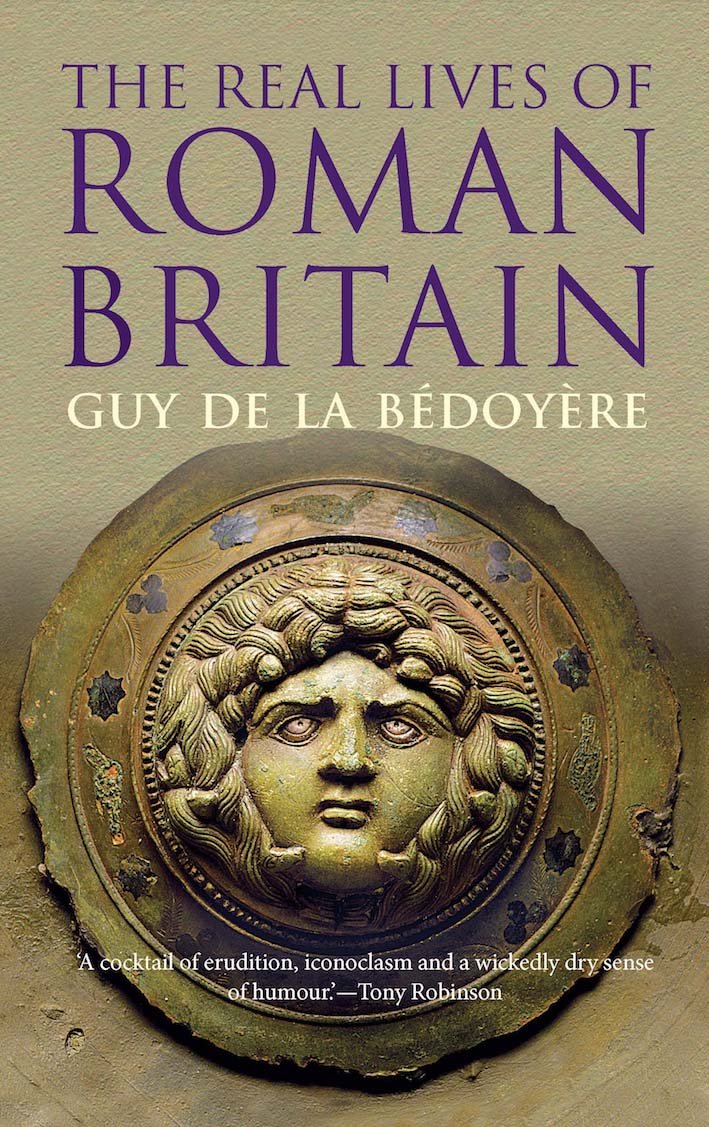
Guy de la Bédoyère’s The Real Lives Of Roman Britain: A History of Roman Britain Through The Lives of Those Who Were There is not a narrative history of Roman Britain. (De la Bédoyère has already written several versions of that narrative.) It is instead an attempt to look at the 360 years of Roman occupation in terms of human experience rather than “the generalities of military campaigns, the antics of emperors, the arid plains of statistical models and typologies of pottery, the skeletal remains of buildings, and theoretical archaeological agendas.” [p.xi]
The attempt is not entirely successful due to a problem that de la Bédoyère identifies early in the book as “visibility”. There is surprisingly little evidence, physical or textual, about the Roman experience in Britain and even less about individuals–often no more than a name and a hint. (Sometimes not even a name. One individual, known as the “Aldgate-Pulborough potter”, is recognizable only by the distinctive incompetence of his work.) Consequently, much of the book is devoted less to the lives of Roman Britain and more to an evaluation of the available evidence.
In lesser hands, this close analysis of inscriptions, clay tablets, pottery shards, and, yes, the skeletal remains of buildings could be as dry as the dust from which they are taken. De la Bédoyère considers each bit of evidence with wit and imagination, leading the reader with him on the path of discovery rather than simply providing her with his conclusions.
From the Archives: Reading My Way Through Roman Britain, Pt. 1
The places I hang out on line are having a lot of fun theses days with the question of how often men think about the Roman Empire. The answer apparently being, a lot. (Really?) I have no idea who started it, or why. But it’s a natural for history nerds being nerdy. It has spawned fun memes, and lots of playful silliness at a time when some of us need that.
I don’t have an answer. (And I haven’t asked My Own True Love the question.) But for those of you who are interested in thinking about the Roman Empire for at least a short while, I’m re-running this series that I orginally posted in 2015. With any luck, by the time the series has run its course I will have finished these endless revisions and we can go back to thinking about women journalists, Nazi Germany, fascism in general, and whatever else grabs my history nerd attention.

“Hadrian’s wall at Greenhead Lough”, with thanks to Velella and Creative Commons
Thanks to the luck of the book-review draw, I recently ended up reading two books on Roman Britain back-to-back.* The two books are very different. Guy de la Bédoyère’s The Real Lives of Roman Britain is an attempt to look at the period of Roman occupation in terms of individual human experience–a frustrating endeavor because there is surprisingly little evidence. Charlotte Higgins’s Under Another Sky: Journeys In Roman Britain is a more personal attempt to understand the Roman occupation and its continuing influence on Britain’s sense of history and identity–think VW bus and hiking Hadrian’s Wall.** Both were fascinating; taken together they gave me a rich picture of a period I mistakenly thought I knew something about.
My reviews of both books will appear in coming posts. In the meantime, here are some of the things that surprised me:
- Rome controlled Britain for 360 years, assuming a floating definition of control. That’s almost twice as long as Britain ruled India.
- Britain was a hotbed of revolt against Rome for most of those 360 years. I knew about Boudica, the female ruler who led an uprising against the Romans in 61 CE.*** And because I knew about Boudica I was vaguely aware that the Druid stronghold at Mona (modern Anglesey) was believed to harbor dangerous rebels. But I knew nothing about, for example, the Gallic Empire, a short-lived break-away regime founded by Marcus Cassianus Latinus Postumus *** in 259 CE in Britain’s northwestern-provinces. Postumus and his successors borrowed all the attributes of a “real” Roman emperor, including coins minted in their names, consulships, assassinations and usurpations.
- I knew that the pre-Roman Britons left no written history. That what we know about them comes from Roman accounts and archaeological finds. (Some of which are pretty spectacular.) I didn’t realize that what we know about the experience of the Romans themselves in Britain is also based on relatively limited evidence. For instance, the primary source for Julius Caesar’s not particularly successful invasions of Britain in 55 and 54 BCE are Caesar’s own accounts, which are certainly contemporary but by no means unbiased.
There’s a lot to learn out there.
* Usually this happens in response to a major historical anniversary, but unless I’m missing something this time it was just because.
**And yes, I am now thinking about hiking along Hadrian’s Wall.
***Thank you, Antonia Fraser
****Which does, in fact, mean posthumous. The name was given to a man born after his father’s death. Who knew?
From the Archives: When Paris Went Dark
Another post from the past, in this case 2014, related to the stuff I’m working on today. New stuff soon, I promise.
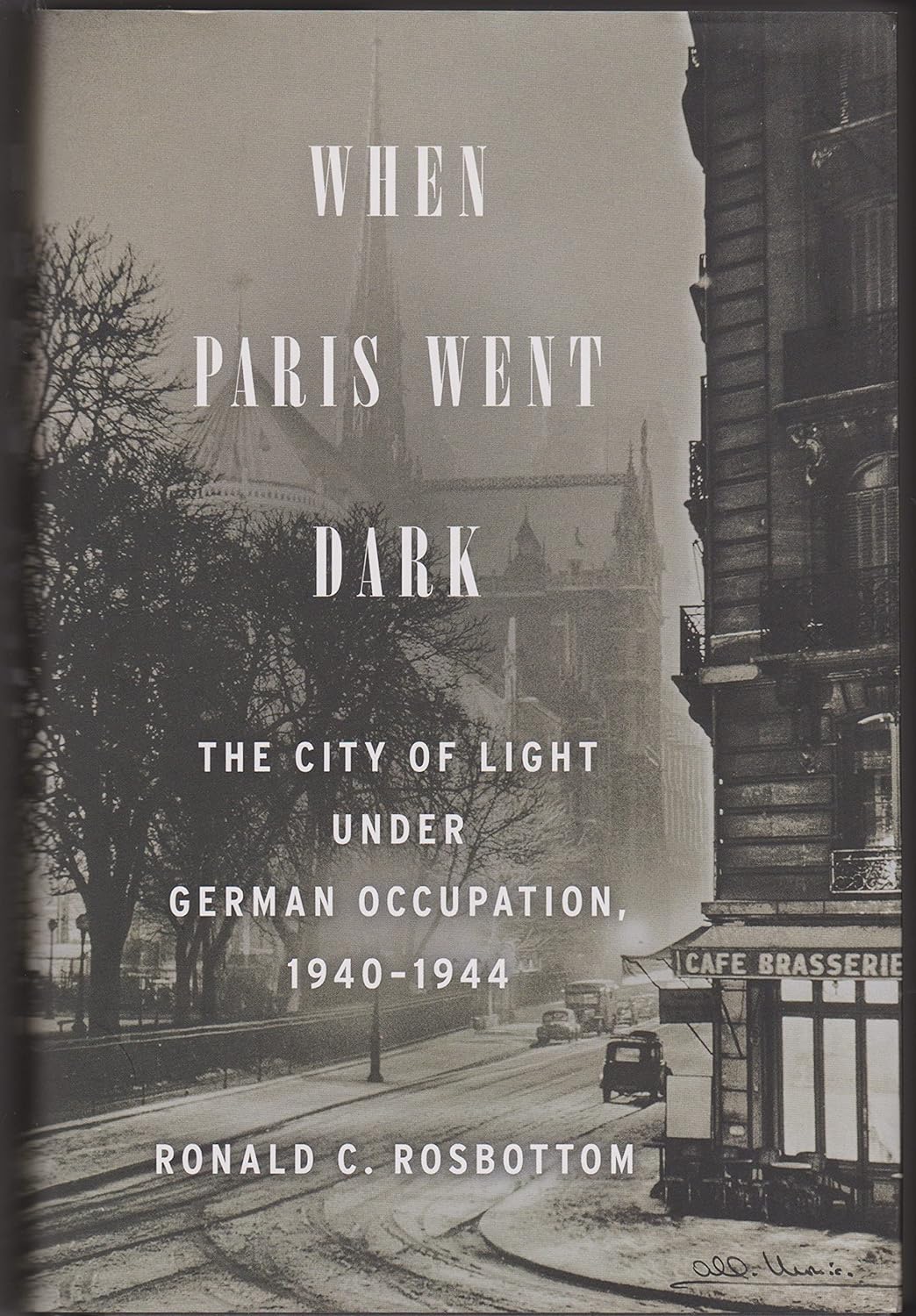
When Nazi troops marched into Paris in June, 1940, the city surrendered without firing a shot.*
In When Paris Went Dark: The City of Light Under German Occupation, 1940-1944 , historian Ronald C. Rosbottom explores face-to-face interactions between occupiers and occupied, the effect of the Occupation on daily life in Paris, its psychological and emotional impact on Parisians and its legacy of guilt and myth.
Drawing from official records, memoirs, interviews and ephemera, Rosbottom tells a story that is more complicated than simple opposition between courage and collaboration, though he offers examples of both. He discusses the fine line between survival and collaboration, the distinction between individual acts of resistance and the Resistance and how occupiers and occupied utilized the hide-and-seek possibilities of Parisian apartment buildings. He considers the act of waiting in line both as an illustration of the difficulties of everyday life and as a replacement for forbidden political gatherings. Above all, he describes the Occupation as gradual constriction of Parisian life within ever-narrowing boundaries.
Rosbottom does not limit his discussion to the Parisian perspective. Some of the most interesting sections of When Paris Went Dark deal with the German experience in the city, a complex mixture of tourism, conquest, envy and isolation. His account of Hitler’s early-morning tour of the capital soon after its surrender is particularly illuminating about the Nazi Party’s ambivalence toward cities in general and Paris in particular.
When Paris Went Dark is an important and readable addition to the social history of World War II.
*I will admit with only the slightest embarrassment that when I think “Nazi occupation of Paris” the images that come to mind are straight out of Casablanca. That will probably never change. Because putting pictures in our heads–accurate or not–is one of the things great art does.