




A War by Any Other Name
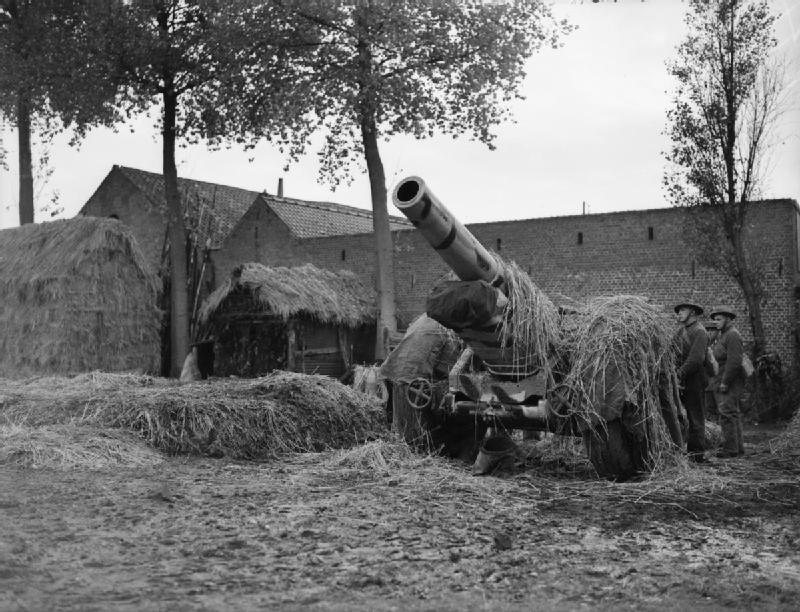
British howitzer camouflaged in France during the “phoney war”
World War II ended, literally, with a bang. In some ways it began with a whimper. First Germany and then the Soviet Union invaded Poland in September 1939* After Warsaw officially surrendered to Germany on September 28, active hostilities slowed on the Western front. Germany consolidated its hold on Poland. Britain and France built up their forces, took defensive positions along the Franco-Belgian border,—and waited. Hostilities resumed again in April, 1940, when Germany invaded Norway.
I’ve always known this period of relative inactive as the “phoney war”—a term attributed to isolationist Senator William E Borah of Idaho, who stated on September 30, 1939, that “there is something phony about this war.”** I was surprised to learn that several alternative nicknames were popular at the time: the British “Bore War”, the German “Sitzkrieg” (or sitting war), and, my personal favorite, Winston Churchill’s poetic “Twilight War.”
Who knew?
*I don’t know about you, but my World History class left out, or perhaps minimized, the fact that the Soviet Union also invaded Poland. In fact, the German-Soviet non-aggression pact that was signed in August 1939 provided for more than non-aggression. It included secret protocols that partitioned Poland between Germany and Russia. Again.
**Borah is best known for the things he led the charge against: the Versailles Treaty (which the United States did not sign), the League of Nations (which the United States did not join), and giving women the right to vote .
History on Display: Wilson’s Creek National Battlefield
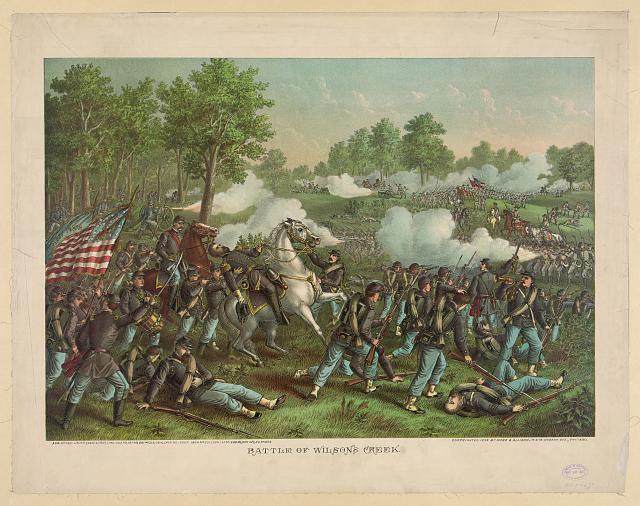
I recently took a short, (relatively) spontaneous trip home to the Missouri Ozarks. While I was there, my parents and I visited the nearby Wilson’s Creek National Battlefield, site of the first major Civil War battle fought west of the Mississippi on August 10, 1861.*
Wilson’s Creek became part of the National Park System in 1961, on the hundredth anniversary of the battle and a month after my third birthday. You could say that the park and I grew up alongside each other. It certainly was part of my education as a little history nerd.
Every time I’ve returned to the part as an adult, the exhibits have been more sophisticated and more nuanced. (I’d like to think the same could be said about me.) This visit did not disappoint.
The main change to the exhibit was a new emphasis on slavery in southwest Missouri in the years before the Civil War (some of which was new to me**), the participation of Black and Native American soldiers in the war, and the role Missouri played in the events leading up to the war. Here are some of the things that caught my attention on this visit:
- An excellent video showing how nineteen century armies maneuvered field artillery, with a digression into the number of horses used and killed in the war. (I was reminded of our visit to a museum dedicated to the engagement known as the Falaise Pocket in Normandy in World War II where we were told that it was two years before people could plant crops agains because the ground water was so polluted with the corpses of men and horses. I’ve said it before, and I’ll say it again: war is ugly.)
- An important component of the soldiers who fought for the Union at Wilson’s Creek were Germans from Saint Louis who had immigrated to the United States after the revolutions that swept Europe in 1848. The ’48ers had come here in search of freedom and were violently opposed to slavery. I had learned about this on my last visit to the battlefield, but it hit me harder this time, perhaps because I’ve spent the last few years deep in Nazis and American Nazi-supporters.
- With a few colorful exceptions, like the various Zouve units, we think of the armies dressed in uniforms that were, well uniform: blue for the Unions and gray for the Confederacy. In fact, many men fought at Wilson’s Creek in the same clothes they wore as civilians, making it hard to tell friend from foe on the battlefield. Even more confusing, at least one existing Union unit had gray uniforms.
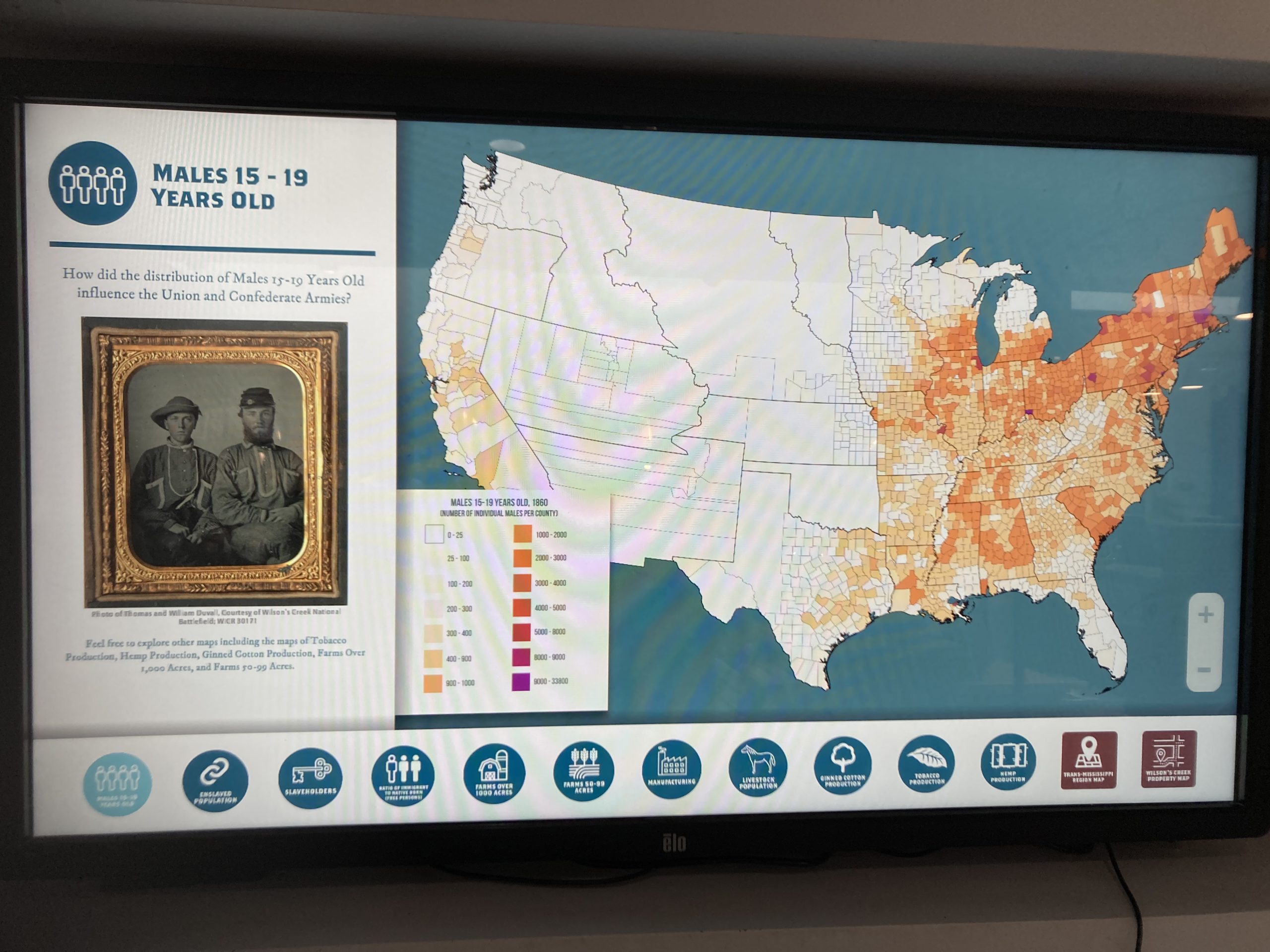
- A interactive map that displayed demographic and economic data about the United States in 1861 down to the county level. I am a sucker for historical maps—after all, history occurs in both time and space. This one was absolutely fascinating. Some of the topics were expected: where cotton was grown for instance. Others were surprising: the distribution of what the map maker calls the “equine population”. (This did make me wonder how they got the information. ) I could have spent a lot more time with that map, and may on future visits.
In short, a worthwhile stop if you are in the area. I love the fact that the National Park Service is beginning to address the parts of history that most of us weren’t taught in school. Plus, maps.
*For those of you who don’t carry a timeline of the American Civil War in your heads: The war began with the fall of Fort Sumter on April 12, 1861. The first full-scale battle of the war, variously known as the First Battle of Bull Run or the First Battle of Manassas—depending on whether you are reporting events from the Union or Confederate perspective—occurred on July 21, 1861. In other words, the Battle of Wilson’s Creek was early in the war. If you want details about the battle itself, I recommend you check out the park website. As always, the National Park Service does an excellent job of telling the story.
**I was surprised to learn that the vast majority of slaves were in the area surrounding St. Louis and moving south. This upended many of my assumptions.
From the Archives– Shin-Kickers From History: Samuel Gompers and the American Federation of Labor

It’s the Labor Day weekend here in the United States. A holiday that many of us celebrate by firing up the grills, hitting up sales, and attending outdoor festivals. In short it is a day off. Something we can thank the American labor movement for, along with child labor laws, the forty-hour week, paid vacations, etc. (1)
One of the major players in the early labor movement in the United States was Samuel Gompers.
Gompers (1850-1924) was born in East London. His family immigrated to America when he was thirteen and settled in the Jewish community on Manhattan’s Lower East Side. For eighteen months, Gompers and his father rolled cigars in their small apartment before finding better job in cigar workshops.
In the evenings, Gompers attended free lectures and classes at Cooper Union. He received an education on the floor of the cigar workshop as well. Unlike many other skilled trades, cigar rolling was quiet work and talking was allowed. Sometimes one of the men in the shop would read to the others.
Gompers and his father soon joined a branch of the United Cigar Makers’ Union. Gompers was not very active in union business until the early 1870s, when the position of skilled cigar makers was threatened by the proposed introduction of a cigar mold that simplified an important step in the cigar-making process. He joined other union members in a series of strikes protesting the use of the mold, with its threat of making skilled workers less necessary.
During this period, Gompers also attended socialist meetings and demonstrations. He was drawn to Marx’s critique of capitalism, but came to the conclusion that socialist goals of long-term transformation were in conflict with the desire of most workers for immediate change. He described his own labor philosophy as “bread and butter unionism.”
After the failure of a 107-day strike, Gompers and fellow union member Adolph Strasser decided to reorganize the Cigar Makers’ Union. The new Cigar Makers’ International Union charged relatively high dues, which allowed them to build a strike fund and offer a benefits program. The idea was to build a sense of identity among union members based on their shared skills and bind them to the union through an extensive benefit system.
In 1881, Gompers was instrumental in creating another level of union strength in the form of a national federation of trade unions, the Federation of Organized Trade and Labor Unions, which became the American Federation of Labor (AFL) in 1886. By 1900, the AFL had roughly 1 million members. (2)
(1) Benefits that not all Americans enjoy even today.
(2) This post is drawn from a chapter on socialism in America from my first book for adults: The Everyday Guide to Understanding Socialism.