




Talking About Women’s History: Four Answers and a Whole Bunch of Questions with Joanne Mulcahy
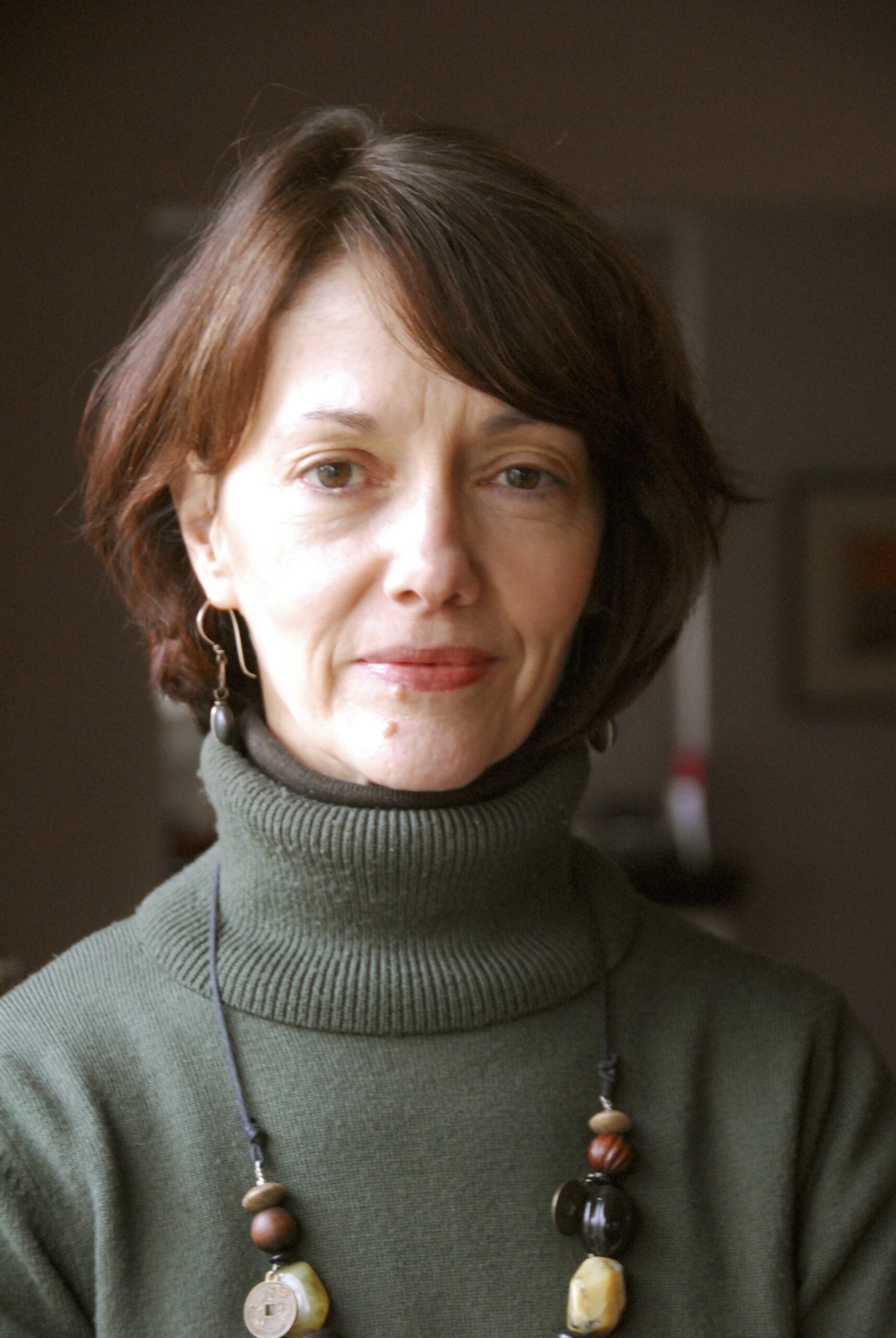
Joanne B. Mulcahy is an essayist, biographer, and teacher of creative non-fiction. Her studies in anthropology and folklore inspired travels to the Arctic, Northern Ireland, Australia, and Latin America. Her travels, in turn, inspired three books, include the prize-winning Writing Abroad: a Guide for Travelers. In 2013, while teaching at La Universidad Latina de America, Mulcahy discovered the murals of an extraordinary but largely unforgotten artist. Her work on that artist, Marion Greenwood: Portrait and Self-Portrait—A Biography, was published in March, 2025.
Take it away, Joanne!
Writing about an historical figure like Marion Greenwood requires living with her over a period of years. What was it like to have her as a constant companion?
My husband jokes that of our nearly thirty-four years together, a third were spent in a ménage-à-trois with Marion Greenwood. There was no escape in our house! I posted images of Greenwood and her paintings on my walls and I bought a lithograph on eBay, now framed in the dining room. Her work filled my life for over a decade, as did her model of a life lived unfettered by society’s constraints.
Despite the vast differences in our lives, I needed and continue to need role models like Marion Greenwood. She forged her own path, resisted social conventions regarding marriage and children, and stayed passionately devoted to her art. She went to her studio daily but she also traveled the world, had many lovers, and generally indulged in pleasure. In the words of her second partner, Robert Plate: “Always with strong appetite for life, Marion ate too much, drank too much, even worked too much, and loved too much.”
But living with Marion Greenwood also revealed schisms between her public and private personae and the numerous struggles she experienced. The public artist wanted and received accolades for her work, beginning with becoming the first woman to paint a mural in Mexico at age twenty-four. Diego Rivera called her one of the world’s “greatest living women mural painters.” The private Marion confessed to her longing to experiment artistically and disappointment at returning to realistic portraits in order to make a living— a rare achievement for an artist then or now. Financial insecurity was a demon she never escaped. Her notebooks offered a glimpse of her money problems, and she lived hand to mouth for most of her sixty years. The publicly assertive woman also needed a level of emotional support missing from her marriage, which Robert Plate did deliver during the last twenty years of her life. Unearthing the hidden aspects of her publicly confident, intrepid, and adventuresome life just deepened my sympathy and admiration.
We’re all familiar with the challenges of finding sources for writing about women from the distant past. What are the challenges of writing about women from the mid- twentieth century?
I didn’t expect that the proximity of Greenwood’s era would pose challenges. If I were writing about women from say, the medieval world, I would suspend assumptions of shared values, world views, and other aspects of culture. The radical differences between eras come alive in one of my favorite articles, “Wonder” by Carolyn Bynum. She suggests adopting “the strange view of things” in order to penetrate a period foreign to our own. I see this as acknowledgment that we can stand in awe of differences yet never truly understand. In contrast, the mid-twentieth century felt, well, familiar, since I was born into it.
Identification with the subject can color the biographer’s experience. In her book Afterlives: On Biography and the Mysteries of the Human Heart, Megan Marshall described “proximate distance,” the ways in which we are both intimate with and apart from our subjects. Temporal proximity can heighten the identification. I had no idea when I found Greenwood’s mural that she came from an Irish Catholic family of six children, as do I. However, a deeper dive into her personal life and the first half of the 20th century turned those facile assumptions on their head. Greenwood’s family was quite unlike mine, and her path was marked by the challenges women faced in her time.
Greenwood left high school at fifteen to attend the Art Students League, a move that didn’t surprise her family of artists and would-be artists. She often pointed to this decision as illustrative of her determination. Yet her decisions raised eyebrow in an era when young women’s education was intended to make them marriageable. Greenwood did finally marry the British-born Charles Fenn; they divorced after thirteen tumultuous years. She lived with her second partner, Robert Plate without marrying, and she was critiqued for her romantic adventures in ways her male counterparts were not. She remained committed to her art during deeply conformist eras, especially the 1950s. I took inspiration from Greenwood’s life but came to recognize how sharply the barriers she faced contrasted with the freedom I had coming of age in the 1960s and 70s.
Regarding sources, my main challenge was the resistance of two collectors who owned archival materials they would not share. The long journey to acquiring those prolonged the research and thus the writing of the book. But Greenwood’s tenacity in her life and artistic practice kept me forging ahead as I confronted obstacles.
Did your training in anthropology and folklore inform your work on Marion Greenwood, and if so how?
My training in anthropology and folklore definitely influenced my understanding of Greenwood’s life and work. When I discovered her mural in Morelia, Mexico in 2013, I had planned to begin research on traditional healing among the Purépecha people of Michoacán. I’d already written two books about healers, one about a Mexican/Otomi curandera, the other about an Alaska Native midwife. However, Greenwood’s mural captivated me. I had to find out more about this American artist who had so powerfully depicted the daily life of the Purépecha in the 1930s. Soon I was deep into the terrain of art history, Mexican culture, and myriad other topics.
I have stayed attuned to debates around representing other cultures, especially ways to tease apart power and representation. Greenwood, I discovered, started out naïve but grew sensitive to her place as an outsider, becoming an advocate for indigenous artists in the WPA art programs. That said, she also fell prey to “romantic primitivism,” that attraction to “otherness” that sometimes blinds outsiders. That she evolved from that stance was due in part to Greenwood’s teacher, Winold Reiss. I’d never heard of this amazing German modernist who came to the US in 1913 to depict the diversity of the Americans. His influence on Greenwood’s vision of cultural diversity was enormous. My background made me particularly alert to these aspects of Reiss’ and Greenwood’s art and the surround that shaped them. Both linked art and social justice, seeking to show the uniqueness of each individual within a cultural context. Questions about cultural representation are of course different today than during Greenwood’s time, so I tried to account for the shifting nature of those discussions.
In your title, you refer to Marion Greenwood in terms of both portrait and self-portrait. What do you mean by that?
Greenwood was a portrait painter as well as a muralist and printmaker. My early research revealed that she was once well-known for the sensitive portraits that garnered a Carnegie Prize, among many others. Critics praised her ability to capture a subject’s inner spirit, one “excavated from beneath surface fact.” I expected that she would still be celebrated for that work, and had she lived beyond 1970, she might have been. Portrait painting is again in vogue, pioneered by artists of color, a resurrection that Greenwood would have applauded. But during the 1940s to the 60s, when abstract expressionism dominated, realism fell from grace and her work was often deemed merely reportorial.
Today, when she is acknowledged at all, it is for her murals, her derring-do, and lamentably, her beauty. When I set out, I had no idea that Greenwood was stunningly beautiful. Her friend Gladys Broksky said that her looks were “almost a handicap.” On my initial search, I found more portraits and photographs of her than by her. Among the artists who tried to capture Greenwood’s beauty and allure were Max Beckmann, Lola and Manuel Alvarez Bravo, Alexander Calder, Isamu Noguchi, Harry Sternberg, and Winold Reiss. Most of their portrayals are glamorous, highlighting her extraordinary looks. In contrast, her self-portraits reveal a woman unsmiling, understated, and decidedly unglamorous. She wanted above all to be taken seriously, a goal of women artists then and now. One of my favorite quotes is from art historian Jennifer Higgie, “The act of female self- portraiture—a woman declaring that her existence is something worth recording—is one of radical defiance: ‘Look at me,’ she is saying. ‘I exist. I have something to say.’ I chose the subtitle based on my belief that Greenwood wanted her self-portraits to point to her achievements, and to her goal of being remembered as a serious, passionate, and uncompromising artist.

A couple of questions from Joanne, who felt that turnabout with fair play:
On your website, you say “At the time, I was deep in the process of writing a proposal for a totally different book about another woman whose story deserves to be told. Is that story still in the works? And what other women call to you?
That story is very much still in the works. I’m currently working on a second draft of a proposal, trying to spiral out from the narrative of her complicated and creative life to see how she connects to today’s world. (wish me luck!)
As far as what women call to me: the overlooked lives, the formerly famous, the creative, the ones who live and work in times of fundamental social change, the shin-kickers. Often I end up following a theme. These days I find myself returning to women entrepreneurs, women inventors, and women artists and illustrators. Beyond that, I’ve got to feel a sense of personal connection, however tenuous that might be. I’ve walked away from more than one story that looked viable and relevant but just wasn’t a good fit.
You’ve written an amazing range of books. What unites the guide to socialism and the history of mankind with the fine-tuned biographies? How does the life link to the bigger picture?
First, it has to be said that the guide to socialism and the history of the world, and several other of my books, were work-for-hire, which means that I was hired to write a book that was someone else’s idea. I don’t take those jobs if I’m not actively interested. I’m proud of the work I did. But they don’t come from my gut the way Women Warriors and The Dragon From Chicago did.
And yet, there is a thread that holds them all together: that idea of fundamental change. Even my history of the world is told in terms of a series of fundamental changes.
***
Interested in learning more about Joanne and her work?
Check out her website : https://joannemulcahy.com/
***
Come back tomorrow for three questions and an answer with April Grossinger and Missy Gibson, the hosts of the podcast Sheela Na Gig