




Berenice Abbott takes New York’s Portrait
These days I’m hanging out a lot with Bohemians (or possibly that should be bohemians) in New York at the turn of the century: radicals, reformers, artists, and a handful of people who are just plain weird. In the process, I am coming across interesting people doing fascinating things. Case in point: photographer Berenice Abbott (1898-1991)
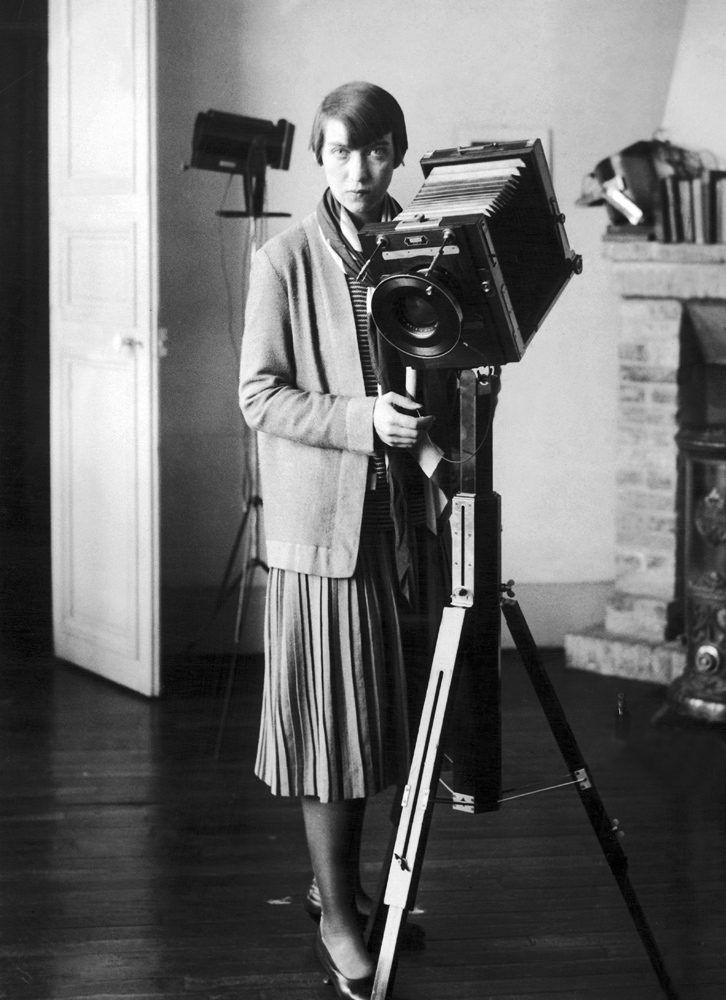
After a brief stint as a student at Ohio State University, Abbott started her artistic career studying sculpture—first in New York, then in Berlin, and finally in Paris, where she worked as Man Ray’s[1] studio assistant. The experience changed her artistic focus[2] to photography
In 1926, after two years of working for Ray, who allowed her to use his darkroom for her own photographs, Abbott set up a photographic studio of her own, where she became a serious rival to her mentor, known for her portraits of the artistic and intellectual circles.(Think “Lost Generation.”) One newspaper review went so far as to call her “the best portrait photographer in Paris, which, is to say, in the world.”
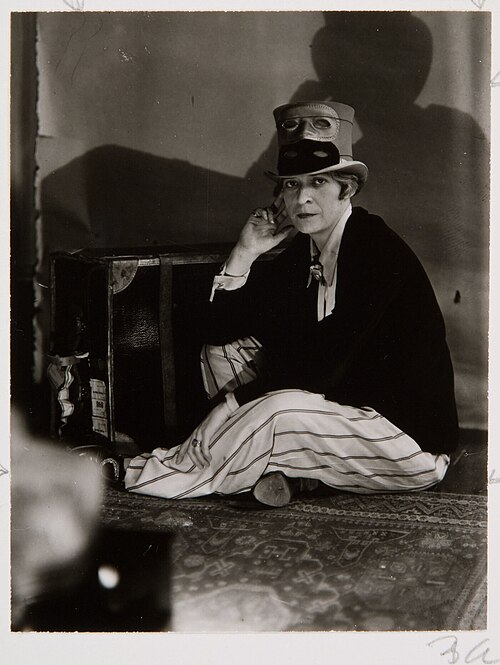
Portrait of Janet Flanner by Berenice Abbot. ca. 1925
In January 1929, Abbott returned to New York, for what she intended to be a short visit. Instead it proved to be another major turning point in her career. As she later described it, “When I saw New York again, and stood in the dirty slush, I felt that here was the thing I had been wanting to do all my life,”
Using a handheld camera, she began to walk through the city, taking what she called “tiny photographic notes” of its infrastructure and its street life[3]. Her project may have been inspired in part by the work of French photographer Eugène Atget (1857-1927), who documented the transformation of Paris from the 1880s through the 1920s.[4] But where Atget’s work was known for its wide views, Abbott developed what she described as “bird’s-eye” and “worm’s-eye” points of view for her work, often capturing the contrast between the old and new in the rapidly transforming city
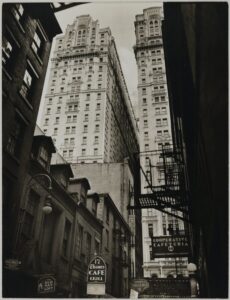
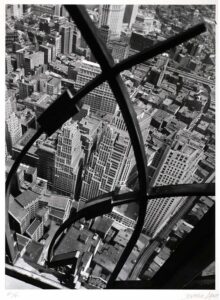
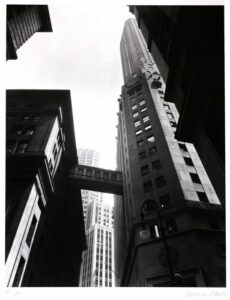
At first the work was a passion project: 266 small black and white photos pasted in a standard photo album, arrange by subject and location. In 1935 she received funding from the Federal Art Project, which was part of the Works Progress Administration. The photographs were displayed as a traveling exhibition and published as Changing New York, which enjoyed both critical and commercial success
In addition to the portraits and documentary photographs for which she is famous, Abbott wrote and illustrated guidebooks about photography and invented new photographic equipment and techniques.
She also integrated art and science in her work. One of her later projects was photographs of scientific phenomenon created in collaboration with MIT. Combining clear demonstrations of abstract scientific principles with artistic vision, her photographs were used to illustrate physics textbooks throughout the 1950s and 19960s.
[1] Short version for those of you who haven’t spent much time thinking about early twentieth century photography: Man Ray began his artistic career as part of the Dada and Surrealist movements. He began to experiment with camera-less photography in 1922, soon after he arrived in Paris, putting objects on a sheet of photosensitized paper and exposing them to sunlight. While he is best known for what he dubbed “rayographs,” he also built a career as a fashion photographer.
[2] Unintentional photography metaphor, but having seen it I chose to keep it. Sorry.
[3] Her process makes me think of the painters of the Ashcan School, who arrived in New York a generation earlier and painted scenes they saw as they walked the city’s streets. (I’m reading a lot about the Ashcan School these days with no clear purpose other than I really like their work. No further reason needed, right?)
[4] After Atget’s death, Abbott bought his work and negatives. She spent forty years making sure his work was remembered.