




Cornelia Hancock’s Civil War: A Q & A with Caroline Ivanoff
Several years ago, I wrote a book about nurses in the American Civil War. It looked at the story of civil war nurses as a group, told through the experiences of individual women. One of my favorites, was a young Quaker woman named Cornelia Hancock, who made her way to Gettysburg as a volunteer nurse. I didn’t have room to tell more than the five minute version of Hancock’s story, so I was delighted to hear from Caroline Ivanoff, who has written the biography that Hancock deserves.
Take it away Caroline!
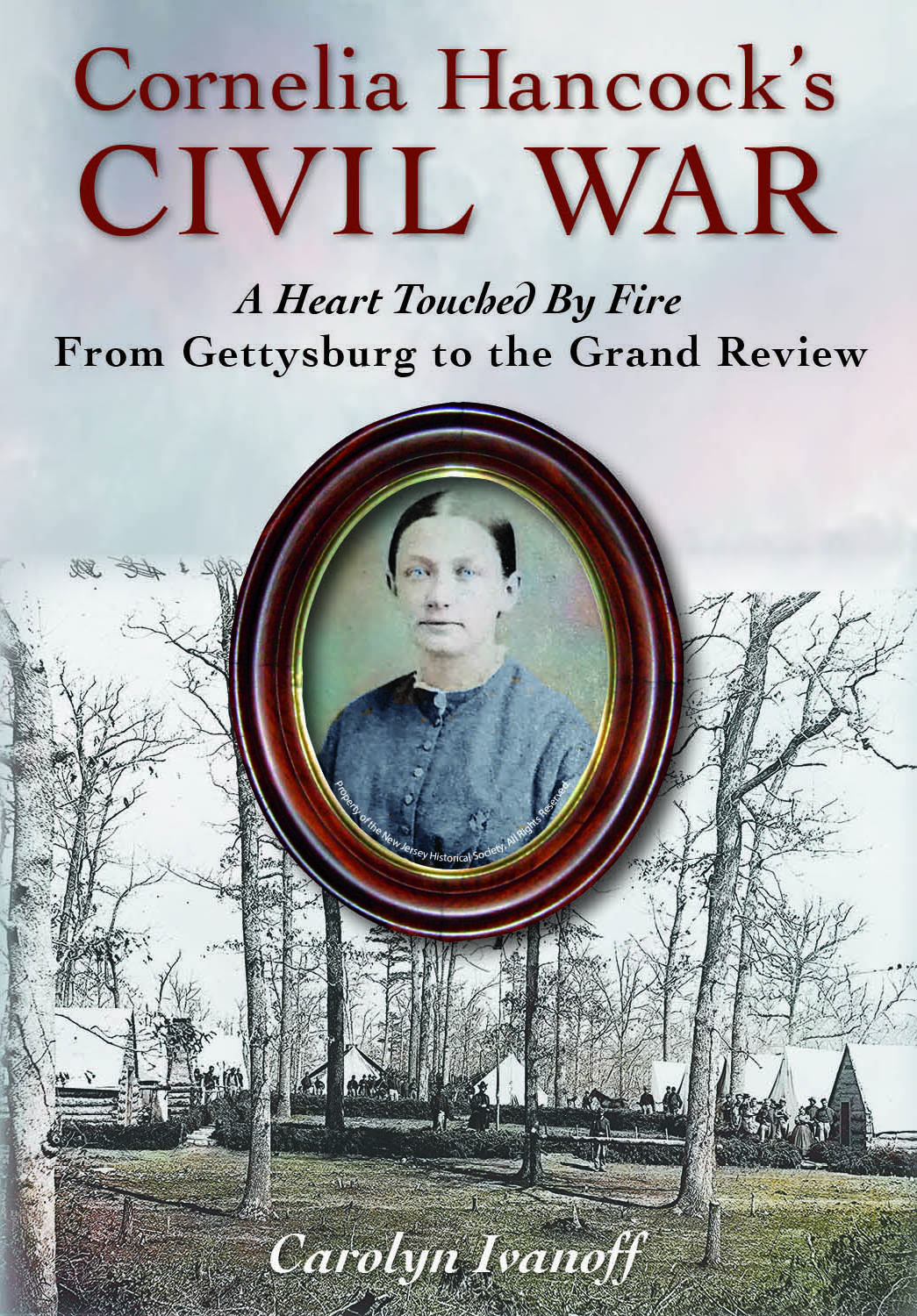
What path led you to Cornelia Hancock and why do you think it’s important to tell her story today?
I first encountered Cornelia Hancock through the paperback edition of her Civil War letters titled Letters of a Civil War Nurse, published by Bison Books in 1998. Cornelia Hancock’s Civil War correspondence, letters mostly written to family, were published without context as a collection of her Civil War correspondence ten years after her death in 1937 and titled South After Gettysburg. In 1956 they were republished with a foreword by Bruce Caton. This edition contained some of her Reconstruction correspondence and again became a best seller. Cornelia Hancock’s observations about war, politics, people and the events around her were acute, astute. and perceptive—she wrote in a voice singularly devoid of the Victorian flourishes that permeated the age.
The larger background picture of her first-hand account of a nation at war and the suffering it caused were evident, but—who were many of the people she was writing about? The famous were easy to know or find, but the common men and women, the nurses and doctors, her patients, each had a story I wanted to know. What were the specific day-to-day events that surrounded her as she wrote that gave insight and depth to her Civil War world?
I wanted to know more about Cornelia’s world and Cornelia herself. I thought other readers of her letters would want to know as well. Her story today is valuable to readers and historians as a primary witness and acute observer of the Civil War. In many histories of the period, and the Army of the Potomac, Cornelia is quoted. She writes from a woman’s perspective with eyes wide open. The path she took, and the ground she broke, as she nursed the men of the Army of the Potomac, paved the way for other women to leave their homes and dedicate their lives to great causes.
Writing about a historical figure like Cornelia Hancock requires living with her over a period of years. What was it like to have her as a constant companion?
I lived with Cornelia for many years. Cornelia’s letters captivated me. I finally decided to write a Civil War biography of her that would frame her letters and illuminate the world she navigated while revealing the determination, courage, and compassion of an extraordinary woman. Periodically over the years, before my publisher gave me a contract to write, I would reread the letters. I would travel to places she had worked during and after the war. I contacted family members from her hometown in Hancock’s Bridge, New Jersey. Periodically between other projects, I would take up the search to locate the people she wrote about, to travel to the battlefields where she served, to try to understand Cornelia and her world. After I received the contract from the publisher, I, like many biographers, submerged myself in research. She was a force to be reckoned with, but one that did not broadcast her accomplishments or publicize her work. I often wondered what she would have thought about me writing a biography of her. Would she have been pleased? Would she have wondered why she had become an object of fascination? Would she have shunned the project? Would she have been flattered? Would she have found merit in her story? Even after all this time, I think she would have been ambivalent.
How did Cornelia Hancock fit into the larger history of nurses in the American Civil War? What role did she play in the culture of social reform that followed the war?
To be a nurse during the Civil War took great courage. Women who nursed during the war defied the norms of society. Before the war, nursing took place in the home. There were no trained nurses in America except a handful of Catholic nuns. Army nurses were men– private soldiers “detailed” or ordered to nurse other soldiers. After the horror and mass casualties of First Bull Run, Dorothea Dix induced the Surgeon General to issue Circular No. 8, which gave the requirements for hired female nurses. Women would step into the breach. But “Good Women” did not seek to care for others outside their own homes. “Good Women” did not go out among strange men in the army to touch them, wash them, comfort them. Nursing outside the home was a low-brow, low-class, nasty thing to do. Nursing called into question the virtue of the nurse. Throughout the war Cornelia would be forced to defend her choices and her reputation. Cornelia and women like her crashed through the Victorian mores that dictated a women’s life was confined to her home. Everywhere female nurses served survival rates improved.
After the war “female” nursing became an honorable profession. After the Civil War, Cornelia, and many of these women, continued their contributions to the nation, working outside the home, and they would never turn back. Cornelia herself worked for the rest of her life as an educator, social worker, and urban engineer fighting to improve the lives of freed people, neglected children, and the underprivileged. Women’s work during the Civil War inspired new ways of thinking about women’s place in society. Women like Cornelia paved the way for the women’s fight for full citizenship, legal and civil rights, social mobility, education, and a professional female work force. The war work of these women laid the foundation for women’s fight for female equality and the vote.
What was the most surprising thing you learned doing research for your work?
Not a surprise, really, but a hope that was dashed. I retrieved all of Cornelia Hancock’s existing personal correspondence and papers from Clements Library at the University of Michigan and The Friends Historical Library at Swarthmore College. I combed through every bit. I was hoping to find answers to several open questions I had about her life, her relationships, and her world that her previously published correspondence did not shed light on. In writing the book I included some of her previously unpublished letters, and unpublished letters from family and friends, and wrote about the events that surrounded her as she wrote. I wanted to give the reader a fuller picture of her life and service. Unfortunately, there were no real surprises in her unpublished letters, and some questions will go unanswered. We can speculate that Cornelia herself, and her literary executor, took pains to ensure that certain aspects of her life will forever remain hidden.
What is your favorite research tip for people interested in writing about less well-known women of the nineteenth century?
I don’t really have a favorite research tip. I’m not a very methodical researcher either. Something I search for one thing or person and find something else entirely. Not dismayed, I know I will make use of unexpected research somewhere—for me the unexpected sometimes pays off. I am a dogged researcher, though, and that has paid off many times. I endure and continue to seek that one missing link, trying different avenues, and sometimes I do find the pot of gold under the rainbow. When I’m looking for an obscure personality or even deepening my research on my subject I try to cast a wide net. Of course, Newspapers.com and Find-A-Grave often provide some very interesting paths to explore that can yield great finds. I also like to search out contemporary accounts—published diaries, letters, and memoirs of people from the era who may have had contact or similar experiences with my research subject. Of course, I use genealogy sites, and sometimes a google search will strike an unexpected nugget. I sometimes return to the old school and search bibliographies and indexes. There is no one specific research tip I can recommend from my own experience except to keep at it– sometimes relentlessly. We all know that no matter how hard you seek, sometimes you cannot find– and that’s hard to accept. Nevertheless, for me research is often the most enjoyable part of the journey in writing a book.
What do you find most challenging or most exciting about researching historical woman?
The most challenging aspect of researching historical women, or anyone really, is getting to the heart of their motivations and what drives them and their relationships with the people they interact with during their lives. Sometimes you cannot find what you are looking for and, therefore, you cannot write about it. For example, there is circumstantial evidence that points to Cornelia Hancock having attended the dedication of the National Cemetery at Gettysburg on November 19, 1863, when Lincoln gave his Gettysburg Address. This was one of the things I sought to find evidence of in my research. I could not definitively substantiate her attendance through any hard evidence; therefore, it was left out of the book. Regarding Cornelia’s relationship during the war with Dr. Dudley, whom she mentioned in so many of her letters, and her reasons for remaining unmarried—two questions I sought answers to—neither could be definitively answered.
It is evident from a close and systematic evaluation of her extant letters that there are gaps in the correspondence. Perhaps these existing gaps can be surmised due to letters that simply did not survive, however, in some instances it is quite likely that Cornelia herself, or her literary executor scrubbed the correspondence. It is certainly no secret that some letters were deliberately burned after Cornelia’s death by her niece before handing them over to her literary executor, Henrietta Stratton Jaquette, who subsequently published them in 1937. This cleansing of personal correspondence is seen repeatedly in researching historic personalities. We always decry the great loss to history, but the action is driven by a deep human need for privacy.
In addition to writing about the Civil War, you are actively involved in Civil War education and preserving Civil War battlefields. When did you first become interested in the Civil War and what sparked that interest?
I have been a member of the American Battlefield Trust and all its predecessor organizations since very early in the preservation movement. In 2003 I was chosen as teacher of the year for the Civil War Trust. In my personal life and in my teaching career I always supported preservation and place-based learning for my students. The land can teach us so much. Once these battlefields and historical properties are developed, they become lost forever. I first became interested in preservation with the advent of the preservation movement in the late 1980s as reckless development began to roar through the nation. As a teacher of American history, I was always an advocate of the National Parks and historical sites and places. As for the history of the Civil War, the war is an enduring a lynch pin in the history of our nation. It was a war that preserved the nation. Cornelia Hancock’s letters provide an unforgettable panorama of suffering and endurance, grief and sacrifice, heroism and tragedy of that war. From overcrowded hospitals to battle scarred landscapes, she chronicled the human cost of war with honesty, compassion, and courage. At the center of her world is a nation in crisis—and a young woman whose fearless devotion to the wounded and dying left an enduring legacy. The world Cornelia Hancock inhabited during the Civil War may seem distant, yet its echoes continue to shape our nation today. We are still searching for a national unity that the war seemingly preserved with our country, but we Americans are still victims of so many of the divisive issues that the war failed to resolve.
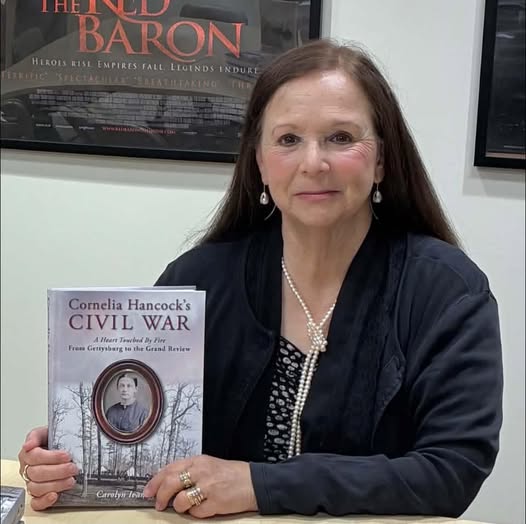
Carolyn Ivanoff is a retired high school administrator, author, and independent historian. She writes and speaks frequently on American history in a variety of formats and venues. As an author, researcher, and presenter much of her work focuses on 19th century America including social, medical, and material culture, the American Civil War, and Connecticut. At the heart of her research and published works are firsthand, primary source accounts of the people of the Civil War generation. Carolyn Ivanoff is the author of two books, We Fought at Gettysburg-Firsthand Accounts by the Survivors of the 17th Connecticut Volunteer Infantry and Cornelia Hancock’s Civil War-A Heart Touched by Fire from Gettysburg to the Grand Review. As a presenter her programs include educational and historical presentations for museums, libraries, schools, community organizations, Civil War round tables, and living history venues.