




All-Night Party
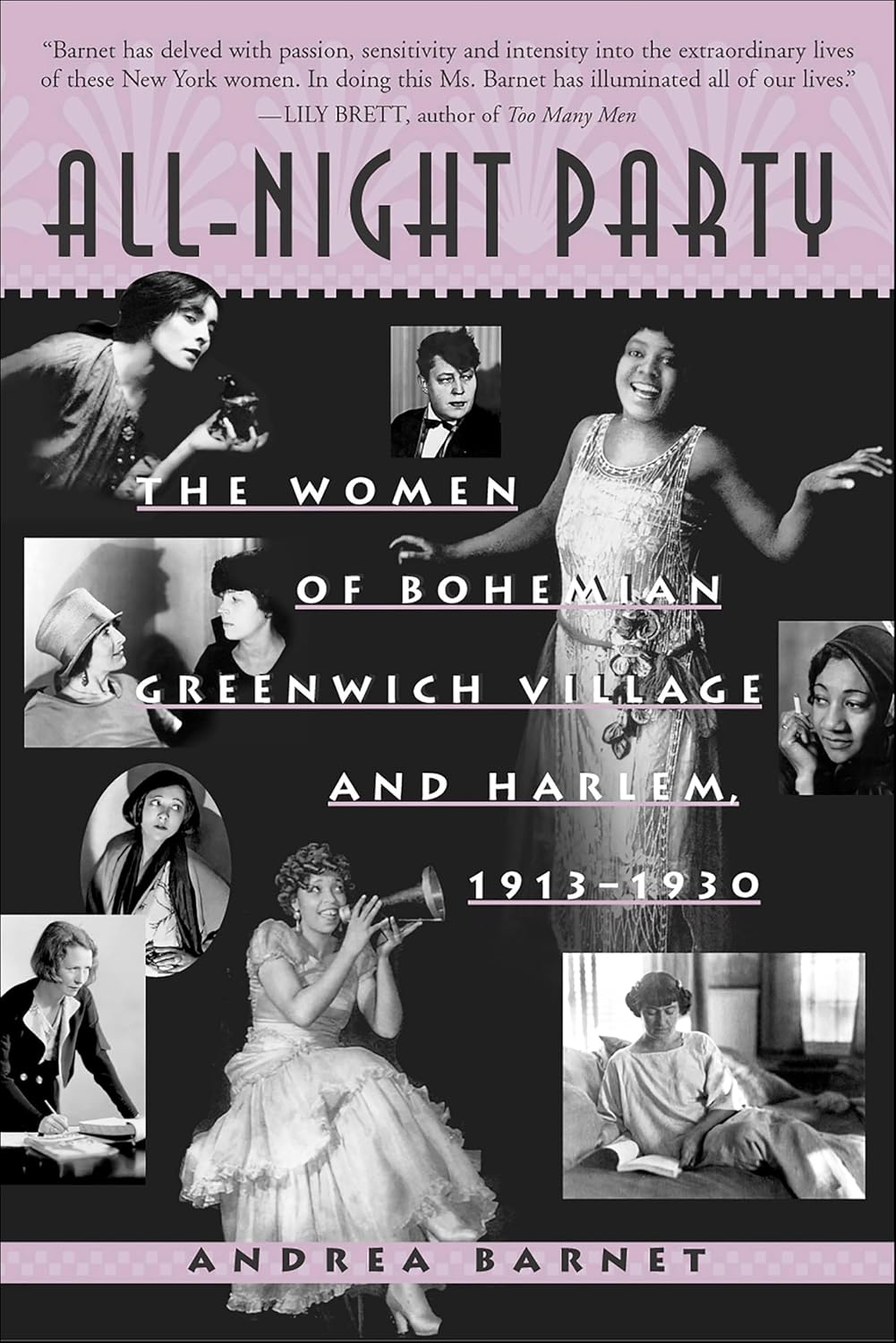
As some of you may have noticed, I’ve been spending a a fair amount of time in recent months in New York City in the 1910s and 1920s, especially the corners of it dedicated to artists, bohemians, and modernists, self-declared and otherwise. Consequently, when All-Night Party: The Women of Bohemian Greenwich Village and Harlem, 1913-1930 by Andrea Barnett crossed my path, I immediately snapped it up.
I expected it to be a companion to Hotbed, Joanna Scutts’ account of radical women in Greenwich Village during much the same period. And in many ways, it is. Barnet discusses many of the women who appear in Hotbed, and makes an occasional passing reference to Heterodoxy, the social club that stands at the center of Scutt’s account. But where Scutts focuses on the radical activism of the women she discusses, using their personal lives as means of entry to the larger social story, Barnet’s account is driven by what she describes as “Creative dissent, whether expressed as artistic innovation or as liberating lifestyle.” Where Scutts’ radical women were for the most part white, with one or two carefully noted exceptions, Barnet divides her subjects evenly between Greenwich Village and Harlem, and the often uncomfortable intersection between the two.
That said, Barnet’s careful attempt at looking at both the white bohemians of Greenwich Village and their Black counterparts in Harlem underlines the fundamental differences between the two worlds. The white women whose stories she tells include poets, artists, magazine publishers, activists, journalists, a photographer, the dancer Isadora Duncan, and at least one woman who seems to have been famous for being famous. With one exception, the Black women she discusses are blues singers. The only place at which their experiences overlap is at the level of the wealthy salon hostesses Mabel Dodge and A’Leila Walker—and the contrast between the two is striking.
I have mixed feelings about All-Night Party, though that may say more about me than it does about the book. I could easily imagine myself as part of the world Scutts depicts in Hotbed; the lives Barnet shares seemed totally alien, even when there is considerable overlap between the two sets of characters. Nonetheless, reading the two in conjunction gave me a richer picture of a complex and fascinating time and place than either book would have provided alone.
Worth the time if you are interested in the period.
I recently read this pair too! I agree, they make a good double feature.