




Mary Elizabeth Garrett, the “Friday Evening” Group, and Coercive Philanthropy
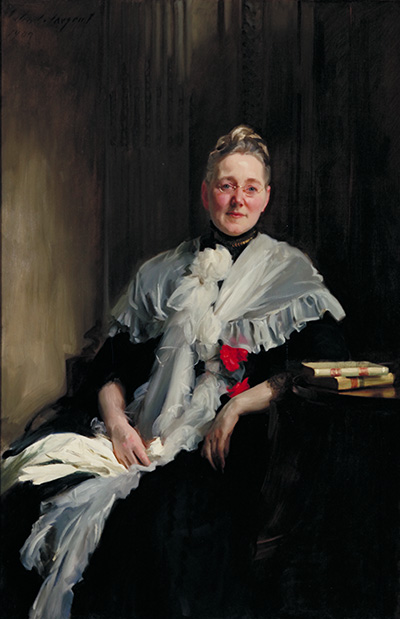
In the course of researching my last blog post, I discovered Mary Elizabeth Garrett (1854-1915), the woman who founded and led the Women’s Medical Fund Committee, which raised the money that allowed the Johns Hopkins University medical school to open, and forced the school to admit women and to improve the quality of medical education. Groups of women raising money for charitable and civic causes isn’t a new story, though the financial blackmail Garret’s team applied is an interesting twist.[1] But when I went a little deeper into the story, I found Miss Garret entirely too interesting to leave in the footnotes. Her story focuses on two issues that I’m spending a lot of time thinking about these days: women’s education and the power of women working in groups
Mary Elizabeth Garrett was the third child and only daughter of banker and railroad tycoon John Work Garrett. Known as the Railroad King, he was the president of the Baltimore & Ohio Railroad, which was the first major railroad in the United States, and one of the most influential men in the country. Because she was a woman, no one expected Garrett to play a role in the family’s financial empire, but she showed an acute business sense from an early age. So much so that her father often lamented that she wasn’t a boy because she would have been such an asset to the company. Her father encouraged her to develop her business skills by using her as his private secretary—a position that was typically held by men in late nineteenth century. As “Papa’s secretary,” she accompanied him on business trips, attended meetings with some of the most influential businessmen of the time, and handled his correspondence. She was also exposed from an early age to personal philanthropy as practiced by her father and his friends financier George Peabody, often considered the father of modern philanthropy, and merchant-banker Johns Hopkins.
When her father died in 1884, her brothers took over the family’s financial empire. Her oldest brother became president of the B & O Railroad. Her other brother ran the family’s original business, Robert Garrett and Sons. Garrett inherited nearly $2 million[2] and three large estates, making her one of the wealthiest women in the country, but her role in the family businesses ended. (That “and Sons” sums it up.)
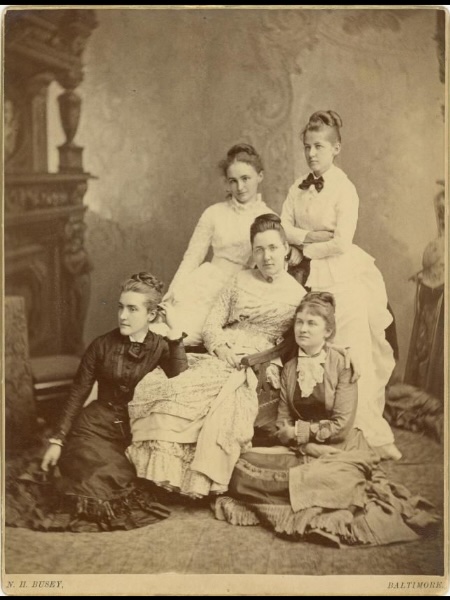
Cut out of the business world, Garrett vowed to use her money to help women by removing some of the obstacles that had stood in her way, helped by a group of women who had been her friends for many years. While in their teens, Garrett and four other young women with progressive leanings— M.Carey Thomas, Mamie Gwin, Elizabeth “Bessie” King and Julie Rogers—began meeting on Friday evenings to discuss art, literature, politics and social issues. They called themselves “the Friday Evening.” All of them were from wealthy families. Most were from Quaker backgrounds. All but Julie Rogers were daughters of Johns Hopkins trustees—a detail that would prove to be important. Over time they came to the conclusion that education was the key to helping women lead more independent lives. They had learned by personal experience that even wealth didn’t open all the doors.
Their first effort in promoting education for women, with Garrett’s financial backing and the “Friday Evening” as the governing board, was the formation of a college preparatory school for women, the Bryn Mawr School in Baltimore[3]. Although some detractors grumbled that the money would have been better spent on a domestic school to teach women to be better housewives and mothers, the Bryn Mawr School became a model for girls’ college prep schools across the country.
Their next contribution to women’s higher education was on a grander scale: the formation of Johns Hopkins Medical School as a co-educational institution. Garrett had offered the university $35,000[4] in 1887 as seed money for a co-educational school of science. The endowment left by Hopkins was going strong and the board of trustees turned her down. Several years later, when the endowment was faltering and the board didn’t have enough money to open the medical school, the Friday Evening saw its opportunity. Because several of their fathers were still on the Johns Hopkins’ board, the women knew just how bad the crisis was. Enlisting support from influential women across the country,[5] they formed the Women’s Medical Fund Committee to raise the needed funds, with the caveat that women be allowed to enroll. They organized fifteen committees in major cities throughout the country, headed by prominent local women. They made sure that newspapers covered their activities. Nonetheless, the committee struggled to raise the entire $500,000 needed. Garrett made up the difference, with the additional caveat that the school be a graduate institution with rigorous entrance requirements. The board of trustees did not take the money or the related conditions laid down by the women easily. (One faculty member quipped that it was a good thing he was already a professor because he would never have gotten in as a student.) But ultimately Johns Hopkins Medical School opened as a graduate level institution, with women in the first class and in every class thereafter.
[1] Introducing me to the term “coercive philanthropy,” in which a donor uses wealth as a weapon to force social change. Garrett was an early and adept practitioner of the art.
[2] My go-to relative value calculator says that would be more than $800 billion today, which would make her worth more than Bill Gates. Even if this is not accurate, it is safe to say that she inherited a LOT of money.
[3] Although the school was named for Bryn Mawr College, which was founded as an all-women’s college in 1885, there was no official relationship between the two.
[4] Roughly $13 billion today. Apparently the trustees really objected to the idea of allowing women to enroll.
[5] Including, among others:
- Frances Louise Morgan, the second wife of J. Piermont Morgan
- Jane Stanford, the wife of Leland Stanford
- First Lady Caroline Harrison
- Bertha Palmer, the queen of Chicago society
- Julia Ward Howe, whose name I assume you recognize
- Novelist Sarah Orne Jewett, whose name came up in a recent blog post
- Dr. Emily Blackwell, who opened the first American hospital staffed by and for women, with her sister Dr Elizabeth Blackwell and Dr. Marie Zakrewzska