




Beatrice Warde: “First Lady of Typography”
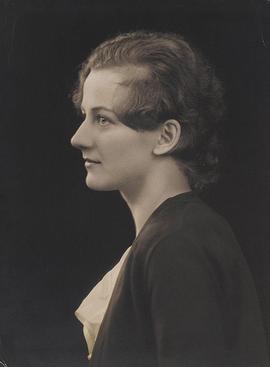
Those of you who read my previous post on Books Across the Sea have already been introduced (very briefly) to American writer and typographer Beatrice Warde (1900-1969).
Like many writers, I have opinions about type fonts,* and I was fascinated to learn about the changing world of typography in the first half of the twentieth century and a woman who made a name for herself in what I am sure you will not be surprised to learned was then a male-dominated field.
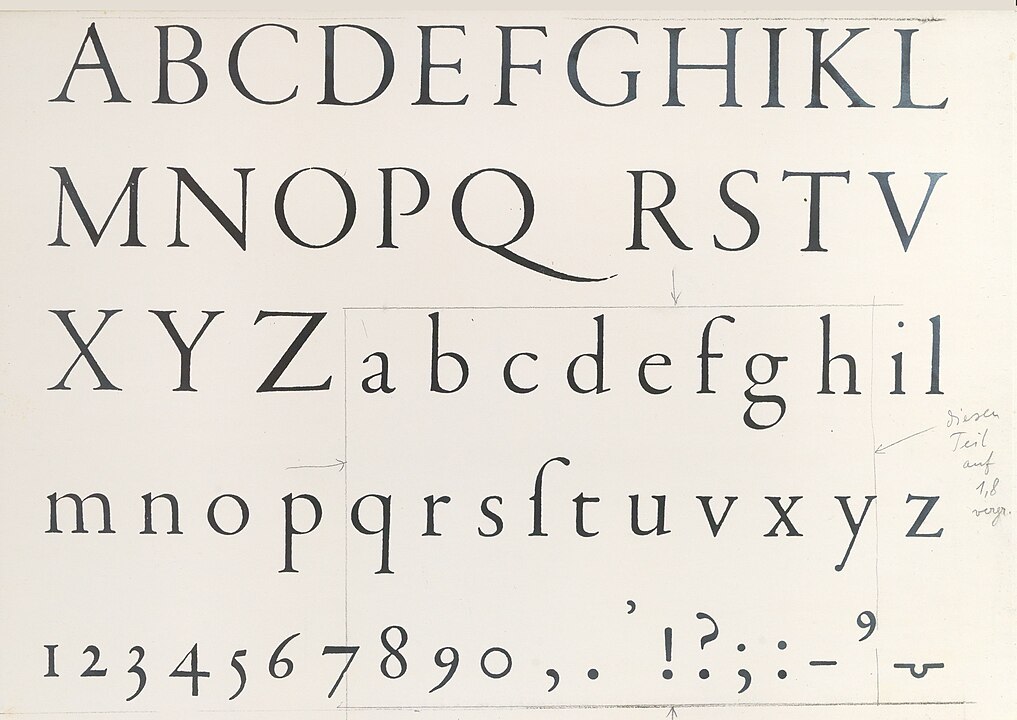
Warde began researching typefaces and printing history as an assistant librarian for the American Type Founders company, where she worked from 1921 to 1925, when she married a typographer and moved to London. She entered the professional world of typography under a male pseudonym in 1926, with an article titled “The Garamond Types, Sixteenth and Seventeenth Century Sources Considered”** written under the name Paul Beaujon. The article appeared in The Fleuron, a magazine devoted to typography, and earned “Paul Beaujon” a reputation as a scholar of typography. It also earned “him” a job offer as the editor of The Monotype Recorder, published by the Lanston Monotype Corporation.
Monotype did not revoke the offer after Warde revealed that she was a woman–which could well have happened. She worked for Monotype first as editor of the magazine and later as the publicity manager until her retirement in 1960, making her one of the few women working in typography at the time. In her years at Monotype, she championed both the intelligent revival of historic typefaces and the work of contemporary typeface designers. In the process, she helped shape the face of modern printing. She believed that type should not call attention to itself : “Type well used is invisible as type.” But that didn’t mean that typographic decisions weren’t important: “Type, the voice of the printed page, can be legible and dull, or legible and fascinating, according to its design and treatment.”
One of her longest lasting contributions to the world of printing was a broadside, printed in 1932 to showcase one of Monotype’s new fonts:
This is a
Printing Office
Crossroads of Civilization
Refuge of all the arts
against the ravages of time
Armoury of fearless truth
against whispering rumour
Incessant trumpet of trade
From this place words may fly abroad
Not to perish on waves of sound
Not to vary with the writer’s hand
But fixed in time having been verified in proof
Friend, you stand on sacred ground
This is a Printing Office
Her words were cast in bronze and stand at the entrance to the United States Government Printing Office, a tangible reminder of the power of the printed word.
*So many ways to be a nerd.
**For those of you who are not font nerds, Garamond is a group of serif-style typefaces based on the work of a sixteenth-century Parisian engraver named Claude Garamond.
*** This blog post led me down a lot of rabbit holes that I ultimately cut, but I couldn’t resist sharing this one: A fleuron, literal a leaf, is a typographic element used to divide paragraphs, differentiate items on a list, or as ornament. (A much nicer term than a bullet list. Also known as a printers’ flower, or “horticultural dingbats.” If I can figure out how to do it, horticultural dingbats may replace asterisks on occasion in this blog.****
****So far, I have failed in this attempt.
Books Across The Seas
Rationing, food shortages, and the clever ways people got around them are major themes in books about the British home front in World War II, fiction and non-fiction alike. Packages from friends in the United States made life easier for a lucky few. (C.A.R.E. packages came after the war.) I recently learned that books from the United States were another response to war time shortages.
Early in the war, Britain banned the import and export of non-essential goods to free up shipping space for necessities. Printed books were on the non-essential list.
Beatrice Warde was an American writer and typographer who lived and worked in London. Even the quickest dip in the research rabbit hole makes it clear that she deserves a blog post of her own, but for now it is enough to say that she was deeply involved in London’s printing world and was no doubt aware of the ban on the transatlantic book trade earlier than most readers.
In 1940, with the help of her mother, May Lamberton Becker,* the literary editor of the New York Herald Tribune, Warde arranged for friends and acquaintances who had reason to travel to Britain to carry single copies of important new American books to London in their hand luggage—where they competed for space with other scarce items such as coffee, sugar, or stockings. A similar selection of books published in Britain were sent to the United States in the same way. It was the beginning of a cultural and literary movement known as Books Across the Sea.
The original set of books that Ward had smuggled, seventy in all, in were displayed in the office of the Americans in Britain Outpost of the Committee to Defend America by Aiding the Allies, also known as the White Committee after its leader, newspaper editor William Allen White.** Books were soon seen to be goodwill ambassadors,*** and a formal organization was created to carry on Warde’s work with poet T.S. Eliot as its president. By 1944, the organization had send some 2,000 books to London and 1,600 books to New York.
The organization continued to operate under the aegis of the English-Speaking Union until 1984.
*Another possible blog post subject. If there is one thing I’ve learned in the last four years, it is that lots of women were doing interesting things in the first half of the twentieth century. More than I ever imagined.
**The White Committee was devoted to supporting pro-British policies in the United States that would help Britain in its war against Nazi Germany, essentially the polar opposite of organizations founded by Elizabeth Dilling. But that’s another story.
*** Duh.
Cultural Currency–Nazi-style
In my last post, I wrote about Sigrid Schultz’s columns titled “From Across the Sea” and the fact that they gave me close up glimpses of life in Nazi Germany. One column that caught my attention in particular was the plan to issue “Kulturemarks” which appeared in her column on March 4, 1938–eight days before Germany marched into Austria.
Wages in Germany had remained stationary. The cost of basic necessities had increased at the same time as the quality of those goods had decreased. Not surprisingly, Schultz told her readers, workers were grumbling. Labor officials were unwilling to raise salaries because consumers would be tempted to buy more things if they had more money, which would increase “temporary shortages”* of food, textiles, and other goods. (Go figure.)
The Ministry for Public Enlightenment and Propaganda** came up with a plan. Instead of increased wages, the government would distribute Kulturemarks which could be spent on entertainment, sporting events, and culture but not on food, clothing, or other necessities. Circuses, but no bread, as it were. It was in some ways a very Nazi approach: the celebration of German Kultur was a common element of pan-Germanism in all its variations.
Another article by Schultz ran the same day. It summed up the big picture nicely: “Assurances of friendship with America, efforts to come to an understanding with England, hidden threats against Austria, and impending rupture of the stagnating German-Russian diplomatic relations marked today’s political developments in Nazi Germany.
In short, big stuff was getting ready to go down. Kulturemarks weren’t even on the radar as far as American readers were concerned. And yet, and yet, the Austrian Anschluss was only the first step in Hitler’s drive east in search of more space, food, and raw materials, which he believed were needed to make greater Germany, well, great. Kulturemarks were intended to distract German workers from the shortages behind that drive.
I don’t know if the plan came to fruition. I haven’t been able to verify it in any of my Big Fat History Books about Nazi Germany or any of my go-to online sources. Even if it didn’t, the fact that such a plan was under discussion is revealing.
*The quotation marks are hers, not mine.
** A name that I find darkly comic.