




“From Across the Sea”
In November , 1933, the Chicago Tribune began running an occasional column titled “From Across the Sea” featuring reported think pieces by correspondents of the Tribune’s Foreign News Service. The column ran on the editorial page along with letters to the editor and other columns such as the whimsical “A Line O’Type or Two.”* Sigrid contributed 78 essays to the column, between December 20, 1933 and October 30, 1938.
In her hands, the column provided an alternate perspective on, and occasionally a sly-counterpoint to, straight news stories from Berlin. In her first column “from across the seas,” Sigrid discussed Nazi efforts to replace the Weimar Republic’s extensive social safety net with a reputedly voluntary relief scheme for winter relief**–an indirect way to talk about the scale of unemployment and hunger in Germany. Her final column disguised a discussion of the Nazi use of radio propaganda under a blanket of “tech talk” about cheap radios and radio loudspeakers in public places.
In the years in between, Sigrid reported on big stories from the relative safety of the editorial page. How censorship had crippled the German newspaper industry. Germany’s attempt to create synthetic oil to reduce its dependence on foreign oil—and the importance of oil in developing a mechanized military. The government’s call for amateurs to provide the politic police with the news and information “needed for its [Germany’s] protection.”
Sometimes she opened a column with a statement or statistic from a German publication as a way of introducing a discussion of a potential dangerous topic. For example, she opened an early column by warning Americans about the dangers of inflation, gave a vivid picture of German life during the hyperinflation of 1923, and discussed the long term consequences for German society—including a culture of hatred directed against Jews and Poland.
In other columns, she used a human interest story to provide background—or give a twist— to a straight news story that appeared elsewhere in the paper . For example, on January 11, 1936, the Tribune ran a news item was the headline “Hitler Assures Diplomats He is in good heath; that same day in “From Across the Sea,” Sigrid ran a profile on the German doctor who had operated on Hitler’s throat after the Führer began having trouble making his radio broadcasts.
Sigrid also used the column to report on smaller issues that might not otherwise have found their way into the Tribune’s pages as a news item, adding an editorial spin about why they mattered. These were a sharp-penned version of the often-over-looked“mailers”: pieces that didn’t have immediate news priority and thus could be sent to Chicago by mail rather than using the quicker, more expensive cable service. Such stories included the publication of a five-volume Encyclopedia of German Superstition, the Nazis’ rejection of Christianity, and the development of “Nazi dances” appropriate to “the new German spirit.” ***
I found some of these smaller stories especially intriguing. They gave me up-close glimpses of Nazi Germany that don’t appear in Big Fat History Books.
* As I mentioned in a previous post, the column’s title was a truly dreadful pun on the linotype machine, a typesetting machine that revolutionized publishing. First introduced in 1866, it powered the production of daily newspapers around the world through the 1970s.
**Not exactly “a thousand points of light.” Thirty thousand welfare offices were manned by unpaid members of the Nazi party and the program was funded by “voluntary” deductions of two percent of a workers’ income taken directly by his employer.
***She described the style as a mixture of folk dancing and “our grandfather’s fashionable counter dancing” (think a more refined relative of the Virginia reel)—in other words, not the “degenerate” dances inspired by imported American jazz.
Elizabeth Dilling: “The Female Führer”
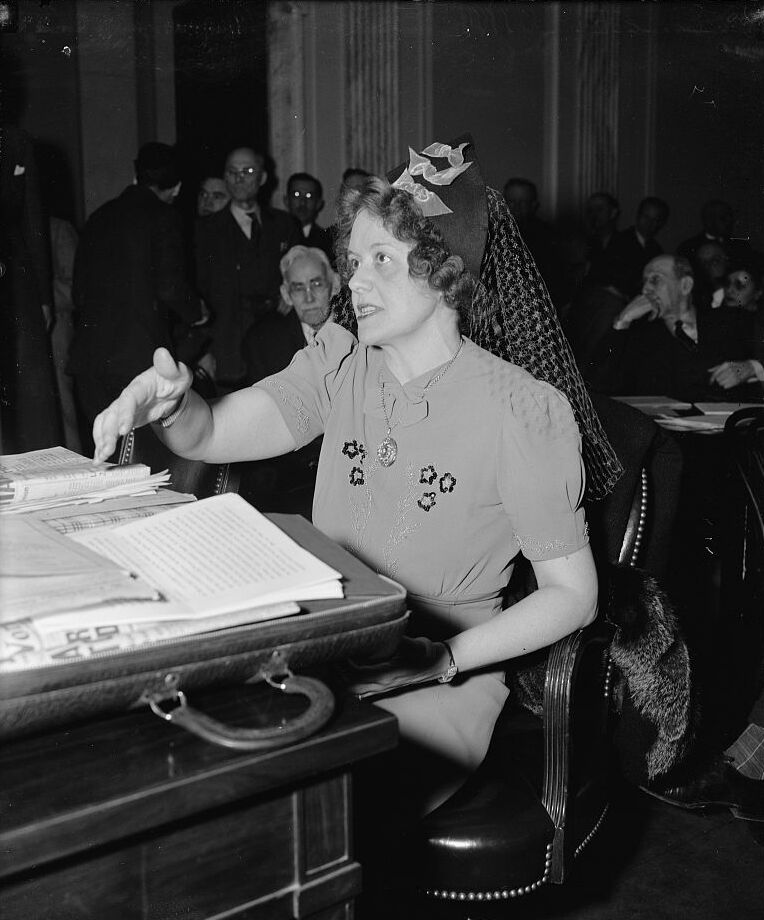
On of my favorite accounts to follow on the site formerly known as Twitter,* On This Day She –which just made its last post– previously made an important point at the head of its feed:
“A reminder: we do not ‘celebrate’ all the women we include in @onthisdayshe . Equal history means including those with whom we profoundly disagree. If the grim men are in the history books, we have to acknowledge the grim women too.”
A case in point: Elizabeth Dilling (1894-1966).
Dilling was a prominent member of the pro-fascist extreme right in the United States during the 1930s and 1940s. According to professor Glen Jeansonne, who studied Dilling and her allies, she considered herself a “professional patriot,” defending flag and faith against an array of threats that included Jews, communism, the New Deal, and the liberal Democrats who supported New Deal policies.
She found her passion as a political activist of the Red-baiting variety on a month-long tour of the Soviet Union with her husband Albert in 1931. She came back an avid anticommunist—a position that would be absolutely understandable if it hadn’t developed into being “anti” a lot of other things. (See above) Over time, her hatred for communism grew into sympathy for the the fascism of Hitler and Mussolini, which she saw as a bulwark against Soviet Russia. A Nazi newspaper gave her the nickname “the female Führer.” She called herself “Little Poison Ivy.”
Back in the United States, she threw herself into an intensive “study” of communism—the kind of study where you learn what you expected to find—and built a name for herself as an anti-communist speaker. Sometimes reaching audiences of several hundred at a time, she spoke to church groups, rotary clubs, women’s groups, most notably the DAR, and veteran’s organizations, including the American Legion.
In 1932, she founded an anti-communist organization, the Paul Reveres, that grew to 200 local chapters. Beginning in 1933, she spent long days researching and cataloguing groups and individuals whom she believed were threats to the United States
In 1934, encouraged by fellow anti-communist Iris McCord of the Moody Bible Institute, Dilling self-published The Red Network: A “Who’s Who” and Handbook of Radicalism for Patriots, a 352 page book that relied heavily on the idea of guilt by association that Senator Joseph McCarthy would use so effectively in his own Red Hunt some years later. Roughly half of The Red Network consisted of lists of more than 450 organizations that Dilling described as “Communist, Radical Pacifist,** Anarchist, Socialist [or] I.W.W. Controlled” and more than 1300 “Reds” and their affiliations, including Jane Addams, Albert Einstein, Sigmund Freud, Mahatma Gandhi, Senator Robert M LaFollette, and Eleanor and Franklin Roosevelt, The book went into eight printings and sold more than 16,000 copies by 1941. Organizations such as the KKK, and the German-American Bund gave away thousands more.
She was involved in an attempt, led by retailer Charles Walgreen, to close her former alma mater*** the University of Chicago as a communist institution. Henry Ford, who was anti all the things she was against and willing to put his money where his hatred was, hired her to investigate communism at the University of Michigan. (She also investigated UCLA, Cornell, and Northwestern—finding all of them to be hotbeds of communism and a menace to the youth who studied there.)
She was a leader of the movement of women’s groups who opposed the United States entering the war in Europe on “maternalist” grounds, arguing that war was the antithesis of motherhood.**** They supported their argument with right-wing, anti-Roosevelt, anti-British, anti-communist and antisemitic rhetoric. She was arrested for disorderly conduct in 1941, after she led a sit-down strike outside the office 84 year-old senator Carter Glass of Virgina. Glass was not a fervent New Dealer by any standard, but he was appalled by the behavior of Dilling and her followers. He called on the FBI to investigate the women’s groups and publicly stated that “I likewise believe it would be pertinent to inquire whether they are mothers. For the sale of the race, I devoutly hope not.” (For the record, Dilling had two children.)
Many of the groups continued to oppose the war after the attack on Pearl Harbor, unlike the better known America First Committee.
In 1942, Dilling and 27 other anti-war activists were indicted under the Alien Registration Act. (This is why she crossed my path. Sigrid Schultz served as a witness for the government.) They were accused of holding pro-fascist views—which Dilling certainly did—and with being Nazi propaganda agents. Dilling was charged with plotting to incite a mutiny in the American Armed forces and setting up a Nazi state. Charges were dismissed in 1946, in large part because the trial had dragged on so long that the second judge who presided over it declared it a travesty of justice.
*And yes, Twitter is problematic. I am exploring other social media sites. But nothing to date has quite captured the things that made the app so satisfying. If you are looking for me elsewhere, I am currently on Bluesky as @pdtoler.bsky.social, on Instagram as pamelatolerauthor and on Facebook as, well, me. (Full disclosure, my Instagram account is mostly about my cat and food. I aspire to do more with it.)
** Apparently not the same thing as isolationists, which she approved of, at least in the context of WWII.
***She attended for three years but did not graduate.
****They were not the first to oppose mother and warrior. I explore this idea in some depth in the first chapter of Women Warriors.
America First; right wing extremist; pro-Germany; anti communist
From the Archives: Reading My Way Through Roman Britain, Pt. 3
The places I hang out on line are having a lot of fun theses days with the question of how often men think about the Roman Empire. The answer apparently being, a lot. (Really?) I have no idea who started it, or why. But it’s a natural for history nerds being nerdy. It has spawned fun memes, and lots of playful silliness at a time when some of us need that.
I don’t have an answer. (And I haven’t asked My Own True Love the question.) But for those of you who are interested in thinking about the Roman Empire for at least a short while, I’m re-running this series that I orginally posted in 2015. With any luck, by the time the series has run its course I will have finished these endless revisions and we can go back to thinking about women journalists, Nazi Germany, fascism in general, and whatever else grabs my history nerd attention.

British journalist Charlotte Higgins (It’s All Greek To Me) was always fascinated by the classical world, but that fascination didn’t extend to Roman Britain. She thought of Britain as an unglamorous outpost on the edge of the Roman Empire–an opinion shared by most Romans of the time-. A visit to Hadrian’s Wall changed her mind. Under Another Sky: Journeys In Roman Britain is the story of her search to understand Rome’s 360-year occupation of Britain and its influence on the British sense of history and identity
Higgins travels across Britain in an unreliable camper van in search of traces of ancient Rome. She walks the tourist-friendly Hadrian Wall and tracks down the remains of Londinium through modern London with the help of a map published by the Museum of London. She visits small museums, major museums, and a tourist trap called Iceni Village. She interviews archaeologists, museum curators, farmers turned innkeepers near Hadrian’s Wall, and a full-time Roman centurion who appears at museum events and school programs. She considers the unexpected cache of Roman “postcards” known as the Vindolanda writing tablets, an influential eighteenth-century forgery of a Roman text, and re-imaginings of Roman Britain by later generations of British antiquarians, poets, military engineers and composers, including Benajmin Britten’s soulful Roman Wall Blues, composed for a radio play by W. H. Auden.
Under Another Sky weaves together Britain’s history and contemporary landscape into a complex and fascinating whole that is part travelogue, part history, and wholly charming.