




From the Archives: Word with a Past–Parchment
One of these days I’m going to come out the other side of this book, honest. Luckily I have 10+ years of blog posts to draw on in the meantime.
I had forgotten all about this one from 2013.
*****
For hundreds of years papyrus was the principal material on which books (or at least hand-copied scrolls) were written. Since it could only be made from the pith of freshly harvested papyrus reeds, native to the Nile valley, Egypt had a monopoly on the product–and a potential monopoly on the written word.
In the second century BCE, the kingdoms of Egypt and Pergamum* got into an academic arms race.
The library at Alexandria had been an intellectual power house since it was founded by King Ptolemy I Soter in 295 BCE. Ptolemy set out to collect copies of all the books in the inhabited world. He sent agents to search for manuscripts in the great cities of the known world. Foreign ships that sailed into Alexandria were searched for scrolls, which were confiscated and copied.**
Thirty years later, King Eumenes of Pergamum founded a rival library in his capital. Both kingdoms were wealthy and the two libraries competed for sensational finds.
In 197 BCE, King Ptolemy V Epiphanies took the rivalry to a new level by putting an embargo on papyrus shipments to Pergamum. The idea was that without papyrus, scholars in Pergamum could not make scrolls and therefore could not copy manuscripts. The Pergamum library would be crippled.
In response, Pergamum turned to a more expensive, but more durable, material made from the skin of sheep and goats. We know it as parchment, from the medieval Latin phrase for “from Pergamum”.
Librarians are a resourceful lot.
* “Where?” you ask. Here:
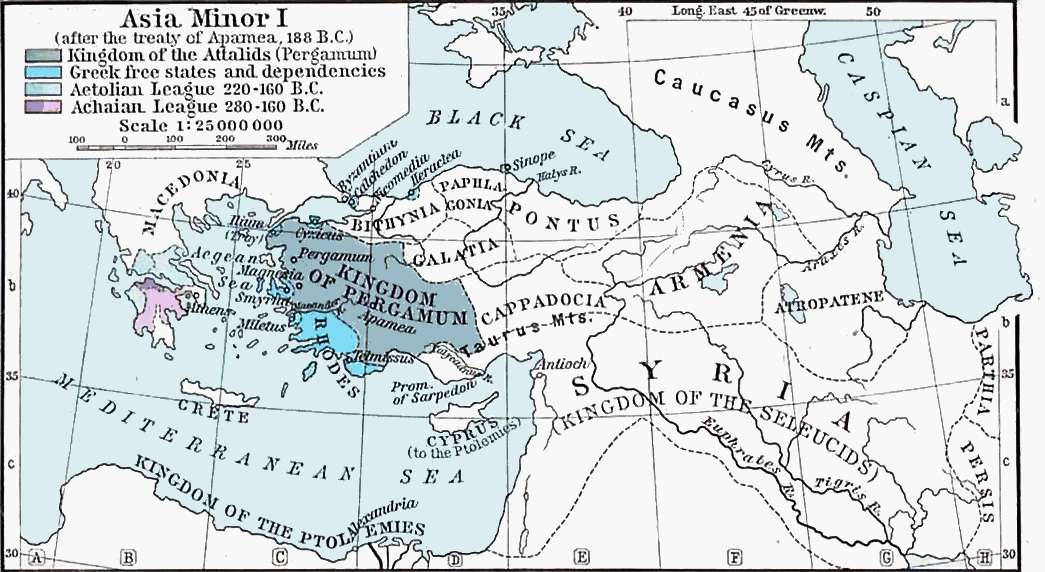
As you can see, not a small place.
** Alexandria kept the originals*** and gave the owners the copies. Piracy of intellectual property is not new.
*** According to Galen, they were catalogued under a special heading: “books of the ships”.
From the Archives: Beyond Belief
I’ve reached a point in the revision process where I’m going back to books I read early in the research process. Because while some people may write and re-write in an absolute straight line, I do not. I move back and forth, and sometimes I zigzag. I’m definitely in a zigzag phase as I draw to the end.
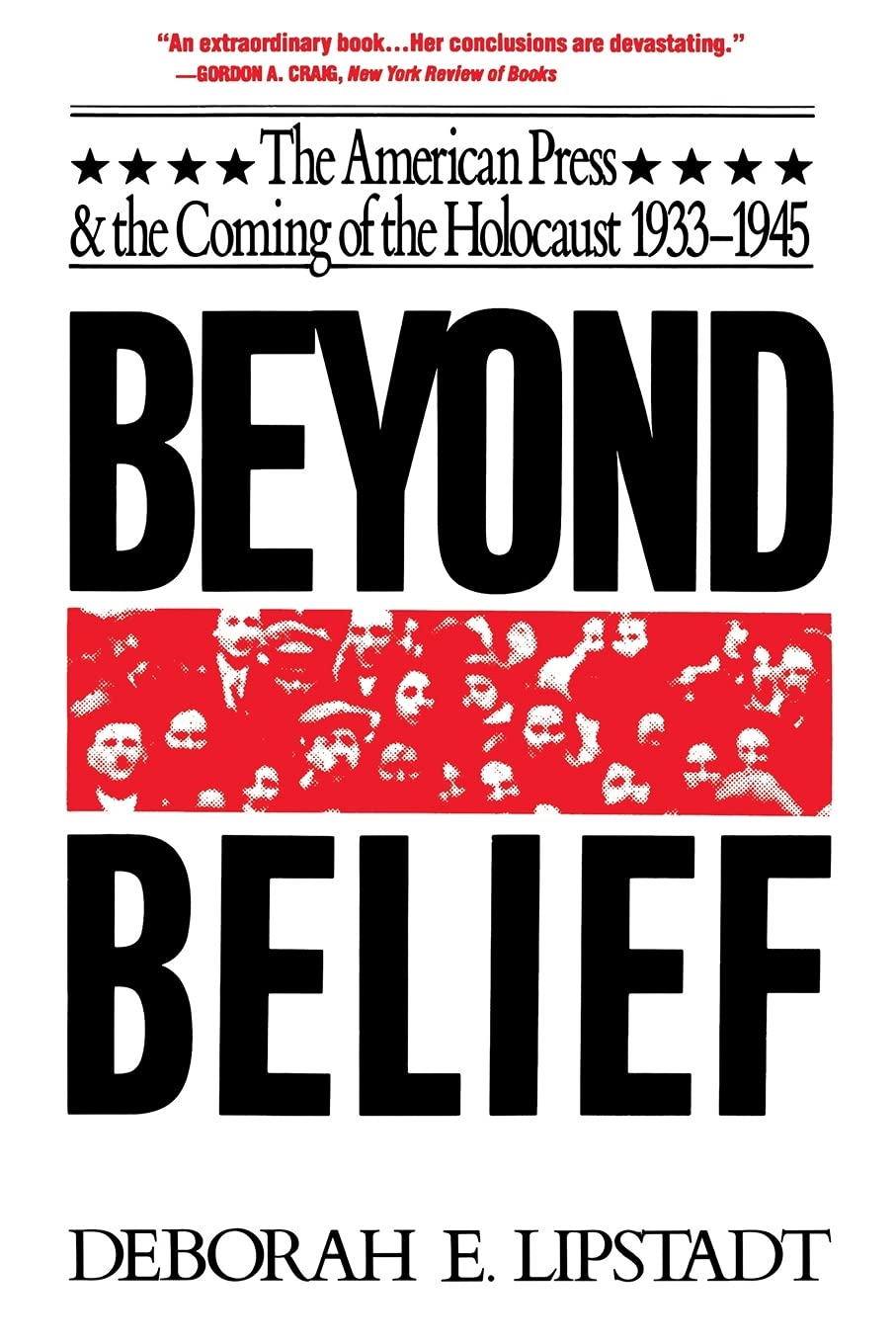
One of the books I’ve gone back to is Deborah Lipstadt’s Beyond Belief, which offers an important look at “fake news” and other currently relevant topics in the context of the Holocaust. I first shared it with you in 2020. I think it’s worth another look.
I am currently taking notes on a pile of secondary source that I read over the last few months. I stuffed them full of sticky tabs as I went and moved on. On the surface, it’s not the most efficient way to do research, and I don’t always have the time to do it. But when time allows, I find it tremendously valuable. Coming back to the material a second time with a fresh eye and more information allows me to make connections that I didn’t make the first time. Re-reading is like re-writing as far as I’m concerned. It’s where the magic happens.
I just finished my second pass on Deborah Lipstadt’s Beyond Belief: the American Press and the Coming of the Holocaust, 1933-1945. The first time through it didn’t even occur to me share it with you.* And yet, and yet: it is important, not only for understanding how Americans could have remained ignorant of the Holocaust at the time, but also as a starting point for the mindset that makes today’s charges and counter-charges of “fake news” possible.
The work had its roots in the classroom. After Lipstadt told her class that detailed information about the Nazi attempt to exterminate European Jews had been available to the Allies very early in the war, one of her students angrily responded “But what did the public—not just the people in high places—know? How much of this information reached them? Could my parents, who read the paper every day, have known?”
Lipstadt argued that a great deal of information was available. American reporters who were stationed in Germany until the United States entered the war had reported on the Nazis in detail, including information about Germany’s persecution of the Jews.
The student wasn’t convinced. “No,” he said. “I can’t believe people could have read about all this in their daily papers.”
Beyond Belief began as Lipstadt’s attempt to prove that she was right. Her final conclusion, which she offers to the student in her acknowledgements: “I was right, but so were you.”
The book consists of a detailed look at who reported what and when, what their editors did with it after they reported it,** and how readers responded. Some of the most powerful portions of the book, and the ones that I think are most important for us today, discuss what Lipstadt describes as “the barriers to belief.” The most critical of these was a legacy from World War I. Stories of German atrocities were reported in the first World War that later proved to be false. The result was an attitude of what journalist and historian William Shirer called “supercynicism and superskepticism” about reports of atrocities. As a group, Americans said “Fool me once, shame on you. Fool me twice, shame on me.” unfortunately, this time the stories were true.
Be warned, Beyond Belief is not an easy read. Lipstadt’s style is clear, but her work is dense with data. Nonetheless, I found it a worthwhile read for reasons well beyond my current research.
*I don’t normally discuss purely academic works of history here in the Margins. They have a different purpose and a different audience and occasionally just plain hard to read.
**Important stories often got buried deep in newspapers. Editors (and sometimes reporters) added seeds of doubt to the reported stories. And some papers didn’t run the stories at all.
American Nazis
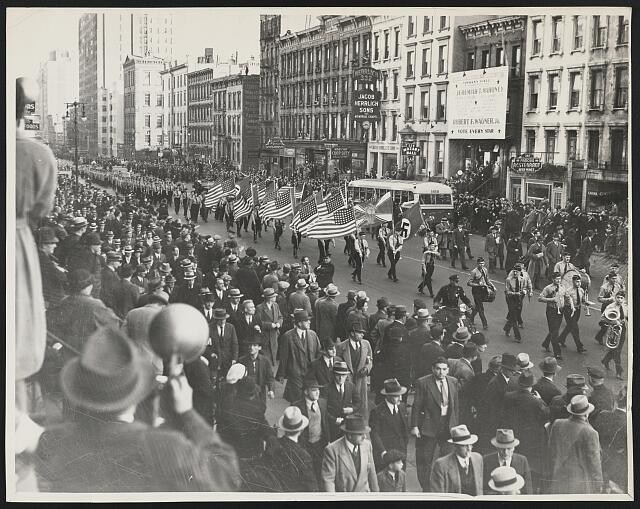
German American Bund Parade, October 30, 1937
In response to a request from a blog reader,* who mentioned that she would like to know more about Americans who supported the Nazis, I’m going to give it a go.
In the early years of Nazi Germany, American students and tourists came back with glowing reports on Germany, and raised questions about the accuracy of serious reports of problems in the Nazi state written by journalists like Sigrid Schultz. (Because a casual observer always knows more than an expert.) Antisemitism was widespread in American culture. Isolationism was a serious political position, espoused by groups like the America First Committee. (Charles Lindbergh was the most prominent figure in all of this.**) It’s an ugly picture, and all too easy to forget in the context of the powerful national narrative of World War II, but as best I can tell, most of these people were not active Nazi supporters. (Though Lindbergh seemed to tiptoe in that direction.
However, there were several organizations in the United States in the years before the war that actively supported Hitler and the rise of fascism in Europe. The most prominent of these was the German-American Bund, which was based in Manhattan and had seventy chapters with thousands of members across the United States. The Bund was founded in 1936 by a German immigrant named Fritz Kuhn, who was a veteran of World War I (on the German side) and became an American citizen in 1934. The Bund was explicitly for German-Americans and their Austrian cousins. It combined Nazi ideology, with its toxic mix of “Aryan” cultural and racial superiority, “scientific” racism, and antisemitism, and what its members framed as American patriotism.
At its height, the Bund sponsored parades, concerts, bookstore and youth camps, which introduced German-American children to camping skills and Nazi ideology. Like their German counterparts, the Bund also had uniformed storm troopers. Not a typical element in American social clubs.
The House Committee on Un-American Activities (HUAC), best known for their Cold War investigations of suspected communist sympathizers, was formed in 1938 to investigate the German-American Bund and other pro-Nazi organizations and sympathizers. HUAC reached the conclusion that while the German-American Bund was overtly racist, its activities were protected by the First Amendment. The FBI, which also investigated the Bund, concluded that it was not a threat to American security. (In all fairness, Nazi rhetoric at that point was horrifying but was not directed at the United States. That came later.)
The high point (or maybe the low point) of Bund activities was a rally at Madison Square Gardens on February 20, 1939. Kuhn called it a “mass demonstration for true Americanization.” Twenty-two thousand members attended. They carried banners with antisemitic messages taken straight from the Nazi handbook:** “Wake up America! Smash Jewish Communism!” “Stop Jewish Domination of Christian Americans.” They gave the Nazi salute to three-story tall banners depicting George Washington, flanked by swastikas.
One hundred thousand anti-Nazi protestors, also carrying banners, surrounded Madison Square Gardens. A few protestors managed to get into the rally. A Jewish plumber named Isadore Greenbaum made his way onto the stage and interrupted Fritz Kuhn’s address, screaming “Down with Hitler.” Bund storm troopers beat him right on the stage until the police intervened and got him to safety. The storm troopers were more gentle with celebrity journalist Dorothy Thompson,*** who shouted “bunk” from the audience. They surrounded her and escorted her from the building.
Within a year, the organization had crumbled. Kuhn was convicted of forgery and embezzlement and other leaders of the Bund was interned as a dangerous alien. By the end of December 1941, following the attack on Pearl Harbor and Germany’s declaration of war against the United States, the government outlawed the Bund.
* I LOVE it when you guys suggest blog topics. Sometimes I actually know stuff about the question. Sometimes I have to rabbit-hole it. Either way, I’m a happy history nerd. Today’s post is a combination.
**The more I read about him, the less respect I have for the man.
***Not a literal Nazi handbook. Though Germany did create a horrifying handbook for its athletes at the time of the 1936 Berlin Olympics.
***You didn’t think I was going to get through this without mentioning a woman journalist did you?
###
If you want to know more about American Nazis in the years before World War II, I strongly recommend Arnie Bernstein’s Swastika Nation.