




The German Interplanetary Society
Over the last few few years, I’ve occasionally gotten glimpses into Sigrid Schultz’s life that don’t quite fit. The kind of things that you can picture her using in one of those ice-breaker games where you have to tell people three things about yourself, one of which is a lie. (I hate those games, but I picture Sigrid throwing herself into them with gusto.)

For example, in May, 1931, Sigrid became a member of the German Interplanetary Society (aka the German Space Club), the first society dedicated to space travel. Her membership card gave her access to the club’s rocket port: “this permission would only be withdrawn in case of particularly risky experiments.” It’s impossible to know whether Sigrid joined the organization because she had a personal interest in the subject or because she smelled a great story in the making. She certainly did not fit the profile of most members of the society, who were young male engineering and science students. (Including an eighteen-year-old student named Wernher von Braun, who joined the society in 1930. He went on to become a driving force at NASA and one of the most important rocket developers of the twentieth century.)
In 1927, a group of young Berliners formed the society, inspired by the idea of space travel. They met in an abandoned munitions depot in a Berlin suburb, which included a three-hundred acre field that they dubbed the “Rocket Airport,” where they fired miniature rockets at the moon and tested liquid-fuel rocket motors. They had little money for their expensive experiments, but they were persuasive. They talked manufacturers into giving them materials at a low cost and gave workmen free housing at the arsenal in exchange for labor.*
In the fall of 1932, news of the project reached the Weimar army, which was trying to rebuild within the confines of the Versailles Treaty. The treaty hadn’t placed any restrictions on rockets. Capt. Walter R. Dornberger, who was in charge of research and development the German army’s ordnance department recognized the military potential of liquid-fuel rockets and reached out to the Interplanetary Society.
As usual, the society desperately needed money. When Dornberger made them an offer to support their research, they did not hesitate. According to von Braun: “In 1932, the idea of war seemed to us to be an absurdity. The Nazis weren’t yet in power. We felt no moral scruples about the possible future abuse of our brainchild. We were interested solely in exploring outer space. It was simply a question with us of how the golden cow would be milked most successfully.”**
The young scientists were naive. In September 1933, Rocket Launch Site Berlin closed under the pretext of an unpaid water bill and their research was folded into the Nazi military machine. Amateur rocket tests were now against the law.
As far as Sigrid’s involvement goes, I find no article on the society or space travel in the Tribune.*** She may have just been curious. (She had hoped for a chance to ride on the first zeppelin to fly from Germany to the United States. maybe she also had dreams of being the first woman in space.)
*Not a small thing. Housing was difficult to find and expensive in Weimar Germany.
**In von Braun’s case, very successfully. The German army financed his doctoral studies in exchanged for his research.
***Pro tip: Do not search an historical newspaper archive using the word space as a keyword without limiting your search to articles. You will end up with hundreds of ad pages results. ****
****You’re welcome.
From the Archives: Road Trip Through History, Nuremberg, Pt. 2, Nazis
I have a whole list of future blog posts to share with you, but today my head is in 1933. Hitler has just become chancellor and things are getting ready to get bad fast. As part of my work on this chapter, I pulled out my notebook from our 2019 trip to Nuremberg–which feels like it happened a lifetime ago. I wanted to review my notes from Nuremberg’s amazing tough-minded museum about the rise of the Nazis. From notebook to blog post was one quick step into the past. I thought some of you might find it interesting as well.
Here we go:
 One of the most impressive things about Nuremberg is the way the city looks directly at its Nazi past, and encourages visitors to do the same. Nowhere is that more evident than in two major museums: the Documentation Center-Nazi Party Rally Grounds and the Nuremberg Trial Memorial.
The Documentation Center, generally called the Doku-Centrum by the locals, is built in to the single remaining major building on the Nazi Party Rally grounds: a labyrinthine concrete addition set on top of the uncompleted Congress Hall that is appropriately oppressive in style. The main exhibit, titled “Fascination and Terror” tells the story of the rise and fall of Nazi Germany from the Weimar Republic through the trials, with an emphasis on the party rallies held in Nuremberg and its symbolic role for the Nazis. (And consequently the city’s symbolic role for the trials.)
The Nuremberg Trial Memorial is located on the top floor of the Nuremberg Palace of Justice, which is a working courthouse. In fact, Courtroom 600, where the trials took place, is still a working courtroom—a fact that I found deeply moving, for reasons that I cannot articulate. (Perhaps simply because it means the room is not always open to visitors, and sitting in that room felt important.) The exhibit attempts to provide an objective account of the trial, complete with a discussion of the legal foundation for war crimes, explanations of the charges against the various men accused of war crimes, and biographies of the judges and prosecutors. (I found the amount of detail overwhelming at times, perhaps because we came directly from the Doku-Centrum.) The exhibit also looked at media coverage of the trials.
I won’t even try to give you a detailed overview of the museums, but these were a few of the things that stuck with me after the fact:
- The depth of the problems in the Weimar Republic even before the Great Depression hit in 1929: political chaos as two very different groups struggled for control, an enormous public debt, monetary depreciation, attempted political assassination and armed groups in the streets. The Weimar Republic was more than cabaret and the Bauhaus.
- I had not realized how quickly the Nazis destroyed all the organizations and institutions that supported social pluralism or democracy. It only took a year.
- The Nazis deliberated used the Nuremberg’s history as a as a free imperial city and the site of the Diet in the Holy Roman Empire to support their claim that the Third Reich was completing German history. The buildings on the parade and rally grounds were designed to evoke both the Roman Empire and the Holy Roman Empire. In fact, the main road into the parade grounds pointed straight to Nuremberg’s castle, creating a visual link between the Third Reich and the Holy Roman Empire.
- The Nuremberg Trials did not deal with crimes against Germans by Germans. I had no idea.
- From the start, the allies recognized the importance of the media covering the trials. The United States Information Service created extensive support services for journalists, including offices, broadcast studios, and living accommodations. Of the 235 seats in the press gallery, seven were reserved for members of the independent German press, which was just beginning to re-establish itself after being effectively dismantled by the Nazis.
- Similar trials were staged in Tokyo. Again, I had no idea.
My Own True Love and I visited the two museums back-to-back in one day. I’m still torn as to whether that was a good choice. On the one hand, it squeezed all the pain into a single day and left us free to concentrate on other, more enjoyable things for the rest of the trip: gingerbread, medieval trade routes and artisans, pencils, and New Year’s Eve. On the other hand, we had to rush through the end of the Nuremberg Trial Memorial. And it made for a very long, very grim day that left me with a headache and the desire to wash away the images with a long shower and a strong drink. My final judgement: it wasn’t fun but it was important to do.
_____________________________________________________
Travel Tips
1. We were lazy and took a cab, but the Doku-Centrum is easy to reach by public transportation.
2. The Doku-Centrum has a surprisingly good cafe. And a good thing, too, since it is in the middle of nothing in particular.
3. Use the audio tour. Even if you read German well, the audio tour includes layers of information that isn’t on the signs.
In which I pull another long-unread book off the To-Be-Read shelf:
There was a time when I felt guilty about the number of unread books sitting on my shelves. They come in faster than I can read them.*
I don’t feel guilty anymore. More than once over the course of writing this book, I’ve found exactly the book I need sitting on my shelves waiting its turn. Books that I might not have known to look for out in the world. Most recently, that book was Fracture: Life and Culture in the West, 1918-1939 by German historian Philipp Blom.
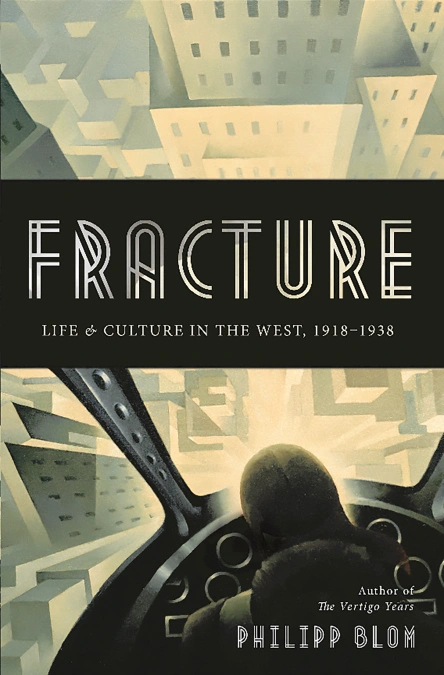
Blom looks at each of the twenty-one years (which, as he reminds us in his introduction, adds up to a mere 1,567 days) from 1918 through 1938 in a separate chapter . He splits them into two parts: Postwar (1918 through 1928) and Prewar (1929 through 1938). But he does not give the reader a step-by-step narrative of the interwar years.*** Instead his structure reflects the, ahem, fractured world between the wars. He looks at
“perceptions, fears, and wishes, ways of dealing with the trauma of the war, with the energies released by industrialization, with the confusing and exhilarating identies that became possible in an industrial mass society, especially once the old values had been shattered.”
Moving from spot to spot in the Western world, he begins with jazz and works his way through the republic of Fiume, speakeasies, Charlie Chaplin, the Harlem Renaissance, the Scopes trial, Marlene Dietrich, Soviet Russia’s Five-Year Plans, and various iterations of the superman. The result is a kaleidoscopic and brilliant picture of a world that was shadowed by the war that had not quite ended and another that everyone believed was soon to come.
Fracture has become a touchstone for me as I write this book.
Who knows what I’ll find on the To-Be-Read shelves next?
*I am not attempting to downplay my responsibility here.I definitely buy books faster than I can read them. And I pick them up from the various Little Free Libraries I cross on my daily wanderings** But I also receive books from publicists for me to consider for review. (Not as often as I used to, because I don’t think it is fair to accept books for review in my current state of overwhelm.) But there is still a slow trickle. And even a slow trickle can eventually cause a flood.
**My rule in that case is that I must deposit one book for each book I take. This requires keeping track of which libraries I owe books to and which ones I am apt to pass on any given trip out the door. (Now that I think about it, I should just carry a book with me whenever I set out and donate one whether I’ve taken one or not. No record keeping involved!)
***A model I am trying to keep in mind as I struggle my way through those same years. It is all too easy to chronicle the rise of the Nazis instead of telling how Sigrid Schultz reported on the rise of the Nazis. It is a subtle difference perhaps,**** but an important one. Moreover, it is a difference that it is easy to lose track of. I write IT’S ABOUT SIGRID NOT ABOUT HITLER at the top of every Scrivener document in the draft,***** and still I wander off into the wrong story over and over.
****Or maybe not so subtle
*****I try to remember to delete it before I give a chapter to my first reader, also known as My Own True Love. He is very clear about this and doesn’t need the reminder.