




From the Archives: The So-Called Black Hawk Wars
Normally when one of my posts refers to circumstances that I wrote about in the past, I simply put a hot link in the new post referring any readers who are interested back to the old post, with no assurance that anyone other than My Own True Love will click through.
But the Black Hawk War—which I now think of as the Black Hawk Massacres—is a recurring theme in the next few posts. Some of you might find this post from 2019 helpful. (And if you don’t, I’ve found it useful to re-read it. Because details fade when you don’t reinforce them.)
* * *
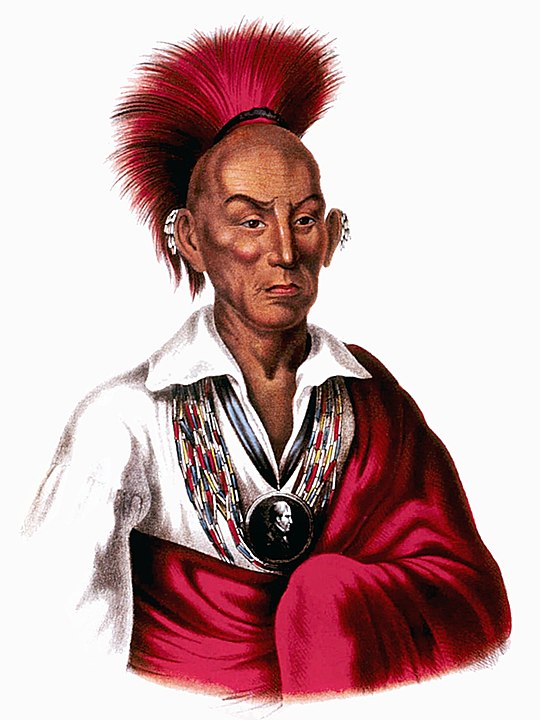
Here’s what I knew about the Black Hawk War at the beginning of our most recent travels along the Great River Road: it was a small scale war between Native American tribes and American settlers in the upper Midwest prior to the Civil War and Abraham Lincoln fought in it as a member of the Illinois militia. I didn’t even known which tribes were involved.
It soon became clear that the war would be one of the recurring themes of the trip. We drove on Blackhawk streets and across a bridge named in honor of Chief Black Hawk. His picture appeared with brief paragraphs in the displays at Effigy Mounds National Monument, the Driftless Area Education and Visitor Center in Lansing, Iowa, and the River Museum at LaCrosse.
We began to get a better sense of the story when we came across historical markers describing actions in the war appeared along the road in Wisconsin.(1) They were set up as a driving tour dedicated to the Black Hawk War, put together in the 1930s by a Wisconsin history buff named Dr. C.V. Porter, who was determined that the events of the war should not be forgotten. He put concrete markers at each stop. (They bear an uncomfortable, and not inappropriate, resemblance to tombstones.) In the 1990s, the Vernon County Historical Society restored the markers and added explanatory plaques. You can now drive a trail that follows Black Hawk’s doomed flight toward the Mississippi, aided by a pamphlet put out by the Vernon County Historical Society and the text on the markers.
Unfortunately, not all of the markers were on our path, and we did not read them in order. Which meant we did not get anything more from the markers than an unhappy sense that the story was an ugly one.
We finally learned the story from beginning to end at an unexpected stop on the road: the Genoa National Fish Hatchery.(2) Here’s the short version:
The conflict began in 1804, with the Treaty of St. Louis, when Sauk and Fox chiefs signed a treaty ceding a large portion of their land to the United States in exchange for $1000 a year and the right to continue using the land until the United States sold the land to settlers. There is some suggestion that William Henry Harrison, then governor of the Indiana territory,(3) resorted to trickery in the treaty negotiations. (In fact, President Jefferson wrote Harrison a letter suggesting ways that the Native American tribes could be pressured into selling their lands, including a establishing a monopoly on trading posts and then allowing Native Americans to get so deeply in debt that they had to sell their lands.) (4)
Black Hawk never accepted the treaty, claiming that the chief who signed for the Sauk did not have the authority to sell the land. He and his people traveled back to their settlement at Saukenuk, near what is now Rock Island, Illinois, each summer to grow corn and other crops. When they returned in 1828, they found that the government had sold off parcels of the Sauk territory to individual citizens. In fact, settlers were living in Black Hawk’s own long house.
In 1832, Black Hawk was determined to return his people to their home, encouraged by promises of help from the British, with whom he had sided in the war of 1812, and by visions of success from an influential medicine man named Wabokieshiek, known as the Winnebago Prophet. (You can see how this is going to work out, right?)
Relationships between the Sauk and settlers had been tense for several years. When Black Hawk crossed the Mississippi into Wisconsin from Iowa with a group of 1500 Sauk, roughly 1000 of them women , children and the elderly, skittish settlers sent word to General Edmund P Gaines. Commander of the Western Army, and Illinois Governor John Reynolds that Black Hawk had invaded.
By mid-April, Gaines and Reynolds, worried about the possibility of British support for the Sauk, had mobilized both the US Army and the Illinois state militia in pursuit of Black Hawk and his people.
Not surprisingly, the promised British support never arrived. In May, Black Hawk attempted to negotiate with a small group of Illinois militiamen under the command of Major Isaiah Stillman who were camped nearby. He sent three of his men with a white flag to the militia camp. The militiamen, who could not understand the three men’s language assumed the worst (despite the white flage) and fired on them, killing one of the truce bearers. When the Sauk retaliated, Stillman’s volunteers panicked and fled in the face of what they perceived to be a large body of warriors. The losses at what came to be known as the Battle of Stillman’s Run were few, but they were enough to end any hope of peace.
Soon Black Hawk’s main goal was to get his people safely back to Iowa. The local American authorities, fearful that Black Hawk and his band would trigger a general uprising among the local tribes, were determined not to let him get away.
Throughout June and early July, small bands of militia and Native Americans fought their way across northern Illinois and southern Wisconsin. (Not all of the Native Americans were part of Black Hawk’s band. Some other groups appear to have taken advantage of the situation to attack settlers, secure that Black Hawk’s people would take the blame.) Although the main Sauk band successfully eluded the pursuing militia, they had no time to rest or resupply.
On August 1, Black Hawk’s remaining forces, totally perhaps 500 men, women, and children, had reached the banks of the Mississippi near the town of Bad Ax.(5) Notified by members of the Winnebago tribe that the Sauk were at the river’s edge, the settlement at Prairie du Chien sent a steamboat upriver, carrying a detachment of US Infantry and a six-pound cannon, with orders to keep the Sauk from crossing the river. Black Hawk attempted to surrender to the steamboat captain, who fired on the unprepared Sauk
The following day, bands of militia pushed the Sauk toward the river, where the steamboat fired at those who tried to cross. The “battle” of Bad Axe lasted more than three hours. The few who made it across the Mississippi met a band of Sioux, who took advantage of the battle to settle old scores.
Black Hawk surrendered on August 27. He was held for a time at Fort Crawford, then sent east as the main attraction of a multi-city tour designed to impress his peers with the folly of standing up against the United States government. The United States used his rebellion as an excuse to demand further concessions from the Sauk and Fox chiefs, most of whom had not participated in Black Hawk’s doomed attempt to regain his homeland.
In my opinion, the fifteen weeks of the Black Hawk War of 1832 would be better best described as the Black Hawk Massacre. Not a story to be proud of.
(1) As I’ve mentioned in earlier posts, we love a good historical marker
(2) We came away from this trip very impressed with the U.S. Fish and Wildlife Service. Its information centers are right up there with those of the National Park Service.
(3) Best known as the president with the shortest tenure of office, dying after only 31 days in office. His death triggered a political crisis, which ultimately clarified how power is transferred when a president is unable to serve his full term. Not a small legacy. But I digress.
(4) Ironic, given Jefferson’s own problems with debt.
(5) Later renamed Genoa at the suggestion of a group of Italian immigrants who argued, probably with some justice, that the name Bad Ax attracted unsavory elements to the town.
* * *
Next up: A visit to the Black Hawk State Historical Site in Iowa, where we learned more about the Sauk and Meskiwaki nations in the period before the Black Hawk Wars.
Road Trip Through History: The German-American Heritage Center and Museum
My Own True Love and I might well have stopped at the German-American Heritage Center and Museum in Davenport, Iowa, for its building alone. The museum is housed in a building that was originally the “Germania”, a Gast Haus for German immigrants. Built in 1870, the Germania was one of the earliest of many immigrant hotels built in the area at the end of the nineteenth century and the last one still standing. It has been beautifully restored and adapted as a museum. We are suckers for old buildings and this kind of thing is jam for our morning toast.*
In some ways, the building itself is the largest exhibit in the museum:** an emblem for the experience of German immigrants that the museum as a whole explores.
The museum was well worth the stop. The main exhibit of the museum traces German history from 9 C.E. through World War II in short clear bites.*** It explains why big waves of immigrant occurred.**** It describes what the journey was like and what immigrants found when they got here. An entire room is devoted to German-American culture in Davenport, as a lens for German immigrant culture in America as a whole. The final section explains what happened to that culture when the United States entered World War I in April, 1917. (The short version? Erasure)
One thing the museum does particularly well is give immigration a face. For a part of the exhibit called “The Passport Experience,” visitors can chose an immigrant, represented by a card with a photograph, demographic details and a QR code, and follow them through a number of stations throughout the exhibit.***** Another feature, called “Step into my Shoes,” allowed visitors to trigger short films in which individual immigrants talk about their experiences by stepping into one of several sets of footprints on the floor.
The museum also included two smaller, thought-provoking exhibits.
The first, called “Hidden Hapsburgs,” looked at citizens of the Austro-Hungarian Empire who emigrated alongside a number of Germans after the uprisings that shook Europe in 1848. Because most of them were German speakers, they are often treated as Germans when people write about the immigrants of 1848, but their experience was different in several important ways. Most notably, the Austro-Hungarian revolutionaries were pardoned in 1867 and had the opportunity to return home. The German revolutionaries were never pardoned. This exhibit was a real head smack for me. I was familiar with a great deal of the material in the main exhibit, but had never thought about Austro-Hungarian revolutionaries.
The second exhibit looked at the experience of immigrants to the Davenport area today and compares it to the experience of German immigrants in the nineteenth century. This exhibit centers on the work of a non-for-profit called Tapestry Farms.
Different in some ways. Alike in so many others.
*If you’re in Davenport and noticed a tall gray-haired man and a short red-haired woman walking around an unusual old building for no apparent reason or bending over to look at a sandstone foundation, it was probably us.
**Though obviously it wasn’t in the museum. Because that would require space to loop in on itself in a way possible only in a Terry Pratchett novel.
***Why 9 C.E. you ask? One word: Romans. Specifically, the Battle of Teutoberg Forest, when a alliance of Germanic peoples defeated the Romans and stopped Roman expansion. It is an important date in European history, but I must admit, the choice of 9 C.E. as a start date gave me the giggles.
****The first big wave occurred after the failed revolutions of 1848. The second occurred in the 1870s when German Catholics faced persecution in the new German Empire.
*****I first saw this technique used at the Holocaust Museum in Washington, D.C., where the effect was heartrending.
*****
Traveler’s Tip: If you’re in the Quad Cities during baseball season, checkout the schedule for the local minor league ball team, the delightfully named Quad City River Bandits. It’s hard to beat a summer night at a small ballpark.
Back on the Great River Road: First Stop, the John Deere Historic Site
My Own True Love and I are back on the Great River Road!
For those of you who are new to the Margins: In November, 2015, My Own True Love and I set out on an adventure. We headed south for a three-week trip along the Great River Road, a conglomeration of 3000 miles of local and state roads that follow the length of the Mississippi River. We started in Memphis, went south until we reached the end of the road in Louisiana, then headed back toward Chicago, stopping at whatever took our fancy. We thought we would make it all in one trip (pause for manic laughter), but our fancy led us to make lots of stops. We only got as far as Vicksburg on the way back.
Depending on how you count, we’re starting our fourth or fifth stint on the Great River Road, beginning at the Quad Cities, and are excited to be back on the trail. As always, I’ll post stories here on the Margins about the stuff we see.*
First up, the John Deere Historic Site in Grand Detour, Illinois—aptly named in our case since we stopped there on our way to the Mississippi.
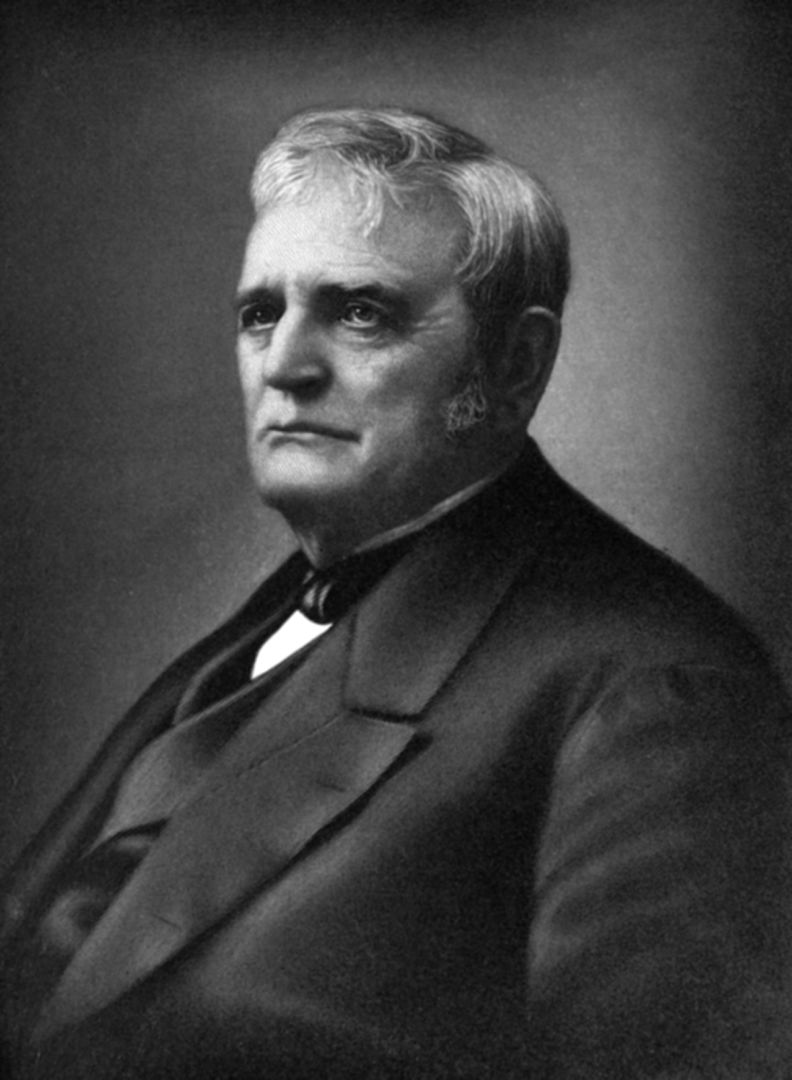
Is it my imagination, or do all these old guys start to look alike after awhile?
For those of you who don’t know, John Deere was the innovator who made the first commercially successful plow, one adapted to cut through prairie soil and thus critical to America’s westward expansion. **
Before Deere, most plows were made of cast iron. These were more than adequate for the light soil of the eastern United States but did not work well in the stickier soil of the prairie and could not cope with the thick roots of prairie grass. Even when a farmer could cut through the the grass, he had to stop every few yards to clean off the soil that clumped off his blade.
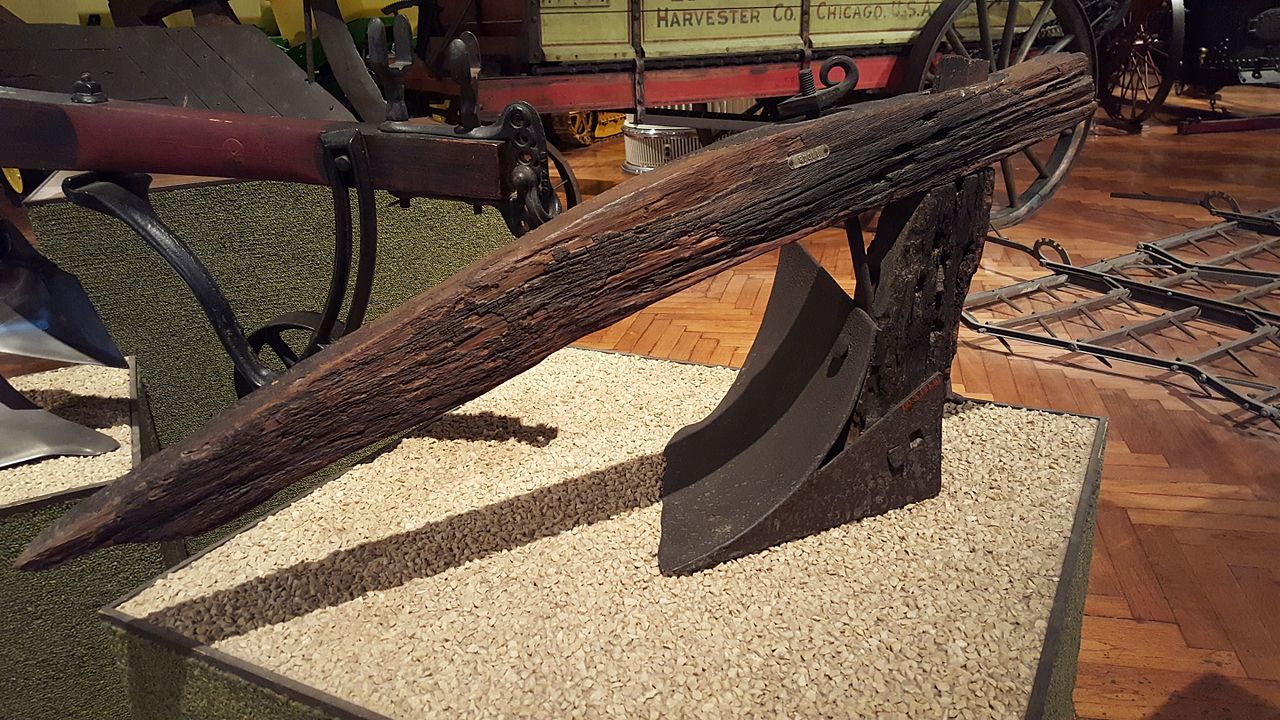
Early John Deere plow, made in Grand Detour. Displayed at the Henry Ford Museum.
Deere was a Vermont blacksmith who moved west in search of opportunity. In 1836, soon after he moved to the new town of Grand Detour, Deere designed a steel blade that was “self-scouring” in response to complaints by the local farmers about the difficulty of working the prairie soil. (Repairing their broken plows made up a large part of his business.) The first year he made one of the new plows. The next year he made two. Then 40. Then 400. Ten years after he had made the first plow he was so successful that he moved the company to Moline, on the Mississippi because he needed access to better transportation—not only to ship plows out, but to ship materials in. In the early days he had to get his steel from England. (A story for another day.)
The John Deere Historic Site is located on the land where Deere lived and worked in Grand Detour. It includes the actual Deere house as it existed before the family moved to Moline, an enclosed archeological dig of his blacksmith shop with attached exhibits and a brief film, and a working blacksmith shop built to the dimensions rediscovered in the dig. Tours of the site begin whenever there are guests. (Touring the site without a guide is not an option. Tough on those of us who like to pause and think about the exhibits.) The Deere story is told with a slightly different emphasis at each of the three stops. In addition to being interested by the story, I was fascinated by the fact that the tour guides consistently “first-named” Deere and his wife—something I haven’t seen at other historical sites. It gave feeling of intimacy, as if the Deere family were their neighbors. As I suppose they were in some ways.***
The blacksmith shop was the high point of the visit, which is entirely appropriate given that the story of the Deere plow begins in his blacksmith shop. I’ve seen many blacksmiths give demonstrations of their craft/art/science but it never fails to enthrall me. There is something truly magical about the process. The blacksmith on duty during our visit to the John Deere site, named Lloyd, was one of the best I’ve seen, not simply because of his considerable skill with the metal but because of the breadth of knowledge about steel, implements, and smithing.
In short, the John Deere Historic Site is well worth a stop if you’re near Dixon, Illinois (the biggest town near Grand Detour).
*If you want to read about our earlier trips, search by Great River Road, or check in the category Road Trip Through History.
**My Own True Love is originally from South Bend, home to the Oliver Chilled Plow, which also claims to have helped “tame the prairie.” He wanted to know how the Oliver plow related to the Deere plow. The docents he asked did not know—not surprising since we were at the John Deer Historic Site, maintained by the John Deere Foundation. So I took a little dive down a very small rabbit hole once we got back to the hotel room. (And why not, I ask you?) The Oliver plow was made of chilled cast iron, using a process developed in 1869 and patented in 1873. It was cheap, durable, and well-designed to use in any type of soil. It, too was a smash hit with farmers. In fact, for a time the Oliver Chilled Plow Works was the largest plow manufacturer in the world, with the trademark “Plowmakers for the World.”
***This might not have caught my attention at another time, but I am currently struggling with the question of whether to call a historical figure by her first name. It is a fraught question, particularly when you are writing about a woman. I spent some thinking about this question in my newsletter, back in December 2020. I’m not sure I have progressed in my thinking since then.
____________________________________
Travel Tips:
1. Dixon is home to Ronald Reagan’s boyhood home, as opposed to his birthplace which is further down the road. We decided we weren’t prepared to take an hour-long tour of a house only a little bigger than the one I grew up in. You might decide differently.
2. There is another, much larger, John Deere museum in Moline, Illinois. It is well worth a visit if you’re interested in agricultural history or big machinery. (I’m not being sarcastic. We spent several hours there on a previous trip to the Quad Cities, long before I started this blog. It was fascinating.)