




Bessie Beatty and The Red Heart of Russia
I was recently digging about in the history of women’s magazines in the early twentieth century when I came across a familiar name: Bessie Beatty. I knew Beatty’s work from her reporting on Russia’s Women’s Battalion of Death, which I wrote about in Women Warriors. At the time, I was totally engrossed in the women Beatty wrote about and gave no thought to the reporter herself. Funny how things change.
Beatty got her start in journalism at the age of eighteen, working for the Los Angeles Herald while she was still in college. Partway through her senior year, she left college to report on a miner’s strike for the Herald.
Her work in Nevada caught the attention of Fremont Older, editor of the San Francisco Bulletin.* At the Bulletin, Beatty ran a feature page, titled “On the Margin” [!!!], in which she covered women’s issues and social work, broadly defined. (Among other things, she ran a campaign on behalf of prostitutes who were put out of work when the red light district was closed. Not your typical social justice campaign even today, let alone in the first years of the twentieth century. )
In 1917, as the Great War raged on, Older sent Beatty on a large-scale reporting assignment: a series of articles called “Around the World in War.” Four days after she sailed, the United States declared war on Germany.
American correspondents, officially accredited and otherwise, headed toward Europe. Beatty and a few others headed east. She reported on social and cultural traditions in Hawaii,** Japan, and China, but her real destination was the revolution in Russia. Like other reporters who built their careers reporting on social justice issues and exposing corruption in government, she had a romantic vision of the new socialist government and wanted to see it first hand.
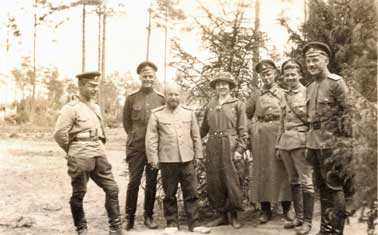
She traveled traveled from the Pacific port of Vladivostok to Petrograd (formerly, and once again, St. Petersburg) aboard the TranSiberian Railway, a twelve-day trip through Russia to the heart of the revolution. Once in Petrograd, she managed to get a room in the War Hotel, where Russian officers lived with their wives. With the hotel as her base, she followed Russia’s involvement in the war and the course of the revolution. She traveled to the front, getting within 160 feet of the German trenches, and sat in a concrete observation station from which she could see barbed wire of no-man’s land through a narrow peephole. She and another reporter, Rheta Childe Dorr, spent a week with the Women’s Battalion of Death, traveling with them to the front and sleeping with them in their barracks. She interviewed sailors, soldiers, peasants and the woman in the street.
When the Bolsheviks overthrew the Provisional Government in November, Beatty witnessed every stage of the new revolution, aided by a pass from the Military Revolutionary Committee that gave her access everywhere in the city. She spent hours in the Soviet, listening as revolutionary leaders argued about the shape of the new state. She interviewed political prisoners, including ministers of the deposed Provisional Government
Like other American journalists drawn to report on the revolution, she believed in the experiment she was watching unfold. (In fact, she would later testify in favor of the Bolshevik Revolution before Senator Overman’s sub-committee on the influence of Bolshevism in America.)***
In February 1919, Beatty and two other journalists, Madeline Doty andLouise Bryant, decided it was time to leave Russia. They caught the last train to leave Petrograd for Finland, which was fighting to free itself from Russian rule, and then traveled by sleigh from the northernmost corner of Finland into Sweden. (*Brrr*)
Like many of her fellow journalists, Beatty wrote a book about her experience of the revolution, The Red Heart of Russia (1918). Her sentiments about the revolution, as she expressed them at the end of the book, were complicated: “Mingled with my sorrow, the morning I left Petrograd, was a certain exultant, tragic joy. I had been alive at a great moment and knew that it was great.”
Back in the United States, Beatty chose not to return to San Francisco. Instead she stayed in New York, where she finished her book and worked as the editor of McCall’s from 1918 to 1921.
She soon grew eager to travel as a journalist again. Her articles on politics, women’s rights, and even tourist destinations, appeared in popular magazines such as Good Housekeeping, The New Republic, Women’s Home Journal, and Century.
Beatty returned to Russia in 1921. It took her weeks to get into the country, but once there she stayed for nine months, writing a series of interviews with Bolshevik leaders, including Lenin and Trotsky, for the San Francisco Bulletin.
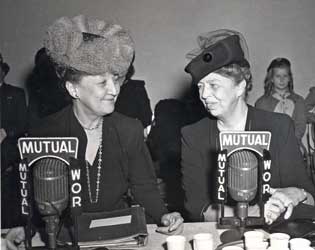
She spent some time as a screenwriter for MGM. She remained a dedicated activist. And in 1940, she entered a new career as the host of a popular radio show on WOR in New York. During World War II, she used her show to sell more than $300,000 in war bonds.**** She continued to broadcast until her death in 1947 at the age of 61.
Describing her on-air personality, Time magazine described her as “a short, voluble bit of human voltage.” Not bad.
*Older was unusually supportive of women reporters and gave a number of talented women, including Rose Wilder Lane, their start in a field that was not always welcoming to women.
**Which was annexed by the United States in 1898 and became a US territory in 1900. Just to give you a piece of chronology to hang your hats on.
***An early version of the Red Scare.
****$5,270,000 in today’s dollars.
* * *
I am deep in the first “real” draft of my latest book. And I’ve got to admit, it’s going slowly. My manuscript is due March 1, 2023, which feels like tomorrow as far as I’m concerned. I love writing these blog posts, but for the foreseeable future I’m going to cut back to one post a week.
History on Display: A Picture Postcard’s Worth a Thousand Words
I recently spent ten days in Boston and Connecticut. Officially, it was a research trip. Unofficially, it was a chance to spend some long overdue time with my BFF from graduate school.
I definitely put in time on the book, with a lot of help from Karin, who believes in getting the work done. We spent time at libraries working with materials that were not easily available in Chicago. We drove to Connecticut, where I worked in a small archive and talked to local historians.* We talked about the book, a lot. She asked tough questions.
But we also spent some time having fun, including a visit to Boston’s Museum of Fine Arts.
We went to see an exhibit on J.M.W. Turner, whose work I love. It’s a good exhibit. It’s always exciting to see paintings in real life for the first time. I would certainly recommend that you see it if you can. But I didn’t come away feeling like I learned anything new about the man or his work.**
But it was another, smaller, exhibit, Real Picture Postcards, that blew me away.

In 1903, when postcards were a Big Deal, the Eastman Kodak Company released a new camera that exposed postcard-sized negatives that could be printed on a blank postcard. (Kodak sold blank postcards alongside as well as the film. Other camera companies followed their lead. Soon photographic postcards were the rage: billions of cards were in circulation in the years before World War I.
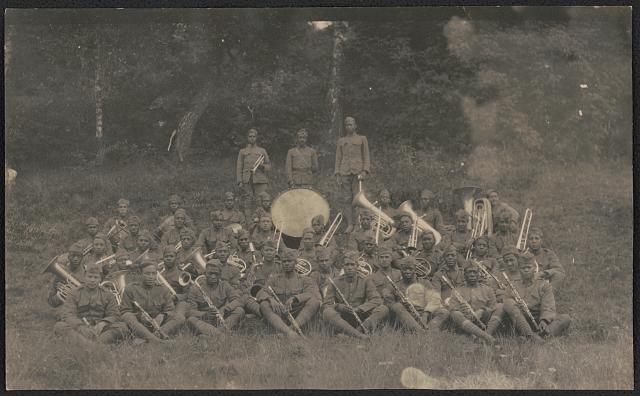
Amateurs and professional photographers alike used the cameras to produce images that were the antithesis of posed Victorian photographs. Because the cameras were cheap and fast, photographers could capture everyday life on film for the first time.
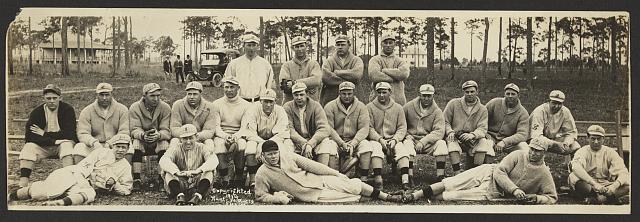

The exhibit displays more than 300 photographs, curated around a number of themes: the work place, sports (including a surprising number of photographs of women’s teams), civic events,*** small town main streets, travel,**** and people messing around. (It also included a “paper moon” for museum vistors who wanted to memorialize their visit in true early-twentieth century style. I regret now that we didn’t do it.) The result is a vivid picture of everyday life in early twentieth century America, recorded by everyday Americans.
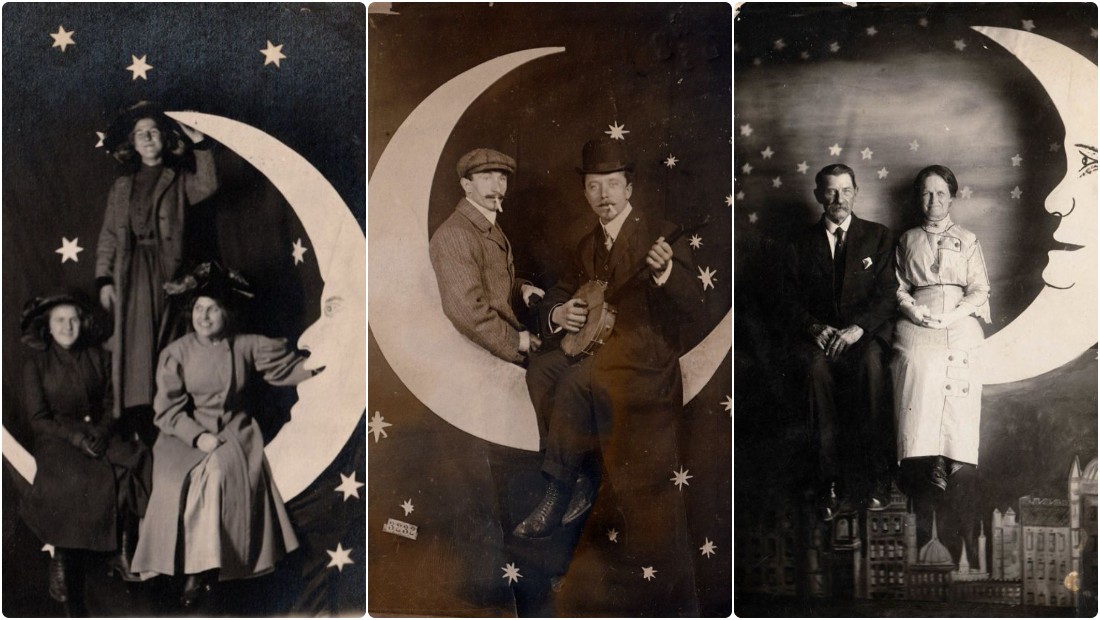
The exhibit is on display through July 25th and is well worth a visit. (There is also a large, beautiful, scholarly catalog, which I decided I didn’t want to carry home in my luggage.)
* Or more accurately, she drove and I rode. We also stopped at Louis’s Lunch in Hartford: an iconic restaurant at which the menu is limited to hamburgers, with or without cheese, tomatoes and onions; potato salad; and chips. NO ketchup. Not ever. I don’t know what the position is on other condiments. I didn’t see any. Instead of asking, I decided to embrace the experience in its totality.
For the record, the burger (with onion) and the potato salad were both excellent.

** Which may be a result of how much time I’ve spent reading and thinking about Turner and his work over the years. What can I say, I’m an art geek as well as a history bugg.
*** I am sad to report that in the course of searching for images for this post, I found one documenting a crowd gathering to watch a lynching in Waco, Texas, May 15, 1916. A useful reminder that the dark side of American history pervades everything, even seemingly fun topics like postcard cameras.
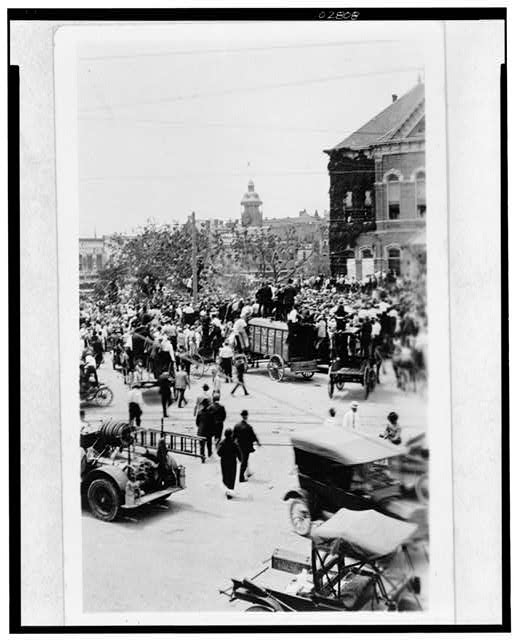
****The creation of the Model-T Ford at much the same time led to a new type of American tourism and the postcard camera was a natural part of it.
Aethelflaed, Saxons, Danes, and The Last Kingdom
Over the last few weeks, it seemed like almost everyone I knew was watching or had watched The Last Kingdom: a British television series based on Bernard Cornwell’s historical novels The Saxon Stories. It is set in Britain in the late eighth and early ninth centuries, when Alfred the Great* (and his adult children) defended their kingdoms against Norse invaders.
Several people mentioned that Aethelflaed, the Lady of Mercia whom I discussed in Women Warriors, enters the story in season two. They also mentioned that they were finding it hard to keep the underlying history of the Danes and the Saxons straight. Allow me to help, with an emphasis on Aethelflaed, whose role in the story is often not given a fair share of attention and is sometimes left out all together.
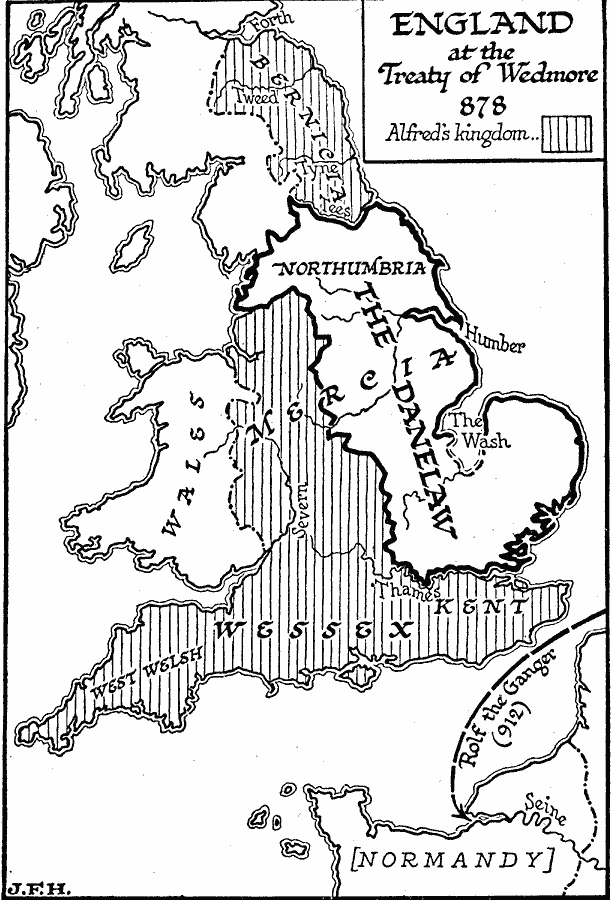
Beginning in 793, Viking raiders arrived in England each spring, as regularly as robins, and attacked the coasts and inland waterways of the British Isles. Over time, Viking raids evolved into permanent Danish settlements. By the end of the ninth century, the area known as the “Danelaw” covered a significant portion of England, from the north of Yorkshire to the Thames.
Alfred the Great (who reigned from 871-899) successfully defended the kingdom of Wessex against Viking attackers, but realized he could not drive them out of England entirely. In 886, he negotiated a treaty with the Danes, which left northern and eastern England under Danish rule and returned West Mercia and Kent to Anglo-Saxon control. I suspect you will not be surprised to learn that neither side honored the treaty, though it did slow down action across the border for a few years.
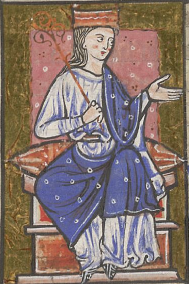
At the same time that he negotiated a treaty with the Danes, Alfred also built alliances with his Saxon neighbors. His most important ally was Aethelred, Lord of Mercia. In order to strengthen the alliance, Alfred arranged for his daughter and eldest child, Aethelflaed, to marry Aethelred.
We know little about Aethelflaed’s life until the first years of the tenth century, when Aethelred became ill. With no direct male heir waiting to inherit Aethelred’s crown, Aethelflaed became the effective ruler of Mercia during her husband’s illness. When he died in 911, she succeeded him without opposition—the only female ruler in the Anglo-Saxon period in England and one of only a handful of women in early medieval Europe who ruled in their own right rather than as a regent for an underaged son or brother. (The fact that Aethelfaed’s mother, Ealhswith, was a daughter of the royal house of Mercia may have played a role in the Mercians accepting her as their ruler.***) Aethelflaed was the Lady of the Mercians, just as Aethelred had been Lord of the Mercians before her. (Don’t let the title fool you. Aethelflaed was a ruling queen by any standard.)
In 917, the conflict between Anglo-Saxons and Vikings intensified. The West Saxon chronicles tell us that Aethelflaed’s younger brother, Edward the Elder, who had succeeded their father as the King of Wessex, occupied the Danish border town of Towcester, in modern Northamptonshire, shortly before Easter. In July, a Danish force counterattacked. By year’s end, the Viking armies of Northampton and East Anglia surrendered to Edward.
The West Saxon chronicles leave out the fact the Edward had more than a little help from his big sister. Aethelflaed, who was already experienced in warfare, led her own offensive against the Vikings. With Danish forces focused on her brother’s army, Aethelflaed took Derby in a savage battle; it was the first of the five great strongholds of the Danelaw to fall to Anglo-Saxon forces. The following year she led her troops against the important Danish fortress of Leicester, which surrendered without a fight. Danish Christians in York, apparently tired by being ruled by a non-Christian Viking from Dublin who had seized control of their region in 911, approached Aethelflaed (not King Edward) with a formal promise of allegiance. Before she was able to finalize the treaty, Aethelflaed died unexpectedly on June 12, 918, leaving Edward to win the final victory against the Danes and the place in the history books.
*I am sure you’ve heard of Alfred the Great even if you don’t know anything about him other than his name. I must admit, until a few years ago the only thing I knew about him was this story:
Taking shelter in the woods after being defeated once again by the Danes, the exhausted king stumbled into a herdsman’s hunt. The herdsman’s wife, who did not recognize him,** invited the hungry and tired man, whom she believed to be a simple soldier ,into her home. She put some oat cakes into the embers of the fire to bake and told him to keep an eye on them while she went out to get more firewood, or perhaps a bucket of water. As soon as she left the king fell asleep, no doubt soothed by the warmth of the fire and the smell of the cooking oat cakes. When the woman came back, she found burning cakes and a snoring soldier. Rightly incensed, the woman not only gave the soldier a tongue-lashing, she boxed his ears or perhaps beat him with her broom. (Different versions vary on the details.) Either way, King Alfred accepted his beating and apologized, without admitting who he was.
My guess is that this story is the medieval English equivalent of George Washington cutting down the cherry. As such it is a fine example of what I like to call “comic book history”: historical stories that are emotionally satisfying but factually untrue.
Just to bring this back to the main topic of this post: I have no idea whether this episode occurs in The Last Kingdom. Anyone?
**And how would she? She probably had not even seen a coin with his portrait. Even if one of the “Alfred coins” had passed through her hands, the “portrait” would not have been useful for identification.
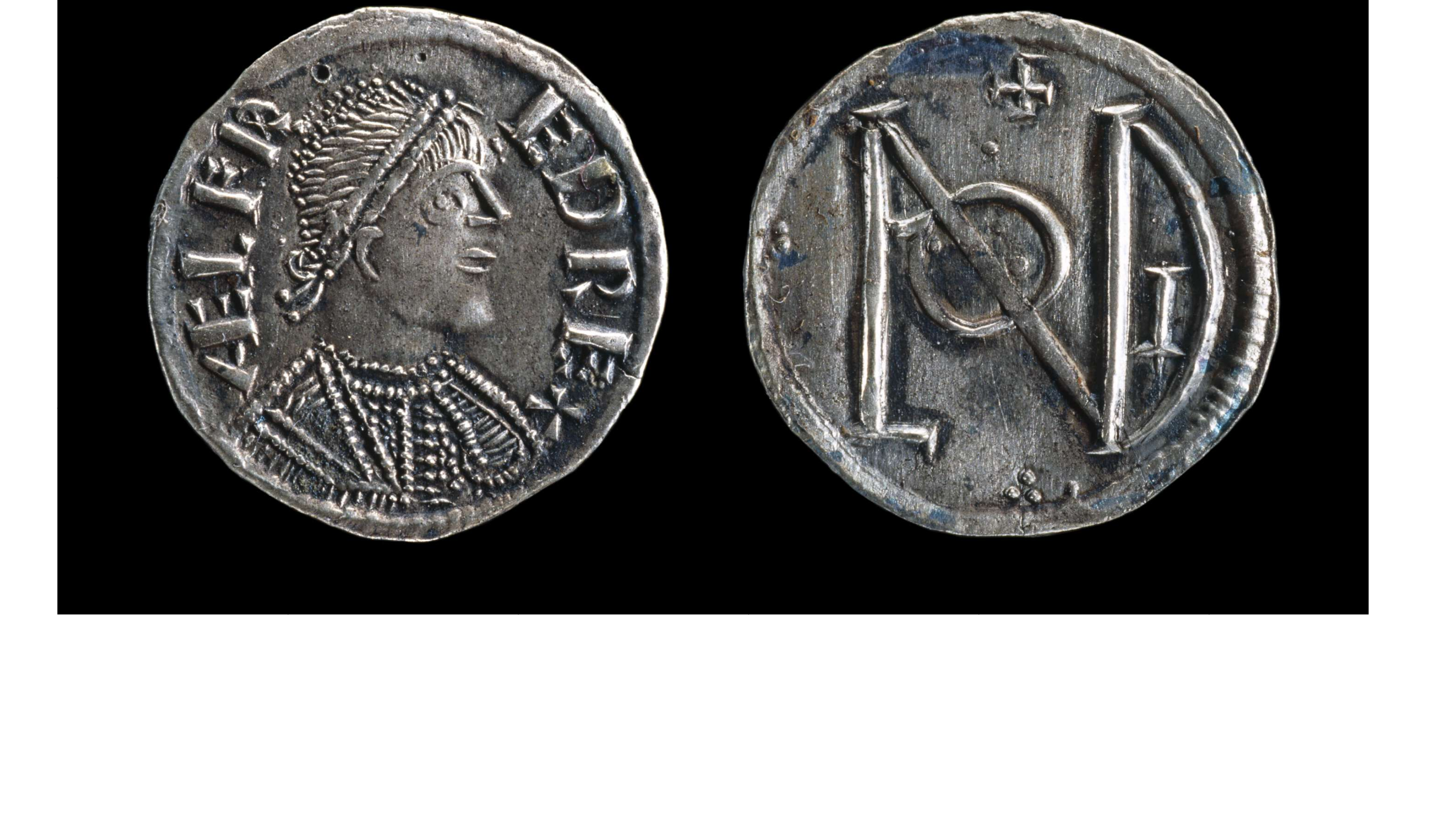
© The Trustees of the British Museum
*** Even if you know something about Alfred the Great, you probably haven’t heard of Ealthswith unless you’re a medievalist because we tend to leave mothers out of royal family trees. When you add the missing mothers–and grandmothers, and aunts and sisters, etc— back in, you often find unexpected connections. And sometimes even answers.