




From the Archives: Dorothy Sayers, Black Cat Cigarettes, and WWI
Sometimes life makes it impossible to write blog posts on a dependable basis. This is one of the those times. For the next little while, I’m going to run pieces from September and October in years past. I hope you enjoy them, and I’ll be back as soon as I can.
Next up, a post from September, 2017:
My second favorite novel by British mystery author Dorothy Sayers is Murder Must Advertise,* in which her dashing sleuth Lord Peter Whimsey goes undercover as an entry level copy writer at an advertising agency where evil is afoot. He solves the murder of course, because that’s the way these things happen. But he also gets caught up in the advertising business and creates the idea for an advertising campaign for a cigarette company called Whifflets that takes off in a big way: people collected coupons and used them first to travel and later to collect all manner of worldly goods. Except coffins, it not being “admitted that any Whiffler could ever require such an article.”
The campaign, and the clever language in which Sayers describes it, always amuses me. So imagine my amazement when I discovered something similar on a smaller scale in the form of Black Cat cigarettes while tracking down a factoid for my latest article for MHQ:The Journal of Military History.
Black Cat cigarettes were first introduced in 1904. The company began to use their cigarette packages as a vehicle for promotion almost immediately. At various points in the years prior to World War I they offered a program similar to S & H Green Stamps,** the Black Cat Library of Short Stories (a series of forty adventure tales), and a popular coupon program not unlike Whimsey’s Whifflet promotion.
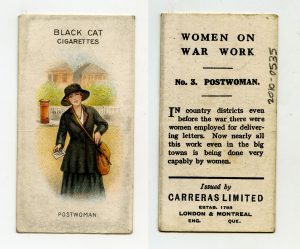
If that was all Black Cat did, I would have just enjoyed the moment when fiction and history collided, but in the First World War, Black Cat stepped up. The company sent gift packages to British troops, with French phrase books inside the Black Cat cigarette packs. In 1914, they offered miniature cardboard Allied flags. And in 1916 they produced the first cigarette cards–similar to baseball cards in bubblegum packs.*** These cards didn’t celebrate anything as innocent as the national pastime–they were produced in alliance with the British wartime propaganda effort. The first set of cards was a series of 140 political cartoons by Dutch cartoonist Louis Raemaekers, with the motto “Lest we forget” on the reverse. But it was the second set that caught my fancy: a series of fifty cards illustrating “Women on War Work.” Each card showed a smiling woman doing a job that women would not have done before the war, including ambulance driver, postal carrier, tram conductor, and furnace stoker. The reverse of each card described the work involved.
A small and engaging illustration (literally) of women’s history.
*My absolute favorite is Gaudy Night. This does not make me unique.
**For those of you too young to remember Green Stamps, you can look it up here: http://www.al.com/living/index.ssf/2016/04/whatever_happened_to_sh_green.html
***I assume those of you who are too young to remember this can figure it out.
From the Archives – Blown Away: The (Attempted) Mongol Invasion of Japan
Sometimes life makes it impossible to write blog posts on a dependable basis. This is one of the those times. For the next little while, I’m going to run pieces from September and October five or six years past. I hope you enjoy them, and I’ll be back as soon as I can.
From September, 2015:

Japan had expected the Mongol invasion for years.
In 1266, Kublai Khan, the new Mongol emperor of China, sent envoys to Japan with a letter addressed to the “King of Japan”–a title guaranteed to offend the Japanese emperor. The letter itself was equally unpalatable. The Great Khan “invited” Japan to send envoys to the Mongol court in order to establish friendly relations between the two states–code for the tributary relationship China habitually imposed on its neighbors. The letter ended with an implicit threat: “Nobody would wish to resort to arms.” Both the largely symbolic imperial court at Kyoto and the military government at Kamakura, which had controlled Japan since the late twelfth century, chose to ignore the khan’s overtures.
For several years Kublai Khan was distracted by more immediate concerns: subduing the newly conquered province of Korea and his war against the Song dynasty of southern China. It was 1274 before the Mongol emperor turned his attention to Japan once more. On November 2, a fleet of 900 ships sailed from Korea with over 40,000 men, including Chinese, Jurchen, and Korean soldiers and a corps of 5,000 Mongolian horsemen. The invasion forces landed first at the islands of Tsushima and Iki, where the local samurai were overwhelmed by the sheer numbers of their attackers.
With the intervening islands secured, the Mongols moved on to the Japanese mainland, landing at Hakata Bay on November 19. The Japanese were waiting for them, alerted by the news from Tsushima and Iki. When the Mongols landed, the twelve-year-old grandson of the Japanese commander-in-chief fired the shot that was the traditional opening in a samurai battle: a signaling arrow with a perforated wooden head that whistled as it flew to draw the attention of the gods to the deeds of bravery about to be performed. The Mongols responded with raucous laughter.
It was an omen of how the day’s battle would proceed. Both armies depended on their archers, but their fighting styles were dramatically different. The Japanese were accustomed to fighting in small-group or individual combat, seeking out worthy opponents by shouting a verbal challenge. They fired single arrows aimed at specific targets. The Mongols advanced in tightly knit formations and fired their arrows in huge volleys. Their movements were accompanied by roaring drums and gongs, which frightened the Japanese horses and made them difficult to control. When the Mongol forces pulled back, they fired paper bombs and iron balls that exploded at the samurais’ feet–something the Japanese had not seen before.
 Seriously outnumbered and baffled by the invaders’ tactics, the Japanese were not able to hold the beaches. By nightfall, they had retreated several miles inland. Instead of pressing forward, the Mongolian forces returned to their ships for the night. A successful attack the next day seemed inevitable, but that evening an unseasonable storm struck the Mongol fleet, dashing its ships against the rocks. With their ships smashed and about one-third of their force dead, the Mongols withdrew. The Japanese hailed the storm as a divine wind (kamikaze), sent by the gods to protect them.
Seven years later, Kublai Khan tried again. The Mongols launched a two-pronged attack against Japan, with a combined fleet of almost 4,000 ships and 140,000 men. The Eastern Army sailed from Korea on May 22; the Southern Army sailed from southern China on July 5. The two fleets were to meet at Iki and proceed together against mainland Japan. The Eastern Army subdued Tsushima and Iki in early June. Instead of waiting for the Southern Army to arrive, they moved on to Hakata Bay.
Japan had used the intervening years to build earth and stone fortifications along the coast of Hakata Bay. When the Mongols arrived, Japanese defenders repulsed the attack from a secure position behind the defensive walls. When the Mongols retreated, the Japanese took the war to them, using small boats to attack the Mongosl at night. After a week of fierce fighting, the Eastern Army retreated to Iki Island to await the arrival of the Southern Army.
The two Mongol forces rendezvoused in early August. On the evening of August 12, the Japanese attacked, using the “little ships” tactic that had been successful before. The Mongols responded by linking their ships together to create a defensive platform. The battle continued through the night. At dawn, the exhausted Japanese retreated, expecting a decisive attack and the subsequent invasion of the mainland. Instead the Mongol ships, still linked together, were caught in a typhoon that dashed the ships against each other and the shore. When the typhoon subsided, the surviving ships headed out to sea, leaving thousands of stranded soldiers behind them to be massacred by the Japanese.
Japanese chroniclers cited the winds as proof that the gods themselves protected the island. The idea of “divine winds” (kamikaze) that protected Japan against invasion remained an important element in Japanese political mythology as late as the Second World War.
From the Archives: Copperheads
Sometimes life makes it impossible to write blog posts on a dependable basis. This is one of the those times. For the next little while, I’m going to run pieces from September and October five or six years past. I hope you enjoy them, and I’ll be back as soon as I can.
First up, this piece from October, 2015:

When we write the history of national conflicts, we tend to assume that “our” side stood united in monolithic opposition to “them”. It’s a simple and enjoyable version of history, but it simply isn’t true. Sympathizers with the “other side”* are a fact of war. Sometimes they engage in fifth column activities.** Sometimes they simply gather with like-minded folk and grumble into their martini glasses. Sometimes, if they live in a place with freedom of speech, they are vocal in their objections and express them through established public channels. There were Nazi sympathizers in Britain and the United States in World War II. There were British loyalists in the American Revolution. And in the American Civil War, Southern sympathizers in the North were known as Copperheads.***
Copperheads opposed the war and advocated the restoration of the Union through a negotiated peace settlement with the South. Many Copperheads were from Ohio, Indiana and Illinois, where many families had southern roots and agrarian interests resented the growing power of the industrialized northern cities. The movement was also prominent in New York City, where many merchants and workers were dependent on the cotton trade. (Demonstrating that there is more than one path to any given political position.) Others were opposed to the draft, abolition, Lincoln’s abrogation of civil liberties, the Republican party, or all of the above. Some just wanted the bloodshed of the war to end.
The New York Tribune first used the term in July 20, 1861,**** comparing southern sympathizers to the poisonous snake that strikes without giving its victims the courtesy of a warning rattle. The implication was that southern sympathizers would, by definition, engage in treason given half a chance. In practice, they were more inclined to fight the war at the level of local elections and on the floor of state legislatures.
Peace Democrats embraced the name: “copperhead” was also the slang term for a penny, which at the time had an image of Lady Liberty on one side. They saw themselves as defending the Constitution and civil liberties against presidential incursions. I leave you to draw parallels to current political positions and note the resultant ironies for yourselves.
*NOT the same thing as pacifists.
**When such people fight the “other side” for “us”, they are called the resistance. You can see how quickly this gets complicated.
***And before anyone raises their hand to protest: I am not saying that British Tories were the moral equivalent of Nazis. Southern sympathizers are a gray area. Quite frankly, many Northerners who supported the war effort were not pro-abolition and even abolitionists were often racist in ways that shock a modern reader.
****For those of you who have not spent recent months living and breathing the Civil War, that was the day before the the first major battle of the war occurred: the First Battle of Bull Run aka the Battle of Manassas aka the Great Skedaddle (depending on where you hang your hat).