




From the Archives: Samuel Gompers and the American Federation of Labor
Yesterday I was walking home from the library with a bag of research books, considering how to spend the long Labor Day weekend. I am working on building the habit of taking Sundays off. (Radical, I know.) And I was musing over whether I could stretch my developing time-off-muscles to include Labor Day. After all, what better way to honor the memory of the people who fought for time off and other benefits for working people? Then it occurred to me that a story from the American labor movement would be a perfect blog post as we slide into the weekend. Turns out I had the same idea in 2018.

It’s Labor Day here in the United States. A day that many of us celebrate by firing up the grills, hitting up sales, and attending outdoor festivals. In short it is a day off. Something we can thank the American labor movement for, along with child labor laws, the forty-hour week, paid vacations, etc. (1)
One of the major players in the early labor movement in the United States was Samuel Gompers.
Gompers (1850-1924) was born in East London. His family immigrated to America when he was thirteen and settled in the Jewish community on Manhattan’s Lower East Side. For eighteen months, Gompers and his father rolled cigars in their small apartment before finding better job in cigar workshops.
In the evenings, Gompers attended free lectures and classes at Cooper Union. He received an education on the floor of the cigar workshop as well. Unlike many other skilled trades, cigar rolling was quiet work and talking was allowed. Sometimes one of the men in the shop would read to the others.
Gompers and his father soon joined a branch of the United Cigar Makers’ Union. Gompers was not very active in union business until the early 1870s, when the position of skilled cigar makers was threatened by the proposed introduction of a cigar mold that simplified an important step in the cigar-making process. He joined other union members in a series of strikes protesting the use of the mold, with its threat of making skilled workers less necessary.
During this period, Gompers also attended socialist meetings and demonstrations. He was drawn to Marx’s critique of capitalism, but came to the conclusion that socialist goals of long-term transformation were in conflict with the desire of most workers for immediate change. He described his own labor philosophy as “bread and butter unionism.”
After the failure of a 107-day strike, Gompers and fellow union member Adolph Strasser decided to reorganize the Cigar Makers’ Union. The new Cigar Makers’ International Union charged relatively high dues, which allowed them to build a strike fund and offer a benefits program. The idea was to build a sense of identity among union members based on their shared skills and bind them to the union through an extensive benefit system.
In 1881, Gompers was instrumental in creating another level of union strength in the form of a national federation of trade unions, the Federation of Organized Trade and Labor Unions, which became the American Federation of Labor (AFL) in 1886. By 1900, the AFL had roughly 1 million members. (2)
(1) Benefits that not all Americans enjoy even today.
(2) This post is drawn from a chapter on socialism in America from my first book for adults: The Everyday Guide to Understanding Socialism.
Nancy Marie Brown and The Real Valkyrie

If you’ve been hanging out here in the Margins for a while, you know that I am fascinated by the continuing archaeological discoveries of ancient women warriors. Sometimes they are genuinely new discoveries. Sometimes they are a result of someone taking a closer look or asking new questions about existing. remains. This trend started in 2017, when Swedish bioarcheaologists released their findings that an iconic Viking war known as the Birka man was in fact the Birka woman. Their results raised a huge flap in the world of Viking studies.
In the intervening years, scholars have begun to ask more complicated, or at least different, questions about sex, gender and remains. These questions, and the Birka woman herself, are at the heart of Nancy Marie Brown’s The Real Valkyrie.
Brown takes the reader on a deeply researched and richly imagined exploration of the possible life of the Birka woman, whom she names Hervor. She interweaves a narrative of what Hervor’s life might have been like with the research on which she bases that narrative. She looks closely at the assumptions at the root of many of those long-held beliefs.* She asks new questions of sagas, chronicles, and archeological sources—and leads the reader through what those sources can tell us. She introduces us to a broader version of the Viking world, and to many powerful Viking women who have been previously dismissed as fiction. In the process she upends much of what we have traditionally believed about Viking women. The end result is a complex and important addition to women’s history.
It is also a fast-paced, delightful read, with lots of “wow!” moments along the way.
If you’re interested in Vikings, women warriors, women’s history, or how historians work with evidence, this one’s for you.
*Medieval Christianity, Victorian ideas about women and a historical novel written by a Swedish writer during World War II all helped shape our popular conceptions about Vikings.

FYI: On September 13, I’m joining Nancy Marie Brown for a virtual discussion about The Real Valkyrie courtesy of the Hudson Valley Library and Historical Society. I expect it to be a lively discussion about the Birka woman,Vikings, and women warriors in general, with Q & A time at the end. Here’s the registration info: An Evening with Nancy Marie Brown . See you there?
When Fence Lines Were Phone Lines
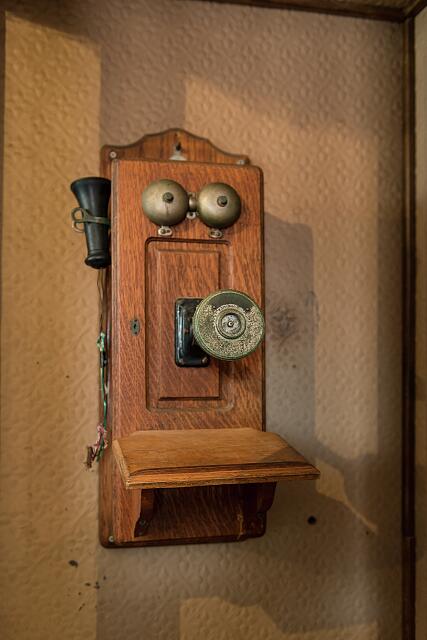
Lyda Hill Texas Collection of Photographs in Carol M. Highsmith’s America Project, Library of Congress, Prints and Photographs Division
One story we learned at the Legacy of the Plains Museum caught my attention so thoroughly that I think it deserves its own blog post.
The first commercial telephone company opened on January 28, 1878 in New Haven, Connecticut. It had 21 subscribers. (I wonder who they were and how they expected to use it.) The first long distance line opened six months later, connecting Springfield and Holyoke Massachusetts. By the end of 1880, there were over 49,000 telephones in the United States, but they were all located in cities (loosely defined). Early telephone companies weren’t willing or able to offer phone service in rural areas, particularly the wide open spaces of the American West.
But while it may have been difficult for a farmer or rancher in Nebraska to get phone service, beginning in 1897 anyone could buy a battery-operated telephone from the Sears Roebuck catalog. And it turned out rural areas already had existing local networks in place in the form of barbed-wire fences, which often were connected at the corners of adjacent farms. Buy the phone, attach it to your fence, and voila! Local phone service. (The addition of small glass as homemade insulators improved the service. Good for more than corn relish and pickled beets. )
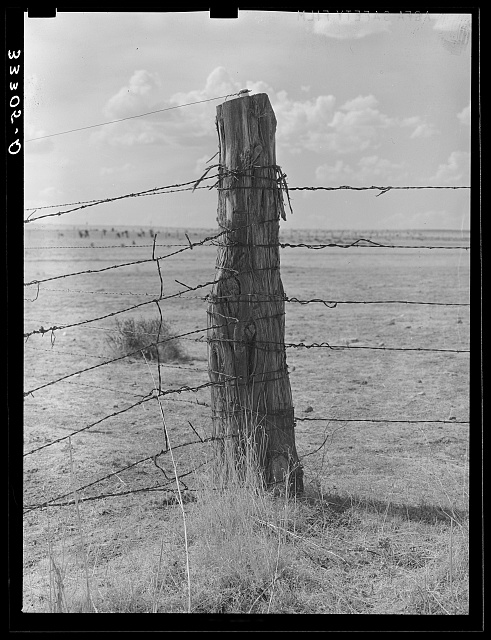
The barbed wire networks were inherently local—but realistically, long distance calls were a rarity even in cities. The networks ere also were the original party line. An out-going call would ring on every phone in the network, so each farmstead adopted a distinctive Mose code-style ring tone of long and short rings. Some networks also adopted a code for a “line call” intended to reach everyone on the line when there was an urgent need to spread news—not so different from Amber alerts and severe storm warnings on modern cell phones.
At its height, the improvised fence line phone service had roughly three million users. Who knew?