




Walter Gropius and the Bauhaus School
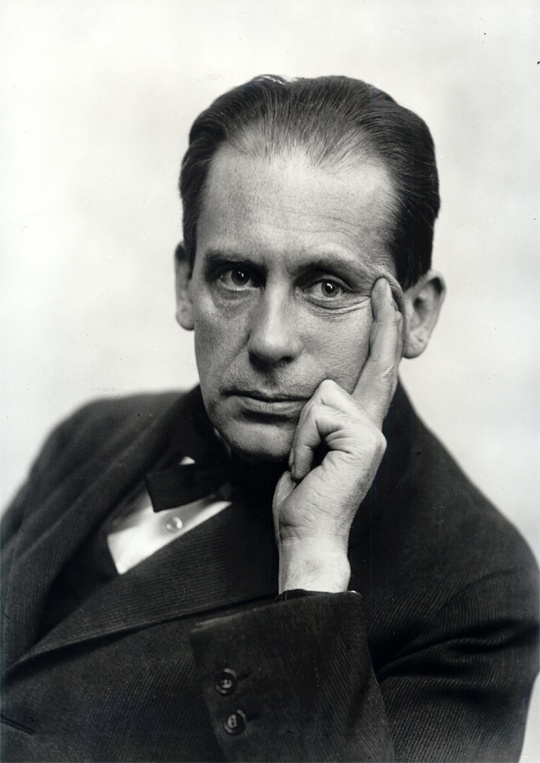 Lately, Walter Gropius and the Bauhaus School have been tracking me down. Actually, now that I think about it, it’s not so much that Gropius is tracking me down, but I’ve been hanging out in the places he hung out: a life of Alma Mahler, some research on the satirical artist George Grosz, some architectural history, a stack of stuff on Weimar Germany.*
They’re pretty fascinating times and places. New music, new art, and definitely new architecture.
Here’s the short version of the Bauhaus story:
In 1919, the Grand Duke of Saxe-Weimar invited German architect Walter Gropius to establish as design school in Weimar. Originally named the Staatliches Bauhaus Weimar, it became known simply as the Bauhaus. Its curriculum embraced all the applied and visual arts, linked by the root concept of structure, “bau”.
Gropius believed that the base of all art began in handcraft and he sought to create a new guild of craftsmen. In its early years, the Bauhaus specialized in teaching art, design and the applied arts in a workshop system that required students to make objects as well as design them.. The Bauhaus was unique for its time in using well-known artists, most notably Paul Klee and Vassily Kandinsky, as instructors in what was essentially a school of architecture and design, a policy intended to break down the distinction between fine and applied arts.
In 1923, the Bauhuas moved beyond its original “Arts and Crafts” roots to embrace industrial technology and explore its implications for design. The school’s workshops began to produce prototypes for mass production. This change in the Bauhaus ideology was reflected in a new motto: “art and technology–a new unity.” An architecture department was added in 1927, though architecture workshops were included in the curriculum from the beginning
In 1925, the Bauhaus lost its base in Weimar and was forced to move to Dessau when Gropius’s bold use of new building materials and innovative architectural methods was condemned as “architectural socialism.” The move provided Gropius with the opportunity to design a new building more appropriate for the school’s activities. Generally considered to be the first example of what would become International Style architecture, the white-walled building is an asymmetrical combination of “boxes” that pushed pre-war techniques of industrial construction to new limits. A glass curtain wall provided light to four stories of studios in the main block. A bridge made of iron-reinforced concrete linked the two main parts of the building. (None of which shows clearly in the photo below, alas.)

When Hitler came to power, Mies van der Rohe, then the school’s director, moved the Bauhaus to Berlin and finally closed it in 1933 rather than submit to Nazi interference. Many teachers from the Bauhaus fled to the United States, where László Mooly-Nagy founded the New Bauhaus in Chicago in 1937, a precursor of the Illinois Institute of Technology.
The Bauhaus had an immediate effect in Germany through its method of teaching and through the production of domestic articles designed in its studios. Modernist architecture developed into the International Style, which was characterized by the use of steel, reinforced concrete, and large areas of glass, a uniform facade, and an absence of applied ornament. It became the dominant style for large-scale architectural projects after World War II. Unfortunately, the stylistic daring of Gropius’s Bauhaus often was reduced to unadorned, functional and interchangeable glass blocks in the hands of lesser architects.
*Why yes, that might be a hint.
In which I review Cecelia Watson’s Semicolon
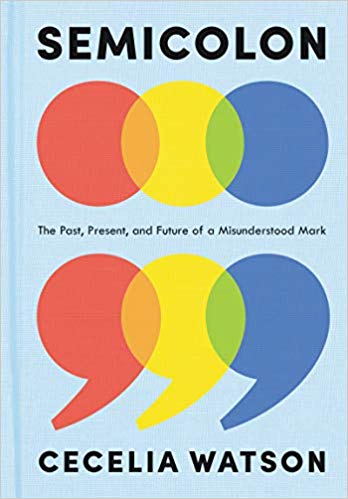 If you’ve read much of my writing, you have probably figured out that I am not a member of the esteemed Semi-colon Haters Society. Personally, I find it a evocative and flexible piece of punctuation. So when I had a chance to review Cecelia Watson’s Semicolon: The Past, Present, and Future of a Misunderstood Mark for Shelf Awareness for Readers, I grabbed it.
It did not disappoint.
On the surface, Watson’s Semicolon is a rollicking history of the punctuation mark that people love to hate. She grabbed my attention immediately with the fact that not only had someone invented the semicolon—something that had never occurred to me—but that we know who he was.*
Watson places the semicolon’s creation in the broader context of Italian humanism, when punctuation was still experimental. She considers the fate and creation of other punctuation marks. She discusses the semicolon’s role in a debate over Massachusetts’s liquor laws in the early 20th century–and the larger question of the impact of punctuation on judicial rulings. She outlines arguments used by semicolon-bashers. She reviews historical attempts to define the proper use of the semicolon.
She also examines the different ways in which five skilled and very different writers–Raymond Chandler, Henry James, Herman Melville, Rebecca Solnit and Irving Welsh–use the semicolon in their work. Watson concludes that the semicolon “represents a way to slow down, to stop, and to think.” Alternatively, it can allow a writer to speed up the pace of her text. In short, the role of the semicolon is to measure time in the pursuit of meaning.
Watson’s vision of the semicolon’s purpose points toward a subversive argument that runs alongside her history of its journey from clarity to confusion. She argues that it is impossible to untangle the history of the semicolon from the history of grammar rules and guidebooks. Looking at grammar guidebooks through the lens of the slippery semicolon, she comes to the conclusion that the written rules of language are a barrier to communication rather than a support.
Well worth the read for history buggs and grammar nerds alike.
*Venetian scholar Aldus Manutius (1449-1515). He is best known for producing high-quality, inexpensive pocket-sized editions of Greek and Latin classics—a new idea at the time. In other words, a book lover’s hero.
Much of this review previously appeared in Shelf Awareness for Readers.
And speaking of Slavic women warriors
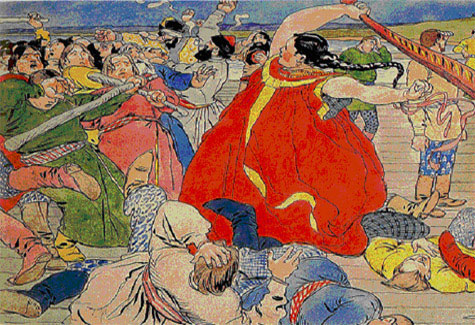
In my last blog post, I mentioned the medieval tradition of Slavic women warriors known as polianitsy: horse-riding, sword wielding female warriors from the steppes. I was frustrated that I didn’t know more. After all, women warriors from across the globe have dominated my intellectual life for the last few years. So I went digging.
The first thing I realized was that I had gone on this particular snipe hunt before. In the early days of working on what would become Women Warriors, I looked at a lot of literary and folk traditions of women warriors. Some, like Viking shield maidens, had an accompanying tradition of scholars arguing for their existence. Others did not—or at least did not have a scholarly tradition that left a trace in languages I can read. The polianitsy were in the second camp and I not only moved on but apparently forgot most of what I knew about them.
In fact, the polianitsy are a recurring feature in Russian folk poems and medieval romances. The term is often translated as knights. Disguised as men, these female knights ride into battle and often fight against the bogatyri , who are the larger-than-life knight-errant heroes of Russian epics.(1) A recurring element in these epics is the moment when a polianitsa is unmasked, usually at sword point, and is transformed from worthy opponent to worthy sexual partner. (2) In one variation on the theme, the unmasked female knight turns out to be the bogatry‘s daughter, born after a previous encounter with an unmasked polianitsa.
In the course of poking around in the subject, I found several scholars who have drawn a long, shaky line between the polianitsy and real life women warriors who fought for Russia in the First and Second World Wars. It’s a bit of a leap. But maybe the polianitsy created a space for women warriors in the Russian imagination. There’s a reason, “see it, be it” is a powerful concept.
(1)It should be pointed out that some scholars have attempted to connect individual bogatyri to historical figures. Perhaps it’s just a matter of time until someone suggests a real-life counterpart for one of the polianitsy. Or for that matter, perhaps someone already has and I didn’t find it. If you have a reference for this type of discussion, let me know.
(2) Shakespeare wasn’t the only author to take advantage of the gender bending possibilities of a girl disguised as a boy.