




And we have winners!

As always when I have books to give away, I’m glad that I don’t have to choose the winners based on merit. As always, you responded with book suggestions,* thoughtful commentary, suggestions for future blog posts, and history-nerd humor–both in comments on the blog post itself and in wonderful e-mails. **
I think I’m the real winner here, but some of you get books. (Drumroll please.)
And the winners are:
Big History: Viriam Khalsa
Divine Fury: Scottie Kersta-Wilson
Exile’s Return: Diana Holdsworth
The Profligate Son: HJ and Jane S. Poole
Voyagers of the Titanic: Robert Rhine
Send me your addresses by e-mail and I’ll get the books in the mail.
Thanks for reading, whether you just discovered History in the Margins or have been reading it for years. More historical bits are on the way.
* Because I clearly don’t have enough Big Fat History Books to read.
**Actually, some of you respond with book suggestions, thoughtful commentary, etc even without a book giveaway. I know bloggers who hesitate to include their e-mail address on their blog because they fear spam. They don’t know what they’re missing!
Big History and Big Buts
Several years ago, when I was working on a Big Project, I stumbled across the concept of Big History.*
It’s basically the opposite of the academic mantra “not my field.” Proponents of Big History integrate many scholarly disciplines in order to look at human history as a tiny part of the history of the cosmos. One of their favorite ways of illustrating how new we are is to compress the timeline of the universe from 13 billion years to 13 years. In this scenario, homo sapiens would have been around for 53 minutes. The entire recorded history of civilization would have existed for three minutes. “Modern” industrial society has been mucking up the environment for roughly six seconds. In short, we are a blink in the eye of the universe.**
This TED talk by Big History promoter David Christian sums up the basic principles:
[Reminder: if you receive this post by email you may need to go to the History in the Margins website to see the video. Just click the headline or the link.]
It’s fascinating stuff. My introduction to Big History has inspired me to ask slightly different questions than I used to ask. Not just how the salt trade functioned, but why our bodies need salt. Not just when did farming start, but how grain was domesticated. Not just the role of fire in making tools, but the role of fire in making man. But, and for me this is a Big But,*** stories about people are what pulled me into history. Here on the Margins I often focus on the smallest stories. When I think about writing books, I gravitate toward big sweeping themes. But whether the scale of my story is tiny or grand, my subject is people, not great flaming balls in the sky. I’m interested in what happened in that last three minutes, or maybe just a little bit before.
Which means I’m not quite sure what to do with Big History other than admire the intellectual audacity behind it. Any ideas?
*Or more accurately, someone beat me over the head with the idea.
**Or maybe a piece of grit.
***And as my best friend from graduate school will tell you, I love Big Buts. (Sorry, sometimes I can’t resist.)
Bernard Cornwell on Waterloo
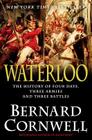 Bernard Cornwell writes historical fiction. Really vivid, well-researched historical fiction with a military bent and complicated main characters. Now Cornwell makes his first foray into historical nonfiction with Waterloo: The History of Four Days, Three Armies, and Three Battles.
Published in time for the 200th anniversary of the Battle of Waterloo, Cornwell’s account features the powerful storytelling and carefully chosen details that characterize his fiction. Although he emphasizes the fact that battle is inherently confusing, he presents the confusion experienced on the battlefield at Waterloo to his readers with utter clarity. He rests his story on the viewpoints of individuals present at each stage of the battle, using letters, journals and memoirs of ordinary soldiers and officers from all three armies engaged on the field as well as those of Napoleon and Wellington. Each chapter opens with a useful map of the action discussed–a luxury military history buffs will appreciate.
Cornwell opens the book with the question “Why another book on Waterloo?” Others may ask, “why another book by Cornwell on Waterloo?” (He explored the subject previously in the novel, Sharpe’s Waterloo.) The answer lies in the writing. It is true that Cornwell’s Waterloo is not a work of innovative scholarship. It does not present new insights or use new materials. Instead, it is a splendid example of historical narrative; as Cornwell himself describes the book at the end of his foreword: “So here it is again, the story of a battle.” And a gripping story it is.
The guts of this review previously appeared in Shelf Awareness for Readers.